When Grilling Chicken: Temperature Guidelines for Safe Juicy Meat
Master grilling chicken with precise temperature targets, thermometer tips, and practical steps to ensure safety and juicy texture every time.


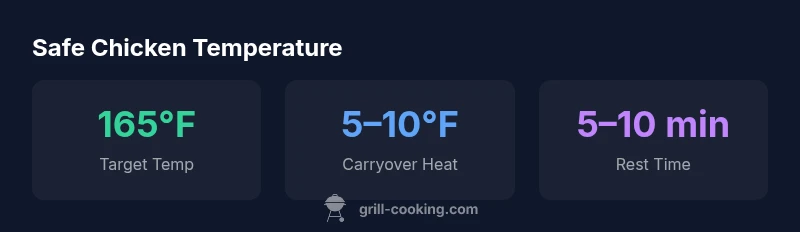
The safe internal temperature for grilled chicken is 165°F (74°C) in the thickest part of the meat. Use a calibrated digital thermometer to check the center, away from bone. Rest briefly after removing from the grill to let juices redistribute. This target applies to all cuts, including breasts, thighs, drumsticks, and whole chicken. Measure at the center, not the surface, and avoid touching bone; for larger pieces, verify multiple spots to ensure consistency.
Why Temperature Matters for Chicken
According to Grill Cooking, temperature is the bridge between food safety and flavor when grilling chicken. The standard target is 165°F (74°C) at the thickest part of the meat. Reaching this temperature ensures that potentially harmful pathogens are inactivated, reducing the risk of foodborne illness. Yet temperature alone does not tell the whole story. How quickly the meat comes up to temp, and how heat is managed on the grill, shapes texture, juiciness, and overall palatability. Thicker portions or bone-in pieces heat more slowly; boneless breasts often dry out if exposed to high direct heat for too long. A practical grilling plan combines a quick sear over direct heat to develop crust with a gentle finish over indirect heat to bring the interior to 165°F while preserving moisture.
Grill Cooking emphasizes that carryover heat continues to rise after removal from the grill. This is why many cooks pull chicken at 160-162°F and let resting bring it to the final safe temperature. This approach minimizes dryness while maintaining safety for all cuts, including breasts, thighs, drumsticks, and whole chickens.
How to Measure Temperature Accurately
A reliable thermometer is essential for accurate results. Choose a probe or digital instant-read thermometer with a thin, flexible stem for minimal piercing damage. Before each cook, calibrate the thermometer for accuracy—use the ice-water method (32°F / 0°C) or boil-water method (212°F / 100°C at sea level) to confirm accuracy. Insert the probe into the thickest part of the meat, making sure it is not touching bone or the pan. For bone-in pieces, take multiple readings around the center to confirm uniform doneness.
Remove the thermometer, wipe clean, and reinsert at different spots if needed, especially for larger pieces. Consistency matters: a well-calibrated thermometer yields repeatable results across multiple cooks.
Temperature Guidelines by Cut
Different chicken cuts have distinct thickness and bone structure, but the internal target remains 165°F for safety. Here are practical guidelines:
- Boneless chicken breasts: 165°F when tested at the thickest portion; be mindful of carryover heat to avoid dryness.
- Bone-in chicken thighs and legs: 165°F at the center, as bones can insulate some areas; verify near the bone but not against it.
- Whole chicken: insert readouts in the innermost thigh and the breast; both should reach 165°F for full safety.
- Chicken wings or smaller parts: check the thickest piece; adjust time via indirect heat if needed to prevent overcooking.
Temperature vs Doneness and Juiciness
Doneness means reaching the safe internal temperature; juiciness is influenced by how quickly you reach that temperature and how you manage heat. High direct heat can create a desirable crust, but if you push the interior past 165°F too quickly, moisture is driven out, causing toughness. Conversely, gradual warming via indirect heat allows collagen breakdown in darker meat and helps maintain moisture in white meat. The balance is to bring the center to 165°F while protecting surface moisture and texture.
Resting, Carryover Heat, and Safety
Resting is a critical step. After pulling from the grill, meat carries over heat, often rising 5–10°F. A short rest (5–10 minutes) under ambient conditions allows juices to redistribute and improves sliceability. Slice against the grain during rest for maximum tenderness. Never skip resting for large cuts, as the final temperature can rise above 165°F if you cut too soon. For thin slices or small portions, rest briefly to preserve juiciness.
Direct vs Indirect Grilling: Hit the Temp
Direct heat is best for searing and crust formation but tends to heat the interior quickly. Indirect heat finishes cooking through gentle warming. A practical plan is to sear the chicken over direct heat for 2–4 minutes per side to develop color, then move to indirect heat to finish to 165°F. For thicker cuts, you may need longer indirect sessions or a two-zone grill setup to manage heat distribution effectively.
Common Pitfalls and Fixes
- Pitfall: Cooking too hot too fast; Fix: Start with indirect heat and finish with a quick sear to set color without overcooking.
- Pitfall:Relying on color alone; Fix: Measure internal temperature, especially near the bone for dark meat.
- Pitfall: Not accounting for carryover heat; Fix: Remove at 160-162°F and rest to allow final rise.
- Pitfall: Uneven pieces; Fix: Stagger thickness with pounding or butterfly cuts to achieve uniform doneness.
Building a Simple Temp-Control Plan for Weeknight Grilling
Plan a two-zone grill setup (hot direct area and cooler indirect area). Preheat to a steady medium-high temperature; target surface temps around 375–450°F for searing. Have a thermometer ready, and check temperatures early and often. Use a timer for resting periods. With practice, you’ll know exactly when to move pieces from direct to indirect heat, pulling at 160–162°F and resting to achieve the final 165°F in the center.
Quick-Reference Temperature Checklist
- Target internal temperature: 165°F (74°C) in the center
- Rest time: 5–10 minutes for most pieces
- Carryover: Expect a 5–10°F rise after removal
- Verify at least two spots on larger pieces
- Always check near the thickest portion and away from bone
Temperature targets by chicken cut
| Cut | Target Temp (°F) | Notes |
|---|---|---|
| Chicken breast (boneless) | 165 | Juice retention requires mindful timing |
| Chicken breast (bone-in) | 165 | Check near center away from bone |
| Chicken thigh (boneless) | 165 | More forgiving; monitor closely near bone |
| Chicken thigh (bone-in) | 165 | Bone can insulate; verify at multiple spots |
| Whole chicken | 165 | Read breasts and thighs; ensure consistency |
FAQ
What thermometer should I use for checking chicken temperature?
Use a probe or digital instant-read thermometer with a thin stem for accurate readings. Calibrate it before each cook, and insert into the thickest part away from bone.
Use a probe thermometer; insert into the thickest part away from bone and calibrate before cooking.
Is it safe to rely on color to judge doneness?
Color is not a reliable indicator. Always check the internal temperature to confirm 165°F.
Don’t rely on color; check the internal temp to be sure.
Should I pull chicken at 160°F and let carryover finish?
Yes. Pull at 160–162°F and rest to let carryover heat bring it to 165°F.
Pull it a little early and let it rest to finish cooking.
Does boneless chicken breast require a different temperature?
No. The target remains 165°F, but thickness dictates time; monitor closely to avoid drying.
Same target temp; thickness affects cooking time.
Does grill type affect the target temperature?
Temperature targets stay the same, but heat distribution (gas vs charcoal) changes timing and method (direct vs indirect).
Gas or charcoal doesn’t change the target temp, just the heat flow.
Can I cook chicken at lower temperatures for more flavor?
Lower temps can work if you maintain safe time and temperature; plan for longer cooking and careful monitoring.
Lower temps can work, but you must monitor time and temp closely.
“Temperature control is the cornerstone of safe, juicy grilled chicken. Precision up front pays off in texture and flavor.”
Quick Summary
- Aim for 165°F in the center for safety.
- Use a calibrated thermometer for accuracy.
- Rest 5–10 minutes to maximize juiciness.
- Consider carryover heat when timing.