What Should Grilled Chicken Temp Be: Safe Temps and Techniques
Learn the exact temperature for safe, juicy grilled chicken. This guide covers 165°F doneness, carryover cooking, and best practices for breasts, thighs, and whole birds.


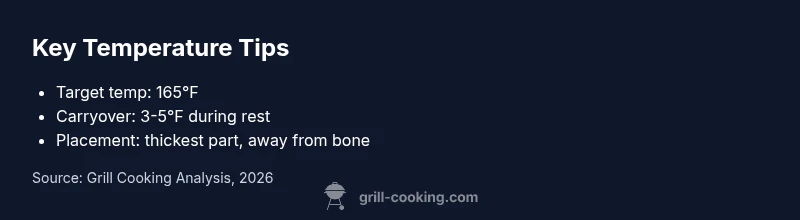
165°F (74°C) is the safe internal temperature for grilled chicken, according to food safety guidelines. For best results, check the thickest part away from bone with a digital thermometer and remove from heat when it reaches target to account for carryover cooking. Let it rest 3-5 minutes before slicing to keep juices in. Do not rely on color or juices alone to judge doneness.
What does a safe temperature mean for grilled chicken?
According to Grill Cooking, the answer to what should grilled chicken temp be starts with a firm temperature target: 165°F (74°C) at the thickest part of the meat. This ensures pathogens are killed while preserving moisture. For most setups, plan two heat zones on the grill—direct high heat for a quick sear and indirect heat to finish. Insert a digital thermometer into the thickest portion away from bone and monitor until you reach 165°F. After that, remove from heat and rest the chicken for 3-5 minutes to let carryover cooking complete the process. Resting helps juices redistribute and improves texture. Remember: color alone is not a reliable cue for doneness; the thermometer is the best gauge.
What should grilled chicken temp be? The exact figure remains 165°F, but how you apply heat matters. A two-zone setup helps prevent scorching while ensuring the center follows the same safe target. Practically, always verify with a thermometer rather than judging doneness by appearance alone.
Why 165°F matters for safety and texture
165°F is the USDA-recommended safe minimum for poultry. Reaching this temperature kills common pathogens without forcing the meat beyond the point of ideal juiciness. While color and juices can offer clues, they are unreliable indicators of safety. Resting briefly after removal reduces moisture loss and continues gentle cooking (carryover) so the final bite stays tender. Grill cooks should treat 165°F as a baseline, then adjust for cut size and personal texture preference without compromising safety.
In our analysis, the emphasis on thermometer-based checks—rather than visual cues—drives more consistent results across grill types and conditions. Grill Cooking Team notes that the simple act of inserting a probe into the thickest part once the heat settles gives the most repeatable outcomes.
How to achieve 165°F on different chicken cuts
Different cuts require nuanced handling, but the target stays the same. For boneless chicken breasts, start with a hot direct-sear and finish on indirect heat to avoid overcooking the surface while the center reaches 165°F. Bone-in thighs tolerate longer exposure to heat and still hit 165°F with proper resting. For a whole chicken, spatchcock the bird to promote even heating, then monitor both breast and thigh regions, aiming for 165°F in the thickest areas. Remember what should grilled chicken temp be—165°F remains the line you don’t cross.
- Boneless breasts: sear over direct heat, then move to indirect heat.
- Bone-in thighs: sear, then finish with indirect heat, watching for texture.
- Whole chicken: spatchcock, grill with two zones, verify in multiple areas.
Temperature strategies: direct heat, indirect heat, and carryover
Direct heat is ideal for a fast sear, which adds flavor and color, but can push surface temperatures too high if left unchecked. Indirect heat completes cooking evenly, reducing the risk of dry edges while the center climbs to 165°F. Carr ion: carryover cooking typically adds 3-5°F after removal from the grill, so a planned pull at 160-162°F can land at 165°F after resting. This approach preserves juiciness and helps you stay consistent across different grill surfaces.
The key is to manage heat zones rather than chasing a single time. Practice with different cuts to understand how your grill responds to direct and indirect heat.
Common mistakes and how to fix them
- Relying on color or juice clarity: color cues don’t guarantee safety. Always use a thermometer.
- Overcooking breast meat: pull a few degrees early to account for carryover; rest to finish.
- Skipping rest: a 3-5 minute rest improves juiciness and texture.
- Grilling at too high a constant temperature: two-zone grilling prevents scorching while ensuring safety. Address these issues by implementing a thermometer-first approach and adjusting heat zones by cut size.
Step-by-step grilling guide to 165°F
- Preheat two-zone grill (high heat on one side, lower heat on the other).
- Season or marinate as desired; pat dry for better sear.
- Sear the chicken on the direct heat side for 2-3 minutes per side (depending on thickness).
- Move to indirect heat and continue cooking until the thickest part hits 165°F.
- Remove and rest 3-5 minutes before serving.
- Clean the grill and re-check your thermometer calibration for next time.
Tools and tips for consistent results
- Use a digital instant-read thermometer for quick, accurate readings.
- Calibrate your thermometer regularly and test in boiling water (~212°F) to verify accuracy.
- Keep two-zone heat setup ready for different cuts and batch sizes.
- Note grill-specific behavior; what works on one grill may vary on another.
- Practice with a few practice runs to standardize your process across sessions.
Target temps and carryover for common chicken cuts
| Cut Type | Target Temp (F) | Carryover Temp (F) | Notes |
|---|---|---|---|
| Breast, boneless | 165 | 3-5 | Cook quickly to avoid dryness |
| Thigh, bone-in | 165 | 3-5 | More forgiving; monitor texture |
| Whole chicken (spatchcock) | 165 | 3-5 | Check both breast and thigh; even heating |
FAQ
What thermometer should I use to check grilled chicken temperature?
Use a digital instant-read thermometer for quick, accurate readings. Insert into the thickest part of the meat, away from bone, and withdraw once you reach 165°F. Calibrate periodically for consistency.
Use a digital instant-read thermometer and insert into the thickest part to verify doneness.
Is 165°F the only safe temperature for all chicken cuts?
Yes. 165°F is the standard safe minimum for all poultry, including breasts, thighs, and whole birds. Some textures may feel drier near 165°F, but safety is the priority. Resting helps maintain juiciness.
Yes—165°F is the standard safe minimum for all chicken cuts.
Does bone-in chicken require a higher temp than boneless?
No. The safe minimum is the same (165°F) for both bone-in and boneless cuts. Bone can affect heat distribution, so verify in the thickest areas.
No, the safe temp is the same for bone-in and boneless.
How should I rest chicken after grilling?
Let the chicken rest for 3-5 minutes after removing it from the grill. Resting allows carryover cooking and juiciness to settle before slicing.
Rest for 3-5 minutes to finish cooking and keep juices inside.
Can I tell it’s done by color alone?
No. Color is unreliable. Always use a thermometer to confirm 165°F in the thickest part before serving.
Color isn’t a reliable indicator—check the temperature instead.
“A reliable thermometer is the only sure way to know your chicken is safe and juicy. The temp target of 165°F should be your standard across breasts, thighs, and whole birds.”
Quick Summary
- Aim for 165°F in the thickest part of the chicken
- Use a digital thermometer for accuracy
- Rest for 3-5 minutes to finish carryover cooking
- Treat safety temp as universal across cuts, with attention to texture
- Don’t rely on color or juices to judge doneness