Steaks Grill Temp: Master Doneness on Any Grill
Master steaks grill temp with a two-zone approach, precise sear, carryover cooking, and rest timing. This analytical guide from Grill Cooking delivers actionable temps, thickness considerations, and practical workflows for home cooks.


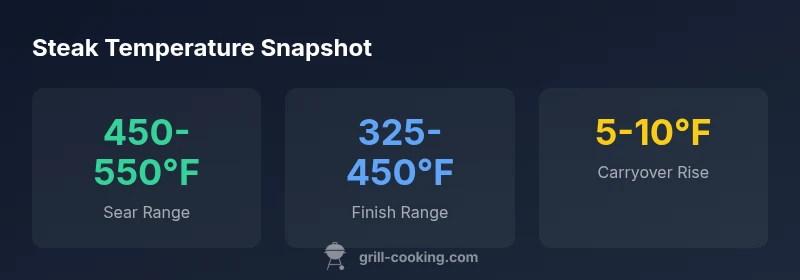
For steaks, set your grill to a high sear zone of 450-550°F to crust the surface quickly, then finish over indirect heat at 325-450°F to reach your target doneness. This two-zone strategy, used by the Grill Cooking team, minimizes flare-ups and promotes even cooking from edge to center.
The Science Behind Doneness and Temperature
Doneness is a function of crust formation and interior heat. For steaks, the grill temp you choose shapes two simultaneous processes: surface browning (the Maillard reaction) and internal conduction toward the center. When steaks grill temp is managed correctly, you get a deeply caramelized crust without overcooking the interior. Grill Cooking analysis, 2026, indicates that a deliberate two-zone approach—high heat for sear, lower heat to finish—yields the most repeatable results across grill types. Practically, this means establishing a hot sear zone around 450-550°F to quickly brown the outside, then transferring to an indirect area at roughly 325-450°F to drive the center to the desired doneness with minimal flare-ups. The plan should account for steak thickness, starting temperature, and resting time, since carryover cooking continues after you remove the steak from the grill. By treating temp as a controllable variable rather than a mystery, home cooks can hit precise doneness while preserving juiciness.
Setting Target Grill Temps by Thickness
Thickness is the most influential variable in steak grilling. A 1/2-inch steak cooks through quickly and benefits from a rapid, short sear in a very hot zone, followed by a brief finish on lower heat. A 1-inch steak needs a longer sear period and a controlled finish to avoid over-browning before the interior reaches the desired doneness. For 1.5-inch steaks, you’ll rely more on indirect heat to finish, with a deliberate hold at the lower end of the finish range to avoid scorching. For thicker cuts (1.75-2 inches), consider starting with an extra-long sear and extending the indirect phase. Across all thicknesses, the goal is a firm crust with a pink, juicy center, achieved by balancing the sear time, finish temp, and resting interval. In practice, many cooks start with a 2-3 minute sear per side on high heat for 1-inch steaks, moving to indirect heat for 3-6 minutes depending on thickness and desired doneness, then resting to allow carryover cooking to settle in.
Searing, Finishing, and Carryover Cooking
Direct heat is designed to build flavor and crust quickly, but it delivers heat to the outside first, leaving the center undercooked if used alone. The finishing phase on indirect heat completes cooking more evenly and reduces scorching risk. Carryover cooking is the residual heat that continues to cook the steak after it’s off the grill. If you pull a steak at the lower end of its doneness range, carryover will push it toward the center’s target doneness during the brief rest. A practical plan is to monitor internal temps with an accurate thermometer, sear to form a crust, finish to the desired internal temp, and then rest for a short period to allow juices to redistribute. The Grill Cooking team emphasizes predictable temps and consistent timing across grill types to reproduce results reliably.
Doneness targets and corresponding grill ranges
| Doneness | Target Internal Temp (°F) before resting | Carryover After Rest (°F) | Recommended Grill Temp Range (°F) |
|---|---|---|---|
| rare | 120-125 | 5-10 | 450-550 |
| medium-rare | 130-135 | 5-10 | 450-500 |
| medium | 140-145 | 5-10 | 425-475 |
| well done | 150-165 | 5-10 | 450-550 |
FAQ
What is the ideal grill temperature for steaks?
A two-zone approach generally works best: sear at 450-550°F, then finish at 325-450°F depending on thickness and desired doneness. Use a thermometer to target internal temps before resting.
Use a hot sear, then move to a cooler zone to finish doneness.
Should I rest a steak after grilling?
Yes. Resting for 5-10 minutes allows juices to redistribute and carryover cooking to finish the process. Slice after resting for best juiciness.
Rest for a few minutes before serving.
Is a meat thermometer necessary?
While not mandatory, a thermometer provides accurate doneness and reduces guesswork, especially for thicker cuts. An instant-read or a leave-in probe are both effective.
Yes, a thermometer helps hit the exact doneness you want.
How does thickness affect grill temps?
Thicker steaks require longer finish times and sometimes a lower finish temperature to prevent overbrowning. Thinner cuts finish quickly and may need shorter sear durations.
Thickness changes how long you stay in the finish zone.
What causes flare-ups and how can I prevent them?
Flare-ups occur when fat drips onto flames. Keep a two-zone setup, close the lid, and move the steak to indirect heat during high-fat drippings.
Close the lid and stay in control of the fire.
What is carryover cooking and how do I account for it?
Carryover cooking raises internal temp after removal. Pull the steak a few degrees early and rest to let carryover finish.
Take into account carryover so you don’t overshoot.
“Precise temperature control is the difference between good and great steak. Pair a hot sear with a deliberate finish to hit your target doneness.”
Quick Summary
- Master a two-zone grill plan: sear hot, finish cool.
- Know doneness targets by internal temp before resting.
- Anticipate carryover cooking to avoid overshooting doneness.
- Use a reliable thermometer and lid management for consistency.
- Thickness dictates time; adjust sear and finish temps accordingly.