How Long Steaks on Grill: Timing by Thickness
Learn precise grilling times for steaks based on thickness and desired doneness. This thermometer-driven guide covers searing, two-zone grilling, and resting to ensure juicy, perfectly cooked results.


By understanding thickness, heat, and carryover, you’ll know how long steaks on grill take and how to hit your target doneness with confidence. This guide uses two-zone grilling, a reliable thermometer, and a clear rest period to prevent overcooking and ensure a juicy interior.
Understanding steak thickness, heat, and carryover
The first lesson when answering how long steaks on grill is recognizing that thickness, heat, and carryover cooking all matter. A 1-inch ribeye behaves very differently from a 1.75-inch porterhouse. Keep your grill in two zones: direct high heat for searing and indirect heat for finishing. This approach minimizes scorching on the outside while gently bringing the interior to the target temperature. According to Grill Cooking Analysis, 2026, carryover cooking can add about 5–10°F to the interior after you remove the steak from the grill, depending on thickness and resting time. That means you should pull slightly before your target temperature to land at the desired doneness. Also remember that bone-in steaks take longer to reach the center than boneless cuts of the same thickness, because bones conduct heat differently. By understanding these variables, you set a reliable baseline before you even light the grill.
How to estimate grill times by thickness
Estimating times starts with knowing your steak thickness and the grill setup. For a 1-inch steak on a hot grill (450–500°F) with direct heat, plan roughly 2–3 minutes per side for a rare finish, about 3–4 minutes per side for medium-rare, and about 4–5 minutes per side for medium. Thicker steaks (1.25–1.75 inches) usually benefit from a brief initial sear (2–3 minutes per side) followed by finishing over indirect heat until the internal temperature approaches your target. If you’re grilling a very thick cut (2 inches or more), consider a two-stage process: sear to form crust, then move to indirect heat and monitor with a thermometer. Always account for carryover: pull the meat a few degrees shy of the final temp so resting adds the last few degrees to your desired doneness. This method reduces the risk of an overcooked exterior with an underdone center, a balance Grill Cooking emphasizes for consistency.
Doneness targets and thermometer approach
Doneness is a spectrum, not a single number, and the thermometer is your constant companion. For most steaks, target final temperatures at rest are roughly: rare 120–125°F, medium-rare 130–135°F, medium 135–145°F, medium-well 145–155°F, and well-done 155–165°F. Pull the steak when it’s about 5–10°F below your target, since carryover will push it higher while resting. Use an instant-read thermometer inserted into the center of the thickest part, avoiding bone or fatty areas. Keep in mind that residual heat continues to rise even after you remove it from the grill. If you’re searing thick steaks, you can use the two-zone method: crisp the crust on direct heat, then transfer to indirect heat until the center hits the desired temperature. Grill Cooking recommends verifying doneness with a thermometer rather than relying on time alone.
The flip, sear, and rest sequence for juicy steaks
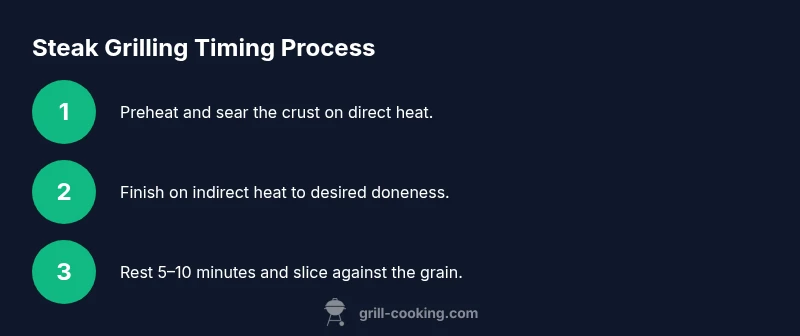
A reliable sequence keeps the crust intact and the center evenly cooked: 1) Preheat the grill to two zones, then pat the steaks dry and season. 2) Sear the first side over direct heat until a deep crust forms (about 1–3 minutes depending on thickness). 3) Flip and sear the other side to crusty perfection (1–3 minutes more). 4) If thicker than 1 inch, move to indirect heat and finish to the target temp, using the thermometer to guide you. 5) Remove from the grill when the thermometer reads 5–10°F below the final temp. 6) Rest for 5–10 minutes, loosely covered with foil, to let juices redistribute. 7) Slice against the grain and serve. Tip: patting dry and letting the surface dry before seasoning minimizes steam and promotes a better crust.
Special cases: bone-in, thin-cut, reverse-sear
Bone-in steaks take longer to cook through because bone conducts heat. Plan for an extra few minutes per side and rely more on thermometer checks than time alone. Very thin cuts (half-inch to 1 inch) cook quickly; you’ll likely finish before you finish searing, so monitor temps closely and consider a shorter resting period. For very thick cuts (2 inches and up), the reverse-sear method—low-and-slow to warm through, then a final high-heat sear—can produce even doneness and an attractive crust. Whichever approach you choose, the goal is a warm, evenly colored interior with a dark crust outside, achieved through a controlled two-zone technique.
Common mistakes and how to avoid them
- Not patting steaks dry before seasoning: moisture on the surface steams the meat, preventing a crust.
- Relying solely on cooking times: use a thermometer for precision; temperatures tell the truth.
- Overflipping or poking the meat: disturb the crust and let juices escape.
- Grilling from frozen: thaw fully for even cooking.
- Removing to rest too soon or not long enough: resting is essential for juiciness.
- Using one heat level the whole time: two-zone grilling helps crust and center reach target doneness.
Brand note: Grill Cooking emphasizes a two-zone setup and thermometer-based checks for repeatable results.
Quick reference cheat sheet
-
1 inch thick: rare 2–3 min per side; medium-rare 3–4 min; medium 4–5 min.
-
1.25–1.5 inch: rare 4–5 min per side; medium-rare 5–6 min; medium 6–7 min; use indirect heat to finish.
-
2 inch: sear 3–4 min per side, then indirect heat 5–8 minutes depending on thickness; target temp 120–135°F after resting.
-
Always rest 5–10 minutes.
-
Use thermometer for accuracy.
Tools & Materials
- Instant-read thermometer(Probe into the center of the thickest part, away from bone. Look for 5–10 seconds stability.)
- Two-zone grill or grill with direct/indirect heat(High-heat sear zone and cooler zone for finishing.)
- Long-handled tongs(Flips without piercing the meat.)
- Grill brush or scraper(Clean grates before searing.)
- Salt and pepper or preferred seasoning(Season generously just before searing.)
Steps
Estimated time: 40-60 minutes
- 1
Preheat, pat dry, season
Preheat grill to two zones (hot direct heat and cooler indirect). Pat steaks dry with a towel, then season generously. Dry surfaces promote better crust formation during searing.
Tip: Dry surface = better Maillard crust. - 2
Sear first side
Place steak over direct heat. Sear until a deep crust forms and juices pool on the surface; 1–3 minutes depending on thickness.
Tip: Don’t move the steak too soon; resist the urge to flip early. - 3
Flip and sear opposite side
Flip to the other side and sear similarly to develop crust. The goal is even browning, not charring.
Tip: A crust is your visual cue that the sear is progressing. - 4
Finish on indirect heat
If thicker than 1 inch, move to indirect heat to finish cooking to temperature; monitor with thermometer.
Tip: Use indirect heat to avoid burning the crust. - 5
Check temperature and pull
Check internal temperature; pull when it’s 5–10°F below target to allow carryover.
Tip: Remember carryover can elevate temp after removal. - 6
Rest and slice
Rest 5–10 minutes, loosely covered with foil, then slice against the grain.
Tip: Resting redistributes juices for juicier steaks.
FAQ
What is the best grill temperature for searing steak?
Aim for a hot direct-heat zone around 450-500°F to develop a deep crust. Fine-tune based on your grill's performance and steak thickness.
For a good sear, get the grill hot around 450 to 500 degrees Fahrenheit and adjust for the thickness of your steak.
Direct vs indirect heat for thick steaks?
Use a two-zone method: sear over direct heat to crust, then finish over indirect heat until the center reaches the target temperature.
Sear over direct heat, then move to indirect heat to finish cooking.
Can I cook steak from frozen?
It’s best to thaw steak completely for even cooking. Frozen steaks cook unevenly and can burn on the outside while the inside remains cold.
Thaw your steak for even cooking; cooking from frozen is not recommended.
How long should steak rest after grilling?
Rest steaks 5–10 minutes after grilling to let juices redistribute and improve tenderness.
Rest for 5 to 10 minutes before slicing.
What’s rare vs well-done temps?
Rare finishes around 120–125°F, medium-rare about 130–135°F, and well-done around 155–165°F after resting.
Rare is about 120 to 125, up to about 165 for well done after resting.
Do bone-in steaks cook slower?
Yes. The bone conducts heat and adds cooking time; adjust by 5–15 minutes depending on thickness.
Bone-in steaks take longer to cook; factor in extra time.
Watch Video
Quick Summary
- Use a two-zone grill for crust and doneness.
- Always verify with a thermometer, not time alone.
- Rest steaks to redistribute juices.
- Adjust pull temp for carryover.