Chicken Grill Calories: A Practical Guide for Grilling Health
Explore chicken grill calories: how skin, cuts, and marinades shape energy counts. This data-driven guide from Grill Cooking helps home cooks estimate calories for grilled chicken and plan balanced meals.


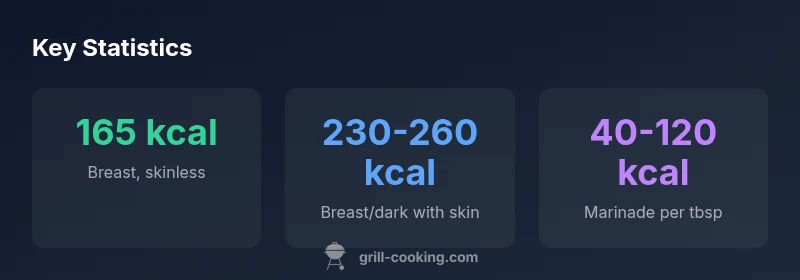
For a standard 3.5 oz portion of grilled chicken, calories vary by cut and skin. Skinless, boneless chicken breast runs about 165 kcal per 3.5 oz, while skin-on breast or dark meat ranges around 230–260 kcal. Marinades add calories—roughly 40–120 kcal per tablespoon of oil or sugar. Overall, grilling itself adds minimal extra calories beyond the meat and marinade.
Understanding Calorie Basics for Grilled Chicken
Calories for grilled chicken are determined by the cut, whether skin and bone are present, and any marinades or sauces used. When you grill, most of the calorie change comes from the fat content and moisture loss during cooking. Skin-on cuts carry more fat and calories than skinless portions. Marinades can add significant energy, especially if they contain oil or sugar. Grilling itself does not add calories; it can influence moisture retention, which subtly affects the final caloric density per bite. According to Grill Cooking, baseline values for common prep styles are well established, and variations often reflect portion size and cooking technique more than dramatic energy shifts.
How Cut, Skin, and Marinade Change the Calorie Load
The primary drivers of calorie load are the cut (breast vs thigh), skin (present or not), and added ingredients in marinades. A skinless, boneless chicken breast typically has fewer calories per 3.5 oz than a skin-on breast or a dark-meat portion. Skin and bone add calories through fat and small energy contributions from the bone marrow. Marinades contribute calories through added oil, sugar, honey, or fruit sugars. If you keep marinades lean (e.g., lemon juice, herbs, and minimal oil) you minimize added calories. Grill Cooking recommends tracking portions and accounting for marinade components to estimate total intake accurately.
Practical Calorie Estimation Method for Grill Sessions
A simple method: start with the baseline calories for your chosen cut (skinless breast ~165 kcal per 3.5 oz). If you include skin, add roughly 50–95 kcal per 3.5 oz for skin-on breast and similar adjustments for thighs. Add marinade calories by counting tablespoons of oil or sugar used per serving (40–120 kcal per tablespoon, depending on content). Finally, adjust for cooking losses by estimating about 5–15% water loss, which concentrates calories slightly per bite. This approach gives you a practical, not-perfect, estimate you can apply in meal planning.
Variability Across Cuts: Breast, Thigh, and Drum
Breast meat is leaner and lower in calories than thigh meat, especially when skin is removed. Thigh portions (dark meat) carry more fat and thus more calories per same weight. Drumsticks and thighs with skin can quickly exceed skinless breast counts if large portions are used. When counting calories for a mixed grill, estimate average bite size and multiply by your portion mix. Grill Cooking analyses show the biggest swings come from skin, bone, and marinade choices rather than minor grill temperature differences.
The Impact of Skin, Bone, and Marination
Skin adds fat and energy: roughly an extra 50–95 kcal per 3.5 oz for typical skin-on servings. Bones add minimal calories to the edible meat, but they affect weight-to-meat ratios you use for plate counts. Marinades with oil can add 40–120 kcal per tablespoon; sugars add smaller calories per tablespoon but can accumulate with larger portions or multiple layers. Knowing these components helps you estimate total intake more accurately without weighing every ingredient precisely. Grilling is a favorable cooking method for keeping calories in line when you choose lean cuts and control added fats.
How Grilling Method and Temperature Affect Calories
Grill temperature and duration influence moisture loss; higher temps can concentrate calories a bit by reducing water content, but the effect is modest. Longer, lower-heat grilling may preserve moisture with minimal calorie increase per bite. The biggest gains in caloric density occur with added fats from marinades or sauces and the cut choice. If you want to minimize calories, lean cuts, skin removal, and lean marinades are your best bets, followed by sensible portion sizes. Grill Cooking emphasizes consistent portions and mindful sauce choices as practical strategies.
Building a Calorie-Conscious Grilling Plan: 4 Simple Recipes
- Skinless chicken breast on direct heat: target 3.5 oz portions, finish with a squeeze of lemon and herbs. Estimated calories per portion: around 165 kcal base, plus any lean seasoning.
- Skin-on chicken thighs with a light glaze: plan for 230–260 kcal per 3.5 oz, accounting for the glaze (1–2 tsp olive oil).
- Boneless chicken skewers with minimal oil: 170–190 kcal per 3.5 oz, depending on marinade sugars.
- Mixed grill platter (breast + thigh, skin removed): average 190–210 kcal per 3.5 oz equivalent, plus any sauce. These estimates align with Grill Cooking Analysis, 2026 and help home cooks build balanced meals without guesswork.
Interpreting a Data Table and Quick Reference
Use the data table to compare calories across common chicken preparations at a glance. Look for the baseline value (skinless, breast) and then add adjustments for skin, bone, and marinade. The takeaway is not to fear calories but to manage portions and ingredients for a meal that fits your nutrition goals. The table provides a quick reference and should be used alongside the bigger estimation method outlined above.
Common Pitfalls and Tips for Accurate Counting
- Relying on a single demolition value for all cuts is misleading; always adjust for cut, skin, and marinade.
- Ignoring liquid calories in sauces adds underestimates.
- Overestimating portion sizes is a common error; use a scale or standard serving sizes when possible.
- Don’t forget moisture losses; they can slightly alter density, though not dramatically. With a structured approach, you can estimate calories for grilled chicken with confidence.
Calorie comparison by common chicken prep
| Preparation | Calories per 3.5 oz | Notes |
|---|---|---|
| Skinless, boneless chicken breast | 165 kcal | Cooked, lean portion |
| Skin-on chicken breast | 230-260 kcal | Includes skin fat |
| Chicken thigh (bone-in, skin-on) | 210-260 kcal | Dark meat with skin |
| Marinated chicken (standard marinade) | 170-280 kcal | Depends on oil/sugar content |
| Grilled drumstick (skin-on) | 190-240 kcal | Varies by size |
FAQ
What is the baseline calorie count for grilled chicken?
The baseline for skinless, boneless chicken breast is about 165 kcal per 3.5 oz cooked. This can rise with skin, bone, or added marinades. Use this as a starting point and adjust for other cuts.
Skinless, boneless chicken breast starts around 165 kcal per 3.5 ounces, with increases for skin, bone, or marinades. Use this as your baseline and adjust for other cuts.
Do marinade calories count toward total?
Yes. Marinades contribute calories depending on fat and sugar content. Count added oil or sugary ingredients per serving to get a realistic total.
Marinades count toward total calories, especially oil and sugar in the mix.
How do bone-in vs boneless affect calories?
Bone-in portions weight more due to bone, but edible meat calories are similar per ounce. The bone reduces the edible portion, so adjust portion weight when counting.
Bone-in pieces have the same calories per ounce for the meat, but the bone lowers the edible portion, so count the meat portion accordingly.
Does skin add calories?
Yes. Skin adds fat and calories. Expect roughly 50–95 extra kcal per 3.5 oz for typical skin-on servings, depending on thickness.
Skin adds calories, typically around 50 to 95 extra kcal per 3.5 ounces.
Can spices add calories?
Spices and herbs add negligible calories. Most calorie impact from sauces, oils, or honey in marinades.
Spices add almost no calories; most calories come from oils or sugars in marinades.
How to estimate calories for homemade marinades?
Tally calories from each ingredient per serving and divide by portions. Start with a baseline and adjust for portions to estimate total.
Add up the calories in your marinade per serving to estimate the total calorie count.
“Calorie-conscious grilling comes down to choice of cut, skin, and mindful marinades. With practical portions, you can enjoy flavorful chicken without overshooting energy goals.”
Quick Summary
- Follow a simple baseline: skinless breast ~165 kcal per 3.5 oz.
- Add 50–95 kcal per 3.5 oz for skin-on servings.
- Marinades can add 40–120 kcal per tablespoon of oil/sugar.
- Dark meat is higher in calories than white meat for the same weight.
- Use portion control and lean marinades to manage calories.