How Much Grilled Chicken Per Person: A Practical Guide
Discover precise portion guidelines for grilled chicken per person, with practical ranges, catering tips, and crowd-friendly serving strategies for home cooks and grill enthusiasts.


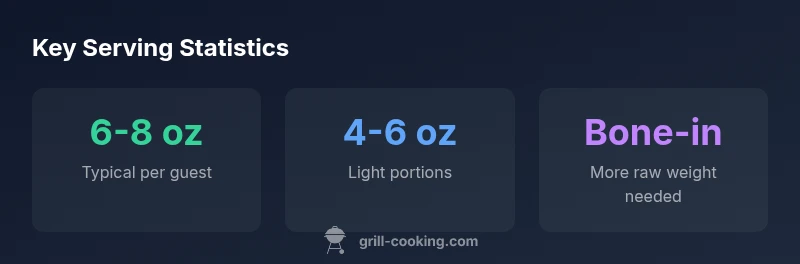
Grill Cooking Analysis, 2026 recommends planning 6-8 ounces of cooked grilled chicken per person for a standard main course. For lighter portions, aim for 4-6 ounces; for hearty appetites or guests with big sides, 8-10 ounces works well. If serving bone-in cuts, expect about 20-30% more raw weight due to trim and bones.
Why portion size matters for grilled chicken
Getting the portion size right is essential for crowd-pleasing grills and minimizing waste. When you grill chicken, the final cooked weight does not equal the raw weight due to moisture loss. For a standard main course, aiming for 6-8 ounces of cooked chicken per person provides a balanced center of the plate, especially when you’re pairing with vegetables and starch. If your guest list includes big appetites or you’re serving generous sides, targeting 8-10 ounces per person can prevent scarcity. Conversely, lighter meals or younger eaters may be satisfied with 4-6 ounces. Knowing these baselines helps you design menus, order ingredients, and estimate cook times more accurately. Grill Cooking analyses emphasize building portions around plated servings rather than raw weight, ensuring you meet expectations without overdoing portions. This approach also helps in minimizing leftovers and waste, especially when you’re feeding a crowd.
How to calculate per person for different meals
A practical way to approach portions is to set a baseline and adjust by appetite and menu context. Start with 6-8 ounces per person for a main course of grilled chicken. If you’re serving a light spread or a family-style meal with dense sides, go with 4-6 ounces. For a feast with multiple proteins or big sides, 8-10 ounces may be appropriate. Translate cooked portions back to raw quantities by applying a yield factor (roughly 1.25x to 1.40x for bone-in vs boneless cuts) to estimate how much raw chicken you must buy. Always consider bone-in vs boneless in your budget and adjust accordingly. Keep a small buffer for corners or spirited eaters—roughly 10-15% extra can save you from running short. As you scale up, use batch calculations rather than one-by-one estimates to reduce error.
Bone-in vs boneless: adjusting your plan
Bone-in cuts add weight to the raw product due to bones. If your goal is a uniform cooked portion, plan on fewer boneless pounds per guest but more bone-in pounds in raw terms to reach the same cooked yield. A practical rule is 6-8 ounces cooked per guest for boneless portions and 8-10 ounces cooked per guest for bone-in portions. When buying raw chicken, expect to need about 1.25x to 1.40x more weight for bone-in cuts than for boneless to achieve the same final portions. This adjustment helps prevent under-serving or over-spending on meat.
Turn planning into a simple chart: quick-start guides
A quick-start guide makes it easy to scale up for crowds. For a party of 4, plan 24-32 ounces (1.5-2 pounds) cooked, equating to roughly 2-2.25 pounds raw boneless or 2.5-3 pounds raw bone-in. For 8 guests, aim for 48-64 ounces cooked (3-4 pounds cooked equivalent), which typically requires 4-5 pounds raw boneless or 5-6 pounds raw bone-in. For larger groups, use a simple multiplier: multiply the number of guests by 6-8 ounces for boneless or 8-10 ounces for bone-in cooked portions, then adjust for the sides, your grill’s capacity, and whether you’re offering more protein options.
Grilling technique impact on yield and safety
Grill temperature and time influence moisture loss. Higher heat sears the surface and can push moisture out more quickly if you’re not careful, potentially reducing cooked yield slightly. Conversely, a gentler, steady temperature preserves juiciness and helps you hit the target 6-8 ounces cooked per person more reliably. Always monitor internal temperatures to 165°F (74°C) to ensure safety. Carryover cooking can add 5-10 degrees after you remove from heat, so consider removing meat a touch early if you’re targeting a precise final weight per person.
Portioning for crowds: practical examples
Consider a 12-person gathering with a mix of boneless and bone-in options. If you serve boneless chicken in the 6-8 ounce cooked range, you’d plan for 72-96 ounces cooked. If you opt for bone-in, plan for 96-120 ounces cooked to compensate for the bones and trimming. Adjust based on sides, sauces, and the presence of other proteins. In buffet-style setups, provide a little extra—an extra 10-15%—to account for larger appetites and grabbing styles. For kids, Lois or lighter eaters, offer 4-6 ounces cooked portions and ensure there are kid-friendly sides available.
Leftovers: storage and reuse ideas
Leftovers are common with grilled chicken, especially when hosting a crowd. Cool cooked chicken quickly, then refrigerate in shallow containers within two hours. Use within 3-4 days, or freeze for longer storage. Reheat to 165°F (74°C) before serving again. Leftover chicken pairs well with salads, wraps, or grain bowls, and can be repurposed into soups or casseroles. Label containers with date to avoid waste and maximize safety.
Quick-start checklist for your next grill
- Decide on boneless or bone-in portions and allocate portions (6-8 oz cooked boneless, 8-10 oz cooked bone-in).
- Determine guest count and calculate raw weight using the yield factor (1.25x–1.40x).
- Add a 10-15% buffer for potential extra servings and leftovers.
- Preheat grill to an appropriate temperature and monitor internal temperatures for safety.
- Plan sides that complement portions and reduce plate crowding.
- Keep leftovers safe with fast cooling and proper refrigeration.
Portion guidelines for common serving scenarios
| Scenario | Cooked per person (oz) | Notes |
|---|---|---|
| Main course, standard appetite | 6-8 | Balanced portions with sides like vegetables and starch |
| Lighter meals or kids | 4-6 | Smaller portions ideal when meals include heavy sides |
| Big appetites or buffet style | 8-10 | Great for guests with large appetites or extra sides |
| Bone-in vs boneless (raw weight) | 8-10 bone-in / 6-8 boneless | Adjust raw weight to account for bones and trim |
FAQ
How much grilled chicken per person should you plan for bone-in vs boneless cuts?
Bone-in cuts require more raw weight to reach the same cooked portion as boneless. For a standard main course, target 6-8 ounces cooked per person for boneless and 8-10 ounces cooked per person for bone-in. Always factor in bones when estimating total raw quantity.
Bone-in needs more raw weight to reach the same cooked portion; plan 6-8 ounces cooked per person for boneless and 8-10 ounces for bone-in.
How many pounds of chicken do I need for a party of 10?
If you plan 6-8 ounces cooked per person, you’ll need about 60-80 ounces cooked total (3.75-5 pounds). To cover yield, buy roughly 5-6 pounds raw, adjusting up if bone-in portions are chosen.
For 10 guests at 6-8 ounces cooked each, aim for about 4-5 pounds cooked; buy 5-6 pounds raw to cover yield.
Should I cook extra to allow for leftovers?
Yes, adding 10-20% extra is common for leftovers and to accommodate unexpected guests. It also makes it easier to reheat and reuse leftovers safely.
It's smart to plan a little extra to cover leftovers and guests who show up late.
How does appetite variability affect portions?
If you expect mixed appetites, offer a mix of portions and sides. Use 6-8 oz cooked for boneless and 8-10 oz for bone-in as a baseline, allowing guests to pick accordingly.
Have a mix of portion sizes and robust sides so everyone can grab what they want.
What are safe practices for storing grilled chicken leftovers?
Cool leftovers quickly, refrigerate within two hours, and use within 3-4 days. Reheat to 165°F (74°C) and discard anything smells off.
Cool quickly, refrigerate, and reheat to safe temperatures to keep leftovers safe.
“Precise portioning minimizes waste and ensures every guest receives a consistent serving, especially when grilling for crowds.”
Quick Summary
- Plan 6-8 oz per person for main course
- Adjust portions by appetite and sides
- Bone-in cuts require more raw weight
- Provide generous sides to balance portions
- Use a portion calculator to scale for crowds