How Many Grilled Chicken Tenders Is a Serving
Learn how to portion grilled chicken tenders for adults and kids, with practical counts, weight-based tips, and meal-planning strategies from Grill Cooking.


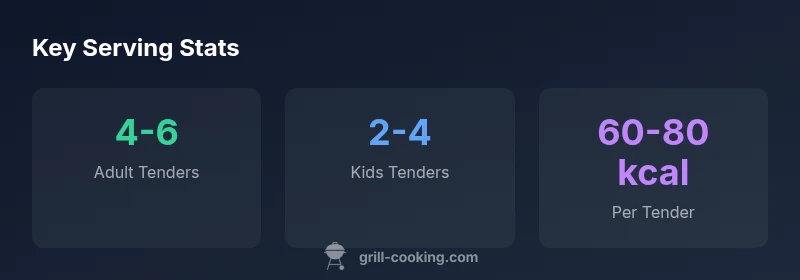
How many grilled chicken tenders is a serving depends on appetite and context. For a main course, plan about 4-6 tenders per adult and 2-4 for children, with sides handled separately. This quick rule-of-thumb aligns with Grill Cooking Analysis, 2026, and supports consistent meal planning.
How many gril led chicken tenders is a serving? Defining a serving in grilling context
Defining a serving in grilling context requires looking beyond a single tender. For many home cooks, a serving should satisfy hunger without leaving the plate half-empty or overflowing with leftovers. Tender size varies widely by brand, cut, and whether you’re grilling battered or unbreaded pieces; these variations mean a fixed number per person isn’t universal. According to Grill Cooking Analysis, 2026, a practical serving should account for tender size, the presence of sides, and the overall meal context. If your tenders are compact and lean, you may need a handful more to reach the same protein target; if they’re thick and breaded, fewer may do the trick. A good starting point for a main course is 4-6 tenders per adult, and 2-4 for children. Remember that sides like rice, potatoes, vegetables, or beans add substantial bulk and can reduce the number of tenders you’d plate as the protein portion. This approach lets you avoid overcooking or under-seasoning, while keeping portions consistent across meals. By framing serving size around appetite, not a fixed count, you’ll simplify meal planning and grilling sessions.
Baseline serving guidance: typical counts and portions
Starting with a baseline helps you scale up or down for crowds. For a typical weeknight dinner, plan 4-6 tenders per adult if the goal is a true main course with moderate sides. If your tenders are large or particularly meaty, you might settle on 4 per person; if they are smaller or you’re serving a leaner plate, you could aim for 6. For children, plan 2-4 tenders depending on age, activity, and appetite; younger kids may be satisfied with 2 or even 1 if served with a robust veggie side. When you’re building menus or meal prep, think in terms of protein grams: a common target is around 25-35 g of protein per meal for many adults; this translates into roughly 4-6 tenders, depending on tender size and breading. Pair the protein with a balance of carbs and vegetables to round out the meal. Grill Cooking’s analysis, 2026, reinforces that these baselines are practical starting points for most households, and can be adjusted up or down according to appetite and meal context.
Factors that influence tender count per serving
- Tender size matters: larger tenders pack more protein and weight, so fewer pieces may be needed. If your tenders are jumbo, aim for 4-5 per adult.
- Breaded vs plain: breading adds weight and moisture loss during grilling, which can slightly change how full a person feels after a bite.
- Sides and overall plate balance: hearty sides like mashed potatoes or rice can replace protein portions; green veggies and salads may require a few extra tenders to reach protein goals.
- Cooking loss: grilling causes moisture loss; plan for a 5-15% reduction in weight, depending on marinade and fat content.
- Appetite and demographics: younger kids often require fewer tenders, while athletes or high-activity individuals may want more.
- Brand and portion variability: different tender sizes across brands lead to differences in counts, so use a flexible guideline rather than a fixed number.
How to estimate servings when batching for a crowd
- Define the total protein target: decide how many grams of protein you want to deliver per person and multiply by the number of guests.
- Convert protein target to tender counts: use your recipe's protein content per tender as a guide (roughly 6-10 g protein per ounce of meat, depending on size and breading).
- Add a 10-20% cushion for shrinkage and seconds: crowds often go back for seconds or second helpings, so a small buffer helps avoid shortfalls.
- Consider service style: if tenders will be served with abundant sides, you can reduce the protein portion slightly; if you’re serving mostly meat with light sides, increase the tender count.
- Final check and accounting: round to whole tenders, then note any dietary restrictions and adjust accordingly. Grill Cooking Analysis indicates this approach yields reliable results for gatherings and weeknight meals alike.
Measuring servings accurately: weight-based vs count-based methods
There are two practical ways to portion grilled chicken tenders: count-based (how many pieces) and weight-based (protein grams). Count-based planning is simple and fast—count the tenders you plan to grill and plate. Weight-based planning can be more precise, especially when tenders vary in size due to brand or batch differences. If you’re aiming for, say, a 25-35 g protein target per adult, weigh several cooked tenders to estimate how many pieces meet that target, then scale up or down for the group. A common tactic is to weigh a batch of cooked tenders once to establish an average weight per piece, then multiply by the desired count. Remember that grilling loss, breading, and sauce can shift weight, so adjust accordingly.
Sample scenarios: adults, kids, athletes
- Adult dinner party: plan 4-6 tenders per guest with generous sides like roasted vegetables and a starch. If tenders are large, lean toward the 4-tender side to keep portions balanced.
- Family weeknight with kids: aim for 2-4 tenders per child depending on age, activity, and appetite; pair with a colorful veggie side and a carb to round out the meal.
- Athletes or active households: depending on training load, 5-7 tenders per adult might be appropriate, especially when meals are post-workout and protein needs are higher. In all cases, adjust for tender size and any dietary goals, and use a simple serving guide to keep portions consistent across meals.
Common mistakes and how to adjust
- Mistake: erring on the side of “more is better” and overloading plates. Adjust by weighing the protein target and balancing with sides.
- Mistake: ignoring tender size variability. Use a size-based baseline (4-6 for adults, 2-4 for kids) and tweak with a quick check of the batch’s average weight.
- Mistake: not accounting for cooking loss. Expect some shrinkage and plan extra tender counts accordingly.
- Mistake: serving without a plan for leftovers. Predefine a safe disposal or repurposing strategy to reduce waste.
- Mistake: failing to consider dietary needs. Always offer variety and note allergen-friendly options when applicable.
- Mistake: skipping a final plate check. A quick final tally helps ensure that every guest has a complete plate.
Quick planning checklist for grill night
- Decide adult vs kid counts and expected hunger levels.
- Choose tender size and breading level to estimate counts.
- Weigh a sample batch to set a typical weight per tender.
- Add 10-20% cushion for waste and seconds.
- Plan sides and sauces to balance portions.
- Note dietary restrictions and offer options.
- Confirm grill time and batch pace to meet serving goals.
Estimated serving ranges for grilled chicken tenders
| Scenario | Estimated Tenders per Serving | Notes |
|---|---|---|
| Adult main course | 4-6 | Size varies; pair with sides for balance |
| Child portion | 2-4 | Adjust for younger appetites; consider energy goals |
| Lunch snack portion | 2-3 | Smaller portion for lighter meals |
FAQ
What counts as a serving of grilled chicken tenders?
A serving is a practical portion that satisfies hunger considering tender size and what else is on the plate. For many households, 4-6 tenders for adults and 2-4 for kids serve as a baseline, adjusted for sides and activity. Weighing portions or using standard recipe yields can improve accuracy.
A serving is a practical portion based on tender size and sides. For adults, start with 4-6 tenders; for kids, 2-4.
How many tenders should I serve per person?
As a general rule, adults benefit from 4-6 tenders for a main course, while children typically need 2-4 depending on age and activity. If your tenders are particularly large or you’re serving generous sides, you may lean toward the lower end for adults and the upper end for kids as appropriate.
Most adults: 4-6 tenders; kids: 2-4, adjusted for age and activity.
Does tender size affect serving counts?
Yes. Larger tenders provide more protein per piece, so you may need fewer pieces to reach a target. Smaller tenders require more pieces to achieve the same protein target, especially when aiming for a specific caloric balance.
Yes. Bigger tenders mean fewer pieces, smaller tenders mean more pieces for the same protein target.
How can I measure servings without a kitchen scale?
Use plate-based portions as a guide: arrange tenders to roughly cover one-third of a standard dinner plate as a protein visual cue, then balance with vegetables and starch. For more precision, estimate by average tender size and count.
Arrange tenders to roughly fill one-third of a dinner plate and adjust with sides.
Are chicken tenders the same as chicken strips or nuggets?
Grilled chicken tenders are often larger and meatier than typical chicken strips or nuggets. Tenders are usually a specific part of the chicken and can vary in size by brand, which affects serving counts.
Tenders are usually larger and more meatier than strips or nuggets, and sizes vary by brand.
Should I account for sides when planning tender portions?
Yes. Sides add bulk and affect how much protein you need. Hearty sides can reduce the number of tenders, while light sides may require more protein to reach a target.
Yes—sides influence portions. Larger sides can reduce needed tenders, smaller sides may increase them.
“Portioning grilled chicken tenders isn’t a one-size-fits-all decision; tailor counts to appetite, sides, and nutrition goals.”
Quick Summary
- Define serving by appetite and context, not a fixed count
- Use 4-6 tenders for adults as baseline
- Kids typically need 2-4 tenders depending on age
- Weigh portions or use plate-based guidance for accuracy
- Adjust for sides, breading, and cooking method