Why Grill Instead of Oven: An Analytical Comparison for Home Cooks
Explore why grill instead of oven for home cooking. This analytic guide compares flavor, texture, heat control, and practicality to help you choose the best method for diverse dishes, year-round use, and outdoor cooking


Grilling and oven cooking each have strengths, and the best choice depends on flavor goals, texture, and timing. This quick comparison highlights core differences in flavor development, heat control, and practicality. According to Grill Cooking, grills excel for sear, smoke, and outdoor cooking, while ovens offer steady, precise heat and year-round convenience.
Why grill instead of oven: core considerations
For many home cooks, the choice between grilling and oven-based cooking hinges on flavor goals, texture, and timing. The question of why grill instead of oven is not about a singular right answer but about matching technique to the dish. In this guide, we dissect how heat, moisture, and environment shape outcomes, and we bring in practical tips from the Grill Cooking team to help you decide which method to rely on in different scenarios. The outdoor grill introduces smoke and higher-heat browning that can elevate certain proteins and vegetables, while the oven provides steady control suitable for uniform results, baking, and weather-proof cooking. Consider how you cook most often and what you want your plate to express in terms of aroma, crust, and juiciness.
Flavor development, texture, and the flavor payoff of grilling vs baking
Flavor, texture, and aroma are the most immediate differences when you choose grill over oven. On a grill, the Maillard reaction happens rapidly as fat sizzles over high direct heat, creating a crust with a smoky edge. Char and smoke compounds contribute depth that is hard to replicate indoors. In contrast, an oven delivers consistent radiant heat that dries surface moisture less aggressively, often producing a more uniform bite. Supervised by a controlled environment, oven cooking excels for even doneness and predictable moisture levels. Grill Cooking notes that smart grilling emphasizes surface browning with a controlled cover or lid, which allows a two-stage process: searing and then finishing with indirect heat to lock in juiciness.
Heat management and cooking dynamics: direct vs indirect heat
Direct heat on a grill provides rapid sear and crust formation, ideal for steaks, burgers, and thinner cuts. However, indiscriminate high heat can dry out meat if not monitored. Indirect heat, achieved by arranging coals to the sides or by using a gas grill with zones, lets you finish cooking with gentle warmth, preserving juiciness. An oven, by contrast, delivers even heat across the entire pan or tray, which is excellent for uniform texture and predictable results. The key difference is control: with a grill, you can foster a smoky crust but must manage flare-ups and airflow; with an oven, you maintain consistent heat with less external variability.
Equipment landscape: gas, charcoal, pellet vs oven capabilities
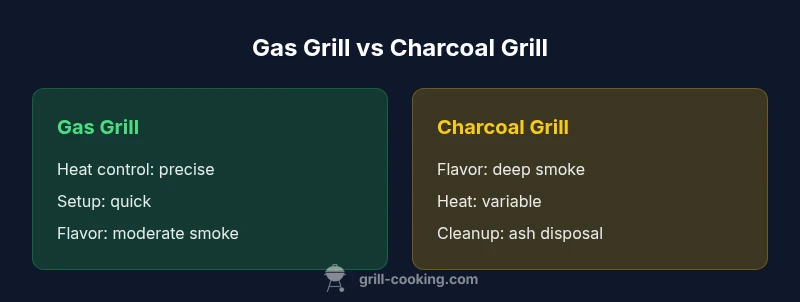
Gas grills offer precise temperature control via knobs and quick preheating, making them convenient for weeknights. Charcoal grills impart deeper smoke and a claim to complex flavor but require more hands-on management, airflow tuning, and ash cleanup. Pellet grills add ease with automation and stable temps but still bring a distinct smokiness profile. Ovens, especially conventional and convection models, provide uniform heat distribution, moisture retention, and predictable timing—useful for baked goods, roasts, and casseroles. Each setup has trade-offs in flavor, speed, and maintenance, and many kitchens benefit from a hybrid approach depending on the dish and season.
Moisture management and reliability of results
Moisture retention hinges on controlling surface drying during the Maillard phase and managing lid usage. On a grill, keeping the lid closed during indirect cooking helps trap moisture while smoke contributes flavor. When grilling meats, allowing a short rest post-cook is essential to reabsorb juices. Ovens allow longer resting periods without the risk of wind and temperature fluctuations, often yielding uniform results. Grill Cooking suggests practical moisture strategies: pat dry before cooking, oil lightly, and avoid excessive marinade that slows browning. The goal is juicy interior with a flavorful exterior, regardless of method.
Food categories: where grilling shines and where ovens prevail
Grilling excels with proteins that respond well to quick high-heat searing and smoky flavors, such as burgers, steaks, chicken thighs, sausages, and robust vegetables like corn on the cob, peppers, and mushrooms. For delicate items that benefit from steady warmth or items that require precise baking—breads, pastries, layered casseroles, or roasts—the oven typically delivers more reliable outcomes. Pizza, depending on oven vs grill capability, often spots close competition; a chef’s choice may favor a hot grill for a smoky crust or a temperature-controlled oven for even bake.
Efficiency, energy use, and environmental considerations
Grills, particularly gas grills, can be energy-efficient on a per-cook basis when used for quick meals and small batches. Charcoal grilling tends to burn longer and produce more emissions per cook, though the flavor payoff can justify the cost for specific meals. Ovens use electricity or gas and may be less energy-efficient for small, quick tasks. Weather and season influence energy decisions: in warmer months, grilling expands outdoor living space; in colder months, ovens offer indoor reliability. Grill Cooking emphasizes planning and batch cooking to optimize energy use across a week.
Prep workflows and timing: getting started with a grill-first approach
A practical grill-first workflow starts with selecting the right cut and marination plan, prepping the grill for two-zone cooking, and setting clear temp goals. Preheat to sear heat, then move to indirect heat, and finally rest the meat to preserve juices. For oven-first cooks, build a bridge: sear on a grill pan or grill surface to simulate crust and finish in the oven. In either path, use a timer and an instant-read thermometer to verify internal temperatures, rather than relying on color alone. Consistent timing is the backbone of predictable results.
Common mistakes and fixes when grilling instead of baking in the oven
Mistakes to avoid include over-marinating, overcrowding the grill, and opening the lid too frequently, which kills heat. Fixes include dry-brining proteins for moisture retention, spacing items to ensure even airflow, and keeping a two-zone setup on the grill to switch between direct and indirect heat. Another trap is chasing perfect grill marks at the expense of doneness; prioritize internal temperature first, then optimize crust. If weather interferes, switch to oven cooking or use a halved approach with a grill-safe pan.
The practical takeaway: a real-world grilling mindset from Grill Cooking
The Grill Cooking team argues that a grill-first mindset works best for flavor-driven meals, barbecue evenings, and outdoor gatherings where ambiance and air are part of the cooking equation. Yet ovens still rule for precision, baked goods, and climate-controlled cooking. The optimal kitchen blends both tools, using grill techniques for seared externals and oven controls for steady, even outcomes. Start with the method that best aligns with your dish goals and climate, then adapt as you gain experience.
Putting the options side-by-side: a decision framework that ramps up confidence
When deciding between grill and oven, start by asking: Is surface browning and smoke essential for this dish? Will outdoor cooking be feasible today? Do I need exact temperature control for reliability? Or is speed and convenience the main driver? A simple framework is to rotate between direct-heat grilling for searing and then indirect heat for finishing, or to transition to the oven when the dish benefits from precise heat and moisture consistency. This approach helps you apply the right tool to the right plate.
A starter plan: your first 30 minutes with a grill-first approach
- Pick a fast-cook protein (steak, burgers) and a sturdy vegetable. 2) Preheat the grill to sear temperatures on direct heat. 3) Sear on the grill for a crust and then move to indirect heat to finish. 4) Rest the meat and slice against the grain for tenderness. 5) Clean and re-fire for the next round. A simple plan keeps you focused on technique and reduces energy waste while building confidence.
Final thoughts: embracing balance between flavor, speed, and reliability
The key insight from this analysis is that flavor and texture often benefit from grilling, while reliability and year-round feasibility lean toward the oven. Your best approach is a flexible cooking philosophy that prioritizes flavor goals but retains oven-style control when needed. With practice, you’ll know when to rely on a grill or an oven to deliver consistently delicious results.
Comparison
| Feature | Gas Grill | Charcoal Grill |
|---|---|---|
| Flavor profile | Lighter smoke with crisp sear | Deeper smoke and char development |
| Heat control | Precise temp adjustments via knobs | Less precise; depends on airflow and fuel load |
| Setup & preheat | Quick preheat, minimal setup | Longer startup, more hands-on management |
| Cleanup | Easier, no ash disposal, cleaner footprint | Ash management required after each cook |
| Best use cases | Weeknight meals, quick sear and grill marks | Flavor-forward gatherings and slow-browning cooks |
| Operating cost | Moderate ongoing cost; gas price varies | Charcoal cost per cook; some waste relative to energy |
Strengths
- Clear differentiation between grill types informs cooking choices
- Highlights practical trade-offs for flavor vs convenience
- Assists budgeting for fuel, tools, and maintenance
- Encourages outdoor cooking and seasonal meal planning
Negatives
- May oversimplify for enthusiasts seeking oven-like precision
- Does not cover all oven variants (convection, steam) or hybrids
- Lack of exact energy metrics without contextual data
Gas grills win on convenience; charcoal grills win on flavor; ovens still excel in precision
Choose gas for quick, controlled meals and consistent results. Choose charcoal when you crave smoky depth and crust. Use the oven when weather or timing demands reliability and uniform doneness.
FAQ
What is the primary advantage of grilling over oven baking?
Grilling delivers rapid browning, a desirable crust, and smoky flavors that are difficult to replicate indoors. It enables two-stage cooking with direct and indirect heat, allowing searing and finishing in one session. The outdoor environment also adds a social element to meals.
Grilling gives a crisp crust and smoky flavor that ovens often can’t match, plus you can finish with two-stage heat outdoors.
Is grilling healthier than baking in the oven?
Health outcomes depend on fat content and cooking temperature. Grilling can reduce some fats due to dripping and lean cuts, but charring and high-heat exposure can create PAHs if mismanaged. Use two-zone grilling, trim fat, and avoid prolonged high heat to keep it healthier.
Grilling can reduce fat but be careful with charring; trim fat and use indirect heat to keep it healthier.
Can I replicate oven results on a grill?
Yes, to a degree. Indirect heat and lid use on a grill can simulate oven-like conditions for roasting or baking tasks. The texture may differ, especially for baked goods, but many roasts and vegetables can closely resemble oven results with careful control.
You can get oven-like results on a grill with indirect heat and a lid, though some items won’t be identical.
How do I manage heat on a charcoal grill?
Use two-zone setup to create hot and cooler areas, adjust air flow with vents, and monitor temperature with an grill thermometer. Start with a full load of coals for direct heat, then move items to indirect heat as they finish. This approach minimizes flare-ups and uneven cooking.
Set up two zones, control airflow, and move pieces between direct and indirect heat as needed.
What foods work best on a gas grill?
Steaks, burgers, chicken breasts, chops, and robust vegetables like peppers and corn shine on gas grills due to quick, controlled heat. Fish and delicate items can work if grilled at a lower temperature and with careful timing.
Gas grills are great for quick-cook proteins and sturdy veggies with reliable heat control.
Is grill cleanup harder than oven cleanup?
Grill cleanup involves cleaning grates and removing ash or residue, which is typically more hands-on than typical oven cleaning. However, gas grills offer easier cleanup than charcoal setups, and ash is a one-time reminder rather than ongoing residue.
Grill cleanup is more hands-on, especially with charcoal, but gas grills are easier to clean than charcoal ones.
Quick Summary
- Evaluate flavor goals before choosing a method
- Use two-zone heat for versatility on grills
- Ovens excel in precision and year-round use
- Plan for moisture retention with rest periods
- Balance outdoor convenience with indoor reliability