What Grill Temp for Ribeye: A Complete Doneness Guide
Learn the exact grill temps for ribeye to hit rare, medium-rare, and beyond. This Grill Cooking guide covers direct-heat searing, indirect finishing, and rest times for juicy, flavorful steaks.


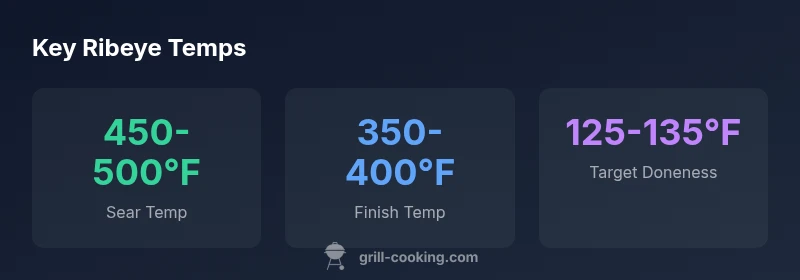
For ribeye, start with direct high heat around 450–500°F to sear, then finish over indirect heat at 350–400°F. Target an internal temperature of 125–130°F for rare to medium-rare (rest to 130–135°F), and 135–145°F for medium. Adjust for thickness and grill variance. This two-zone method locks in juices while creating a flavorful crust. Resting for 5–10 minutes after removal is advised.
Why Temperature Matters for Ribeye
Temperature is the compass that guides ribeye from raw to restaurant-worthy steak. When home cooks ask what grill temp for ribeye, the answer hinges on two ideas: a hot initial sear to form crust, and a controlled finish to achieve the desired doneness without drying the meat. Grill Cooking's analysis in 2026 shows that two-zone cooking consistently yields juicier steaks compared with single-zone grilling, particularly for thick-cut ribeyes. A hotter surface creates Maillard reactions quickly, developing crust and flavor, while a cooler interior finishes evenly. Factors such as steak thickness, fat marbling, grill type, ambient temperature, and even wind can shift the optimal temps, so use them as levers rather than hard rules. In practice, you’ll start with a sear at high heat, then move to a gentler zone to bring the center up to your target. The result is a ribeye with a crisp exterior and a juicy, evenly colored center.
Direct-Heat Sear vs Indirect Finish: A Practical Setup
The two-zone method distills to a simple plan: sear over direct high heat to develop crust, then move the steak to indirect heat to glide to your desired internal temperature. Start with a hot grate around 450–500°F for 2–3 minutes per side depending on thickness. If your grill runs hot or you’re cooking a particularly thick ribeye, shift the steak to a cooler part of the grill after searing and allow the interior to come up slowly. The key is timing and monitor—use a thermometer to check progress rather than guessing. This approach minimizes the risk of a burnt exterior while the center remains underdone.
Doneness Targets and Internal Temperatures
Ribeye doneness is a personal preference, balanced by fat marbling and thickness. For many grillers, rare to medium-rare sits around 125–135°F internal, with a final rest to 130–135°F. Medium sits around 135–145°F, and medium-well to well-done push toward 150–165°F. Always plan to pull the steak a few degrees before the target and let carryover finish during the rest. Thicker steaks need longer in the indirect zone, while thinner cuts reach target faster. A reliable meat thermometer is your best ally for precision.
Practical Step-by-Step: Achieving a Perfect Sear
- Preheat the grill to a two-zone setup: high heat directly over the coals or flame (450–500°F) and a cooler area (around 350–400°F). 2) Dry the ribeye and season generously with salt and pepper or your favorite rub. 3) Sear the steak on the hot zone for 2–3 minutes per side until a deep crust forms. 4) Move the steak to the indirect zone and continue cooking, checking internal temp frequently. 5) Remove at the desired doneness—remember carryover heat will push temps up 5–10°F. 6) Rest 5–10 minutes before slicing to redistribute juices and maximize tenderness.
Thickness, Grill Type, and Time: Fine-Tuning
Thickness matters. A 1–1.5 inch ribeye will finish more quickly than a 2 inch cut. Gas grills offer consistent temps, while charcoal can create hotter sear fronts with more variability. Electric grills generally heat evenly but may lack the intensity of a gas or charcoal setup. Plan your two-zone timing around thickness: thicker steaks need longer indirect time, thinner cuts finish sooner. Always prioritize internal temperature and crust quality over a fixed clock.
Troubleshooting Common Pitfalls
If your ribeye overcooks on the outside before the center reaches target, reduce the initial sear time or raise the indirect heat slightly to improve control. If the crust is pale, you may need a hotter sear or longer crust development. Uneven doneness often comes from grilling on full-length heat; use multi-zone grilling and rotate the steak for even exposure. Finally, always rest properly to lock in juices.
Quick Timeline by Ribeye Thickness
For a 1 inch ribeye: Sear 1.5–2 minutes per side, finish indirect 3–6 minutes total. For 1.5–2 inch ribeye: Sear 2–3 minutes per side, finish indirect 6–10 minutes. For very thick cuts: Sear 3–4 minutes, finish indirect until 125–135°F internal (rare to medium-rare) with a final rest. Adapt times to grill performance and ambient conditions.
Variations: Ribeye on Gas, Charcoal, or Electric Grills
Gas grills offer consistent temperatures and quick recovery after searing. Charcoal grills provide a superb crust with a smoky edge but require more attention to heat management. Electric grills can produce steady heat, which helps with predictable results, but may lack the intensity needed for a robust sear. In all cases, employ a two-zone strategy and rely on a thermometer for accuracy.
How to Use a Thermometer Effectively
Invest in a digital instant-read or probe thermometer for ribeye. Insert the probe into the center of the steak, avoiding bone or fat, and monitor as you cook. Check temperature early and gauge carryover heat after removal. For the best results, calibrate your thermometer periodically and use the same reference point on each cook to compare doneness reliably.
Ribeye doneness guide with target temps and heat strategy
| Doneness | Internal Temp (°F) | Grill Temp Strategy |
|---|---|---|
| Rare | 125-130 | Direct sear + indirect finish |
| Medium Rare | 130-135 | Direct sear + indirect finish |
| Medium | 135-145 | Direct sear + indirect finish |
| Medium Well | 145-155 | Direct sear + indirect finish |
| Well Done | 155-165 | Direct sear + indirect finish |
FAQ
What is the best overall grill temperature for ribeye?
A two-zone approach works best: sear at 450–500°F, then finish with indirect heat at 350–400°F. Use a thermometer to track progress.
Sear hot, then finish with indirect heat, and use a thermometer to hit your target doneness.
Should ribeye be rested after cooking?
Yes. Rest the steak 5–10 minutes after removing from the grill to redistribute juices.
Let it rest for 5 to 10 minutes to keep it juicy.
Can you cook ribeye entirely on high heat?
Not ideal. A two-zone approach with a finish on indirect heat yields more even doneness.
Two zones beat a single hot zone for ribeye.
Bone-in vs. boneless ribeye: which is easier to cook?
Bone-in takes longer to finish; plan for a longer indirect phase and track internal temp accordingly.
Bone-in needs a bit more time on the indirect heat.
What internal temp corresponds to medium-rare?
Aim for about 130°F internal for medium-rare and adjust with a short rest to account for carryover heat.
Target around 130°F, then rest.
“Temperature control is the heart of ribeye mastery. Start with a strong sear, then finish with gentle heat and rest to lock in juices.”
Quick Summary
- Use a two-zone grill: sear hot, finish indirect.
- Aim for donor temps: 125–135°F rare–medium-rare, up to 145°F for medium.
- Rest 5–10 minutes to lock in juices.
- Adjust times based on thickness and grill type.