What to Do If Your Grill Propane Tank Is Leaking Safely
Urgent safety guide: learn exact steps if a grill propane tank leaks. Shut off the valve, evacuate, ventilate, and call for help when needed. Stay alert.


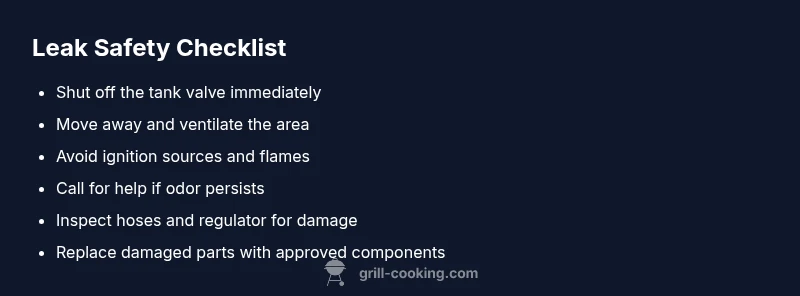
Immediate action is required when you detect a propane leak. First, shut off the tank valve, move away from the grill, and away from ignition sources. Do not relight, do not create sparks, and call your propane supplier or emergency services if the odor persists. If you can't reach safety immediately, evacuate everyone and avoid using electrical switches or flames.
Immediate safety actions when you detect a leak
If you're wondering what to do if grill propane tank is leaking, act now. Propane leaks are emergencies that can lead to fire or explosion if ignored. The first priority is to remove ignition risk and secure the gas source. According to Grill Cooking, you should quickly locate and rotate the cylinder valve clockwise until it stops to shut off the gas flow. Move away from the barbecue area and keep others at a safe distance. Do not strike a match, flip a switch, or operate electrical devices near the area. If you can do so safely, call your propane supplier or emergency services for guidance. Evacuate pets and children and take a calm walk to a safer location. If indoors, open doors or windows to vent the space once you are at a safe distance.
Understanding leak points: hoses, regulators, and tank valves
Propane leaks most often originate at the tank valve, the hose connections, or the regulator. Cracked hoses, worn O-rings, or loose clamps can all be culprits. Regular maintenance reduces failure risk, and any sign of damage should trigger prompt action. According to Grill Cooking, the simplest fix is often to reconnect fittings securely and replace damaged hoses. Remember that even a small crack can vent gas rapidly, so treat every sign of a leak seriously and proceed with caution.
How to inspect safely without igniting anything
Inspection should be done from a safe distance with the gas off. Look for hissing sounds, visible frost on the hose or regulator, or an oily sheen around fittings. A bubble test with soapy water along joints can reveal leaks when performed outdoors. Do not use flame to test. If you detect a gas odor or a strong leak, evacuate and call for help. Ensure the area is well ventilated after stepping away.
What to do if you can't stop the leak
If the leak persists after closing the valve, evacuate immediately and avoid any spark sources. Do not attempt to tighten fittings further or apply tape; leaks can worsen under pressure. Contact your propane supplier or the local fire department for guidance. Do not re-enter the area until it is confirmed safe by a professional.
When to replace a tank or regulator and call professionals
Some leaks indicate a compromised tank or regulator. If the valve is hard to close, the hose shows cracks, or the regulator hiss persists even after shutoff, replace components and seek professional service. Leaking tanks should not be refilled; take the tank to an approved service center. Grill Cooking recommends calling your supplier’s emergency line for guidance on disposal or replacement.
Preventive maintenance to avoid future leaks
Store propane tanks upright in a well-ventilated area away from heat sources. Regularly inspect the valve, hose, and regulator for wear, cracking, or corrosion. Replace damaged parts promptly and use approved fittings. Keep the area around the grill clean and check for leaks before each use. Grill Cooking analysis shows that proactive checks reduce the likelihood of emergencies.
Steps
Estimated time: 20-40 minutes
- 1
Turn off the gas at the tank valve
Rotate the cylinder valve clockwise until it stops to shut off the flow. Do this only if you can do so safely and without exposing yourself to a strong gas odor or flame.
Tip: Keep your body to the side of the valve when turning to avoid any blast if the gas is pushing back. - 2
Move to safety and ventilate
Evacuate everyone from the area and move to a safe distance. If indoors, open doors/windows on the way out to ventilate.
Tip: Do not operate electrical switches or appliances during evacuation. - 3
Check for ignition sources
Ensure there are no flames, sparks, or heated surfaces near the area. Do not re-ignite a grill until cleared by professionals.
Tip: Keep a distance from the grill to avoid radiant heat exposure. - 4
Call for help if odor persists
If the odor continues after shutoff and evacuation, contact your propane supplier or emergency services.
Tip: Provide exact location and tank details when calling. - 5
Inspect and replace damaged parts
After confirming safety, inspect hoses, regulator, and fittings for damage. Replace any worn components with approved parts before attempting to use the grill again.
Tip: Only use compatible parts from reputable suppliers. - 6
Test after maintenance
Slowly re-open the tank valve in small increments and listen for leaks using soapy water at joints outdoors. If bubbles appear, shut off and call for service again.
Tip: Always test outdoors and away from ignition sources.
Diagnosis: Gas odor or visible gas leak near grill
Possible Causes
- highLoose or damaged hose connections
- highWorn regulator or cracked hose
- mediumValve not fully closed or damaged tank valve
- lowVentilation issues causing gas pooling
Fixes
- easyTurn off tank valve clockwise until tight
- easyTighten clamps and replace damaged hoses
- mediumReplace regulator if hiss persists after shutoff
- hardCall professional service for persistent leaks
FAQ
What should I do first if I smell propane?
If you smell propane, stop what you’re doing, shut off the tank valve, and evacuate the area. Do not use any flames or switches. Call your propane supplier or emergency services if the odor remains.
Smell propane? Shut off the tank and evacuate, then call for help if the odor continues.
Is it safe to use the grill after leaks are fixed?
Only after a professional confirms the system is leak-free. Do not relight or use the grill until a thorough check is completed.
Only use the grill after a professional confirms there are no leaks.
Can leaks be repaired at home?
Most leaks indicate worn hoses, faulty regulators, or damaged tanks that require replacement. Do not attempt risky at-home repairs; replace components or call a pro.
Leaks usually mean bad parts; don’t repair them yourself—replace or call a pro.
How can I test for leaks safely?
Use a soapy water solution on joints and listen for hiss sounds outdoors. Do not use flame to test leaks.
Test leaks with soapy water outside and avoid flames.
When should I replace a propane tank?
Replace a tank if it shows rust, denting, or inconsistent valve operation. Follow local regulations for disposal and recycling.
Replace a compromised tank according to regulations.
What preventive steps reduce leaks?
Regularly inspect hoses, regulators, and connections; store tanks upright; keep vents clear and away from heat.
Regular checks and proper storage prevent leaks.
Watch Video
Quick Summary
- Shut off gas immediately and evacuate
- Avoid ignition sources and ventilate area
- Call for help if odor persists
- Replace damaged hoses/regulators promptly
- Prevent leaks with regular checks