When to Replace Your Grill: A Practical Guide for Home Cooks
Learn how to tell when your grill needs replacement, with safety checks, cost comparisons, and timing tips for home cooks and grill enthusiasts.


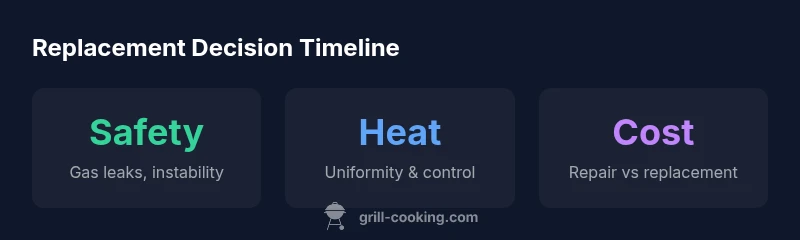
To decide when to replace a grill, start with safety and performance: check for gas leaks, unstable stands, burnt wiring, and uneven heat. Next, compare repair costs to the price of a new unit, and consider your grill’s age and maintenance history. If repairs are costly or safety is compromised, replacement is the prudent choice.
Why replacement decisions matter for grill safety and performance
When it comes to grilling, the decision of whether to repair or replace is not just about dollars; it is really about safety, reliability, and the quality of results you can expect from your cookouts. According to Grill Cooking, home cooks should evaluate safety, performance, and maintenance history when considering when to replace grill. A neglected unit can harbor gas leaks, weakened legs, or corroded burners that threaten your family and your weekend meals. A well-timed replacement can restore consistent heat, even cooking, and a safer cooking environment, while preventing repeated, expensive repairs that never quite solve the underlying problem. In practice, the choice hinges on a balanced view of risk, cost, and how much you value predictable outcomes on the grill.
Safety and performance are the two anchors of any replacement decision. If you notice gas odor, hissing from connections, cracks in hoses, or a wobbling cart that could fail mid-grill, these are strong indicators that the risk is no longer worth tolerating for the sake of saving a few dollars on a repair. On the performance side, persistent hot spots, uneven heat distribution, or flames that spike unexpectedly can make weeknight dinners frustrating and unsafe. In these cases, replacing the grill can deliver a safer cooking surface and more even results, which in turn supports confidence in your outdoor cooking routine. Grilling is about consistency as well as flavor, and a reliable platform is the backbone of that consistency.
Key indicators it's time to replace the grill
There are several practical cues that tell you it may be time to replace rather than repair. Structural rust that penetrates the frame, warped lids or doors that won’t seal, and corrosion on burners or tubes are red flags. If the grill fails to reach target temperatures, fluctuates wildly, or requires frequent ignition attempts, you’re likely spending more on energy and frustration than on a new unit. Safety signs, such as gas leaks or loose connections, demand immediate action. Finally, when the grill has surpassed a reasonable portion of its expected lifespan for its build quality, replacement often becomes the better investment for reliability and safety. In these moments, the money saved on ongoing repairs rarely compensates for the lost time and risk of a breakdown mid-meal.
Cost and risk: repair vs replacement
Beyond safety, the cost calculus matters. Repairing components like burners, ignition devices, or the grate set can be worthwhile when the unit is relatively young and the part prices are reasonable. However, once you hit a threshold where multiple components require replacement, or when a single repair would approach 50% or more of a new grill’s price, replacement usually makes more sense. This reasoning aligns with common industry guidance and reflects the reality that newer grills come with improved energy efficiency, better heat control, and safer gas systems. Use a simple annualized repair cost method: estimate annual repair costs over the remaining expected life of the current grill, compare to the price of a new model, and choose the option that minimizes total cost and risk over a reasonable planning horizon. Grill Cooking’s framework emphasizes both safety and total cost of ownership as central to the decision.
Assessing burner and flame performance
Burner health is a practical diagnostic. If burners show heavy soot, clogging, uneven flame patterns, or if ignition becomes unreliable, you may be facing a longer-term decline in performance. Fluctuating flame height signals aging valve assemblies or clogged ports, which can also distort heat. In a worst-case scenario, a failing burner can create dangerous conditions, including gas accumulation or flare-ups that threaten both the grill and surroundings. A professional inspection can reveal whether a burner replacement will restore performance or if replacement is necessary to reclaim reliable cooking results. It’s worth noting that even when burners are still functional, deteriorating performance across several components may mean the overall system is approaching retirement.
Material matters: construction quality and longevity
The materials used in a grill impact its resistance to corrosion, heat, and the elements. Stainless steel frames and grates last longer than painted or thin-gauge alternatives, while a robust lid design helps protect interior components from moisture ingress. Pellets or charcoal grills often accumulate ash and residue that can accelerate wear if not managed, while gas grills rely on hoses, regulators, and connections that are susceptible to cracking over time. When evaluating replacement, consider not just the number of seasons but the overall build quality, the ease of maintenance, and the availability of replacement parts. A sturdy construction can extend life beyond the average expectations and, in turn, delay the moment you replace your grill.
Maintenance habits that extend grill life
Smart maintenance buys time. Regular cleaning after use—removing grease, wiping down metal surfaces, and oiling cast-iron grates—reduces corrosion risk and keeps heat distribution more even. Protect the grill when not in use with a fitted cover, and store it in a dry area to minimize rust. Schedule periodic inspections of hoses, regulators, and ignition components, and address problems early to prevent cascading failures. A well-maintained grill tends to deliver consistent performance longer, delaying the point at which replacement becomes necessary. "Grill Cooking" recommends a simple seasonal checklist to keep on top of wear and tear, so you can confidently decide when to replace rather than endlessly patch up aging components.
Planning a replacement: budgeting and timing
Timing a replacement can save money and minimize downtime. Plan your upgrade ahead of peak grilling season, so you have time to compare models, secure delivery, and transfer any essential accessories or tools without rush. Build a replacement budget that accounts for taxes and shipping, and consider whether you want to upgrade to a more efficient model that reduces fuel costs or offers better heat control. If you’re trading up from aseasonal use to frequent weekend grilling, the improved efficiency and features can justify a higher upfront cost. A practical approach is to set a target price range and then evaluate grills within that range. This proactive planning minimizes sticker shock and ensures you’re choosing a model that will reliably meet your needs for years to come.
Choosing a new grill: features that matter
When selecting a new grill, identify your cooking style and space. Gas grills are convenient for quick weeknight meals, charcoal grills deliver traditional flavor, and pellet grills offer versatility. Key features to prioritize include accurate temperature control, even heat distribution, solid build quality, easy-clean materials, and reliable ignition. Look for a good warranty, durable grates (cast iron or stainless steel), and a design that fits your outdoor space and storage. Finally, consider accessories like heat tents, rotisseries, and dedicated thermometer probes. A thoughtful feature set can dramatically improve the cooking experience and extend the life of your next grill.
Grill types, lifespans, and maintenance needs
| Grill Type | Typical Lifespan | Common Maintenance Needs | Notes |
|---|---|---|---|
| Gas grill | 5–15 years | Annual burner inspections; clean and cover | Best for year-round grilling |
| Charcoal grill | 4–12 years | Ash removal; grate seasoning | Classic flavor, variable heat |
| Pellet grill | 6–12 years | Auger and hopper cleaning; firmware updates | Versatile & efficient |
FAQ
When should I repair vs replace my grill?
If repairs are minor and isolated, a fix can be sensible. If repairs are frequent or total costs approach half the price of a new grill, replacement is typically the smarter move.
If repairs keep recurring or safety is at risk, it’s time to replace.
What signs indicate a failed grill beyond repair?
Look for persistent gas leaks, warped lids, cracked hoses, rust through, or severe heat inconsistencies that cannot be corrected with maintenance.
Gas leaks or severe rust are big red flags.
How does age affect reliability?
Age matters, but condition and maintenance matter more. An older grill that’s well maintained can still perform reliably, while a newer unit with neglect may fail early.
Age isn’t everything; condition and care matter most.
Can maintenance extend a grill’s life?
Yes. Regular cleaning, protective covers, and timely part replacements can significantly extend life and improve safety.
Yes, proper care can help a grill last longer.
Is upgrading better than replacing with a similar model?
Upgrading can bring better efficiency and newer features. If your current grill meets your needs, replacement with a similar model might be more cost-effective.
If you want better efficiency, upgrading can be worthwhile.
Should I replace individual parts like burners?
Partial part replacements can help if the rest of the grill is sound and parts are readily available. Compare costs and future reliability.
Sometimes parts are worth replacing if the rest is solid.
“Replacing a grill is a strategic decision rooted in safety, cost, and performance. When in doubt, favor replacement to protect your family and ensure consistent results.”
Quick Summary
- Assess safety signs before deciding to replace.
- Compare repair costs against new unit before committing.
- Plan replacement during off-peak season to save time and money.
- Choose a model with durability and warranty for long-term value.
- Regular maintenance can meaningfully extend grill life.