Charcoal Change Timing for Grills: When to Replace
Learn when to change charcoal in a grill with confidence. This guide covers signs, timing, and safe practices to maintain heat, minimize flare-ups, and keep you grilling like a pro.


This guide explains when to change charcoal in grill, highlighting key signs of wear (heat drop, ash buildup, and uneven burning), how often to replace between cooks, and the safest method to add fresh charcoal without starving the fire. You’ll learn to balance heat retention, airflow, and flare-up control for consistent grilling sessions.
Understanding why you change charcoal
Charcoal is the flame’s fuel, and its performance changes as it burns. A grill relies on a steady supply of oxygen and the right particle size to create even heat. Over time, charcoal breaks down into ash that can blanket air vents and choke airflow. If you know the signs, you can decide whether to top off or replace the charcoal, keeping heat consistent and controllable. For home cooks, the question “when to change charcoal in grill” isn’t about a fixed time—it’s about heat, ash, and airflow in real time. The Grill Cooking team emphasizes that proactive charcoal management reduces temperature swings and improves flavor. Grilling experts know that timing a charcoal change is part science, part feel, and part technique.
- Heat consistency matters more than burn time alone.
- Airflow governs how quickly new fuel catches and sustains heat.
- Ash management keeps vents open and predictable temperatures.
How charcoal behaves over a grilling session
Charcoal doesn’t burn evenly from start to finish. Lump charcoal tends to light quickly and burn hotter, while briquettes offer longer burn with more predictable heat. As the session progresses, fuel efficiency declines: you’ll notice a lower average temperature, slower airflow if ash builds up, and more fluctuations in heat as the fire moves from a blue-hot start to a cooler afterglow. In practical terms, you’re asking your grill to re-balance heat and airflow as the fuel source evolves. This is why timing matters: too early a replacement wastes fuel; too late, and the food risks uneven doneness and flare-ups. According to Grill Cooking analysis, a typical medium grill session may require charcoal adjustments to maintain consistent searing versus steady indirect heat.
- Lump burns in bursts with larger gaps between coals.
- Briquettes stabilize heat but require more time to come up to temp.
- Ash layers reduce effective venting and heat transfer.
Signs it’s time to replace charcoal (not just add)
Detecting when to change charcoal is about reading heat, ash, and burn quality. If you reliably see the following, it’s wise to replace a portion of the fuel to refresh heat and airflow:
- Temperature drops quickly after the grill reaches target heat.
- Thick ash covers the briquettes or lump and blocks vents.
- Food cooks unevenly or sits in cooler zones despite vent adjustments.
- Flames become inconsistent or sporadic, signaling limited airflow.
- A noticeable odor of woodsmoke without the familiar charred aroma indicates fuel depletion and inefficient burn.
For accuracy, cross-check by testing a small fresh batch of charcoal in a heat-safe area and observe how quickly air moves and heat builds. The Grill Cooking team notes that frequent small top-offs can keep heat steady without fully rebuilding the fire, but you should replace fuel when ash buildup exceeds an inch or when heat can’t be stabilized by vent tweaks.
- Watch vent openings; if you can’t sustain proper airflow, consider replacing part of the load.
- If the ashes are clumped and blocking the bottom vents, replace the affected fuel pieces.
- When in doubt, err on the side of fresh fuel to restore consistent heating and flavor.
Techniques to extend burn time between replacements
Smart charcoal management can extend burn time and stabilize heat without a full replacement. Here are practical methods:
- Build a two-zone fire: keep a hot zone for searing and a cooler zone for indirect cooking. This reduces the need to constantly chase temperature.
- Use a small top-off rather than a full rebuild. Add a layer of briquettes over hot coals to re-ignite without dumping cold fuel.
- Arrange coals in a rough arc or pyramid so air can circulate; avoid burying all coals under ash, which suffocates heat.
- Manage vents carefully: small adjustments can dramatically affect burn rate and temperature stability.
- Keep a heat-safe thermometer handy to gauge hot and cool zones quickly.
When to top off vs replace charcoal
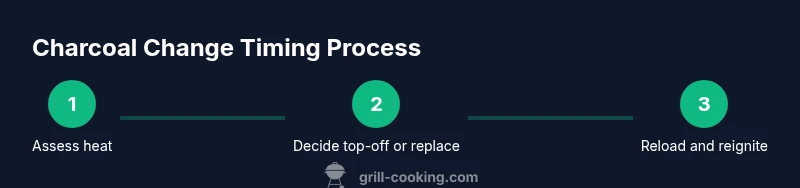
Top-offs are great for extending a cook and saving fuel, but you should replace fuel when the old charcoal is glazed with white ash, heavily caked, or sags under the grate. If you notice persistent low heat, uneven sear, or frequent flare-ups, consider replacing part or all of the fuel. The decision hinges on how much usable heat remains and how well air is flowing through the grate. A common guideline: if ash thickness exceeds 1/4 inch to 1/2 inch on contact points, it’s time to refresh the fuel for more reliable heat and airflow.
- Top off for long cooks with a two-zone plan.
- Replace when ash impedes airflow or heat delivery.
- Assess after preheating: if you can’t reach target temp quickly, fuel may be exhausted.
Lighting and safety considerations
Safe handling is essential when changing charcoal. Always use heat-resistant gloves and long-handled tongs. Start with a chimney starter or electric starter to minimize lighter fluid use. If you must use lighter fluid, never add it to hot coals or during cooking; allow flames to die down before continuing. Never pour water on coals; this damages the grill and can cause dangerous steam. Maintain a clean ash dump and avoid overloading the grill with fuel, which can cause dangerous flare-ups and smoke.
- Use a chimney starter for quick ignition.
- Ventilate the grill properly when adding new fuel.
- Keep a metal bucket nearby for ash disposal.
Practical troubleshooting for common grilling scenarios
Different recipes demand different fuel strategies. For steaks and burgers, you want a hot, direct heat zone; for ribs or chicken, you may rely more on indirect heat and longer burn times. If you encounter stubborn heat drops while cooking vegetables or delicate proteins, a small top-up of charcoal can help you regain proper sear without starving the food of heat. If you encounter unexpected wind or rain, you might need to adjust vent settings more aggressively and consider briefly moving to indirect heat mode to protect the food while you refresh the fuel.
- Sear with a hot direct zone, then finish with indirect heat.
- In windy conditions, close vents gradually to prevent flare-ups and temperature swings.
- For delicate foods, avoid sudden temperature spikes that lead to burning.
Maintenance habits that keep charcoal fresh
Maintaining charcoal readiness is about discipline and routine. After each cook, clean ash from the bottom ash pan and grill grates. Store charcoal in a dry, sealed container to prevent moisture that makes lighting harder. Regularly inspect the grill for vent obstructions and rust that could affect airflow. By keeping your grill clean and your fuel dry, you increase the reliability of your next cook and improve flavor consistency.
toolsMaterialsNameItemsTextAccountForEverythingUnusedImportant
This field will be replaced by actual items in the final output.
Tools & Materials
- Charcoal briquettes or lump charcoal(Choose lump for quick ignition and high heat; briquettes for longer, steadier burn.)
- Chimney starter(For safe, efficient ignition without lighter fluid.)
- Long-handled tongs(Needed to move hot coals and adjust fuel without burn risk.)
- Heat-resistant gloves(Protect hands when handling hot coals and grill grates.)
- Grill brush(Clean grates after cooking; helps even heat transfer.)
- Thermometer (meat + grill ambient)(Useful for quick heat assessment and control.)
- Ash scoop or small shovel(Clean ash and maintain airflow by keeping vents clear.)
- Water spray bottle(Use sparingly for flare-ups; never aim at hot coals unless necessary.)
Steps
Estimated time: 40-60 minutes
- 1
Inspect grill and prep tools
Before lighting, wipe down surfaces and check vents for obstructions. Remove old ash, and lay out the tools you’ll need. A clean starting point helps you gauge heat accurately and avoids contamination from previous cooks.
Tip: Clear the ash bin and vents to improve air flow from the start. - 2
Fill and light charcoal
Fill a chimney starter with your chosen charcoal and light from the bottom. Wait until the coals are mostly ashed over and glowing white at the edges (about 10–15 minutes for lump, longer for briquettes).
Tip: Avoid adding lighter fluid to hot coals; use a dedicated lighter to prevent flare-ups. - 3
Dump and organize the coals
Pour the hot coals into the grill in a rough two-zone arrangement: a dense hot area for searing and a cooler area for indirect cooking. Spread them evenly to promote stable heat.
Tip: Create a curved arc of hot coals for efficient airflow. - 4
Establish vent settings
Open the vents fully at first to establish temperature, then gradually close or adjust to control heat. A steady flame is easier to maintain than chasing a fluctuating fire.
Tip: Tiny vent adjustments have big effects on temperature. - 5
Preheat and test heat
Place the grate on and close the lid for 5–10 minutes to preheat. Use the thermometer to confirm target zones; adjust by moving the coals as needed.
Tip: Aim for a hot zone around 450–500°F for searing, if your recipe calls for it. - 6
Cook with two zones
Sear on the hot zone, then move to indirect heat to finish. Rotate food for even cooking and monitor internal temps to prevent overcooking.
Tip: Use a two-zone approach to avoid burning. - 7
Refresh fuel mid-cook (if needed)
If heat drops too much, top off with a small amount of fresh charcoal or add a fresh batch to extend the burn without re-igniting from scratch.
Tip: Add gradually to maintain control and prevent flare-ups. - 8
Shut down safely
When finished, close vents to starve the fire and let the grill cool. Dispose of ashes in a metal container once completely cool.
Tip: Never pour water on hot coals; it causes dangerous steam and damage.
FAQ
How often should I change charcoal during a long cook?
For long cooks, consider topping off with fresh charcoal to refresh heat without restarting the fire. If ash blocks vents or heat cannot be maintained, replace fuel entirely.
For long cooks, top off to refresh heat, but replace fuel if airflow is blocked or heat cannot be maintained.
Can I reuse partially burned charcoal?
Partially burned charcoal can be reused in some cases, but efficiency and flavor may suffer. It’s often better to start with fresh fuel for consistent heat.
You can reuse some partially burned charcoal, but it may reduce heat consistency and flavor; start fresh if in doubt.
What’s the difference between lump charcoal and briquettes for timing?
Lump heats quickly and can reach high temps fast, but burns faster. Briquettes burn longer and steadier but take longer to light. Choose based on cooking style.
Lump charcoal heats fast but burns out quicker; briquettes last longer but light slower.
Is it safe to add charcoal while the grill is hot?
Yes, but do it with care: use tongs, keep vents stable, and add gradually to avoid flare-ups. Let the fire settle before cooking again.
Yes, but add slowly and use tongs to avoid flare-ups.
How do I prevent flare-ups when adding charcoal?
Spread flames with a light touch, avoid dumping coals all at once, and keep a two-zone setup to shield exposed food.
Avoid adding a big lump of fuel all at once—add gradually while maintaining airflow.
What should I do with ash after cooking?
Let ashes cool completely, then dispose in a metal container. Regularly clean the ash pan to ensure good airflow for future cooks.
Let ash cool, then dispose in metal container and clean out the ash pan.
Watch Video
Quick Summary
- Anticipate heat changes by monitoring ash buildup and vent openings
- Use a two-zone setup to extend burn time and control flare-ups
- Top off fuel for longer cooks, replace full loads when ash blocks airflow
- Practice safe lighting and ventilation for every refuel
- Regular grill maintenance improves fuel efficiency and flavor consistency