Is Grill or Griddle Better? A 2026 Comparison
Discover whether a grill or griddle suits your kitchen. This objective guide compares heat, flavor, versatility, price, and maintenance to help home cooks decide which tool fits their cooking style.


Is grill or griddle better? The quick answer is nuanced: neither tool is universally superior. Grills excel at smoky flavor, char, and outdoor versatility, while griddles deliver a flat, even surface for uniform browning and breakfast-focused cooking. Your choice should reflect your most frequent dishes, available space, and cooking environment. For many home cooks, starting with one and planning a future addition to cover both scenarios is a practical path.
The core differences in cooking philosophy
When you ask is grill or griddle better, the answer hinges on your goals, space, and cooking environment. Grills rely on direct flame and open air to develop smoky flavors, char marks, and a dynamic browning process. Griddles offer a flat surface that heats uniformly, providing precise control for items that benefit from steady contact. According to Grill Cooking, recognizing these foundational differences helps home cooks plan a kitchen setup that supports their most frequent meals. The result is not a single grand winner, but a decision framework: pick the tool that reliably delivers the results you routinely cook, and plan around your most common dishes.
Defining a grill vs griddle
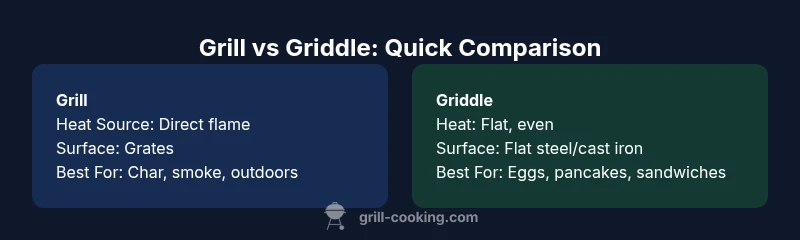
A grill uses grates and an ambient flame source—charcoal, gas, or hybrid setups—to produce high direct heat and that quintessential grill aroma. A griddle is a flat cooking surface, typically seasoned steel or cast iron, that conducts heat evenly across the entire surface. The distinction is not merely hardware; it’s chemistry and technique. Grills create convection and smoke, while griddles emphasize contact and uniformity. Understanding these definitions helps cut through marketing hype and align equipment choices with actual cooking objectives.
Is grill or griddle better? A heat and flavor comparison
- Heat distribution: Grills present uneven heat with hot spots and variances, which is ideal for rapid searing and flavor development but challenging for delicate foods. Griddles deliver uniform heat across a flat surface, supporting even browning for multiple items at once.
- Surface interaction: Grates on a grill promote grill marks and lifting of fats, shaping texture and flavor. A griddle’s flat surface maximizes contact, producing clean searing and smooth browning, especially on foods like eggs or sandwiches.
- Flavor profile: The smoky, charred notes from a grill are a hallmark of outdoor cooking; griddles tend to deliver milder browning without smoke infusion.
- Temperature range: Grills can reach very high temperatures quickly, ideal for quick char; griddles lag slightly behind some grills in peak heat but maintain steadier temperatures for long cooks.
Food categories: what shines on each
Grill-friendly foods typically include high-fat steaks, burgers, kebabs, and vegetables that benefit from char and smoke. Poultry with skin and marbling also respond well to direct heat and flame. Griddles excel with breakfast items (eggs, pancakes), delicate proteins (fish fillets, skinless chicken), and pan-to-plate meals like grilled cheese or sautéed vegetables. The flat surface supports stacking and parallel cooking, which is a time-saving advantage for busy weekends. For many homes, this translates into choosing a grill for weekend burgers and a griddle for weekday breakfasts.
Practical setup: space, budget, and maintenance
Outdoor grills tend to require weather-resilient spaces and proper ventilation. They range from compact portable units to full outdoor islands, and maintenance often involves cleaning grates, seasoning cast iron components, and managing grease. Griddles can be compact enough for countertop use or large as standalone outdoor or indoor options. They require regular seasoning if they are cast iron and careful cleaning to prevent sticking. Budget considerations commonly reveal that a quality grill incurs higher upfront costs when factoring in fuel and accessories, while a griddle’s cost is often correlated with surface material, thickness, and whether it is electric or gas-powered.
Hybrid solutions and simulations
If you want the best of both worlds, consider hybrid options like a grill with a flat-top griddle insert (or a separate griddle plate for indirect heat) or using a cast iron skillet on a grill grate. Some cooks simulate a flat-top surface by placing a large, heavy cast-iron skillet over the heat zone, effectively turning part of the grill into a griddle. These approaches require careful heat management and attention to wind and flare-ups, but they can save space and offer flexibility for a mixed menu.
Weather, environment, and timing
Outdoor grills are influenced by wind, humidity, and ambient temperatures. High winds can create inconsistent heat and flare-ups, while colder climates can slow heat-up times and energy efficiency. Griddles, especially indoor electric models, aren’t susceptible to weather, providing predictable performance. If you live in an area with mild summers, a grill can be a rewarding centerpiece; in tighter spaces or colder climates, a quality indoor griddle can extend your cooking season and reduce weather-related variability.
Decision framework for choosing based on your kitchen
To decide whether is grill or griddle better for you, start by listing your most frequent dishes and their requirements. If you cook a lot of burgers, steaks, and vegetables with smoke flavor, a grill should be primary. If you prepare eggs, pancakes, sandwiches, and delicate proteins, a griddle meets core needs. If you have space and budget, a two-tool setup offers maximum flexibility. If space or budget is tight, prioritize the tool that will handle 60-70% of your weekly meals.
Myths and misconceptions debunked
A common myth is that one tool can flawlessly replace the other. In reality, while you can simulate a griddle on a grill, you will not perfectly replicate flat-top contact across the surface, and you won’t achieve true smokiness on a griddle alone. Conversely, a griddle cannot create the intense, direct heat profile of a well-managed grill. The goal is to understand strengths and limitations and build a cooking plan that leverages both tools where needed.
Actionable next steps: plan your purchase and usage
Begin with an honest kitchen audit: what do you cook most often, what space do you have, and what flavor profile matters most to you? If you decide to buy one now, choose the option that will cover the majority of your weekly meals. For most households, a grill that can participate in weekend meals plus a griddle or flat-top insert can cover two major bases. Finally, consider a phased approach: start with a single workhorse and add the other tool as your repertoire grows. This strategy minimizes risk while maximizing culinary versatility.
Comparison
| Feature | Grill | Griddle |
|---|---|---|
| Heat Source & Surface | Direct flame with grate; uneven heat distribution | Flat, seasoned surface; even heat distribution |
| Flavor & Texture | Smoky flavor, distinct char, grill marks | Even browning, clean sear without smoke |
| Best For | Charred meats, kebabs, vegetables with smoke | Eggs, pancakes, sandwiches, delicate proteins |
| Maintenance | Seasoning required for grates; cleanup varies by fuel | Seasoned surface maintenance; easier cleanup on flat top |
| Space & Setup | Outdoor or well-ventilated area; wind management | Indoor or outdoor option; countertop or portable setups |
| Versatility | Searing, charring, indirect heat with accessories | Flat-top versatility for breakfast to lunch meals |
Strengths
- Grill offers authentic smoky flavor and authentic grill marks
- Griddle provides a large, flat surface for multi-item meals
- Flat-top surface simplifies egg and pancake cooking
- Hybrid solutions expand capability without full separate gear
Negatives
- Grill requires more fuel management and weather considerations
- Griddle lacks smoky flavor and authentic char without adjuncts
- Cast iron griddles require seasoning and ongoing maintenance
- Two-device setups demand more space and budget
Neither option is universally superior; your choice should align with your cooking goals and space.
Choose a grill if you crave smoky flavor and outdoor cooking. Opt for a griddle for breakfast foods, even browning, and indoor versatility. A phased approach or a hybrid setup can deliver best-in-class flexibility.
FAQ
Is grill better than griddle for flavor?
Grills naturally impart smoke and char, delivering distinctive flavor. Griddles offer uniform browning without smoke, which some prefer for consistency. Your flavor preference should guide which tool you prioritize.
Grills give smoky flavors and char; griddles give even browning without smoke. Choose based on which flavor profile you enjoy more.
Can you cook breakfast on a grill or griddle?
Yes. Griddles excel for eggs and pancakes due to the flat surface, while grills can handle breakfast items with careful heat control. Many cooks use both for varied morning menus.
Absolutely—griddles shine for breakfast, but you can cook many breakfast items on a grill with the right setup.
Which is easier to clean: grill or griddle?
Griddles with flat surfaces tend to wipe clean more easily, especially when seasoned. Grills require more attention to grates and flare-ups, but maintenance scales with how you cook.
Griddles usually clean up quicker; grills demand more scrubbing and grate care.
Are electric griddles a good alternative to outdoor grills?
Electric griddles offer indoor convenience and predictable heat but sacrifice outdoor smokiness. They’re great for year-round cooking in limited spaces, while outdoor grills excel at flavor development.
Electric griddles are convenient indoors, but they don’t replicate outdoor grill flavor.
What foods are best on a grill vs a griddle?
Grill best for burgers, steaks, kebabs, and vegetables with char. Griddle shines with eggs, bacon, sandwiches, and delicate proteins that benefit from flat-top contact.
Grill for char and flavor; griddle for breakfast and flat-top cooking.
Can you simulate a griddle on a grill?
You can create a flat surface on a grill using a cast-iron skillet or a flat pan, though heat distribution won’t be perfectly identical to a true griddle. It’s a practical workaround when space or budget are limited.
Yes—use a cast-iron skillet on the grill to mimic a flat griddle when needed.
Should I buy a grill first or a griddle first?
If you cook heavy outdoors and crave smoke, start with a grill. If your priority is breakfast foods and even browning indoors, start with a griddle. A mixed kitchen benefits from having both eventually.
If you cook outdoors, go grill first; if you want even browning at home, start with a griddle.
Quick Summary
- Define your most frequent dishes to guide purchase
- Grill = flavor and outdoor capability; Griddle = even heat and flat-top versatility
- Consider a hybrid approach if space and budget allow
- Maintenance needs differ by surface material and usage
- Plan for weather and environment when shopping for outdoor gear