BBQ Grill vs Griddle: Which Surface Suits Your Cooking?
A rigorous, synthesized comparison of BBQ grills and griddles, covering heat control, flavor outcomes, maintenance, space, and best-use scenarios for home cooks and grill enthusiasts.


bbq grill vs griddle comes down to flavor, heat control, and food type. A traditional BBQ grill relies on live fire for smoky flavor, grill marks, and indirect heat, while a flat griddle delivers a consistent, high-heat surface ideal for breakfast items, burgers, and delicate seafood. Your choice hinges on weather, cleanup willingness, and the kind of cooking you do most.
What is a BBQ Grill vs Griddle?
A BBQ grill and a griddle occupy similar spaces in the outdoor kitchen, but they serve different purposes. A BBQ grill is defined by its grate or grate-pattern surface that allows fats to drip away and smoke to envelop food as flames lick upward. This setup excels at searing, charring, and imparting that classic barbecue flavor. A griddle, by contrast, uses a flat, continuous metal surface—usually cast iron or steel—that heats evenly and remains smooth under high heat. Griddles are exceptionally efficient for quick turning of items like eggs, pancakes, hash browns, burgers, and delicate seafood that may otherwise stick on a ribbed grill. From a design standpoint, grills rely on a flame source (gas, charcoal, or pellet) with varying heat zones, while griddles focus on uniform surface temperature and rapid release of foods that benefit from direct contact with a hot plate. Understanding these fundamentals helps explain why certain foods perform better on one surface over the other and why many cooks eventually want both options in their outdoor arsenal.
Core Differences: Flavor, Heat, and Surface
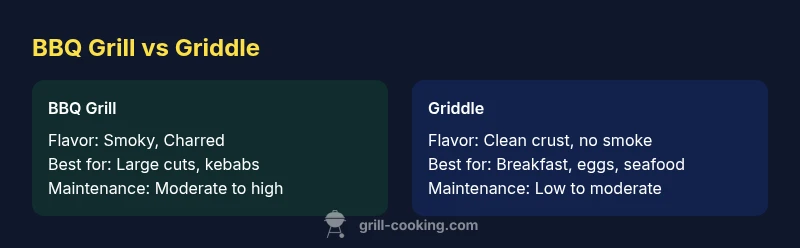
When evaluating bbq grill vs griddle, flavor is often the first deciding factor. Grilled foods gain smoke, char, and depth from dry heat and flame interaction. Griddled foods rely on a direct, even sear from a continuous metal surface, which can produce superior crusts without requiring smoke. Heat control differs between the two: grills typically offer multiple heat zones, letting you sear over high heat while cooking slower in a cooler area. Griddles emphasize a uniform temperature across the entire surface, which helps with predictable results for small or delicate items. Surface design also matters: grills have gaps that allow drippings to sizzle away and create a distinct sear pattern, while griddles provide a seamless, non-stick-friendly platform that is ideal for food that would fall through the cracks on a grate. Finally, maintenance and cleanliness follow suit: grills require more effort to manage ash, grease, and residue from open flames, whereas griddles are generally easier to wipe clean and maintain a consistent non-stick surface over time.
Heat and Flavor: Why Open Flame Matters
Open flame cooking on a BBQ grill introduces variability—wind, heat distribution, and oxygen influence how energy reaches the food. This variability is desirable for flavor development in beef, pork, and larger cuts where a powerful sear followed by indirect heat can finish the roast. Griddles, with their flat surface, offer repeatable browning because the heat is stable and direct. This consistency makes the griddle a favorite for breakfast plates, pan-seared fish, and small vegetables that benefit from a rapid, even crust. Home cooks who prioritize texture over smoke will often lean toward a griddle for weeknight meals, while dedicated barbecue enthusiasts savor the complexity that a grill’s flame can contribute to the final dish. In short, bbq grill vs griddle presents two different flavor and texture paradigms rather than merely two different cooking vessels.
Surface Design and Maintenance
The surface design of a BBQ grill typically involves ribbed grates spaced to allow fat to render and reach the flame for smoke and charring. This arrangement makes cleanup more involved—grease collection, ash disposal for charcoal models, and occasional grate cleaning to prevent stuck-on debris. A griddle’s flat surface is designed for straightforward maintenance. Cast iron surfaces require seasoning to maintain non-stick performance and prevent rust, while steel griddles usually get a quick oil wipe after use. Temperature control is simpler on many griddles, since the surface heats evenly. If you’re cooking for crowds, a grill excels at feeding groups with larger cuts and kebabs that require high heat, while a griddle shines for small portions and precise searing of delicate items. The choice between bbq grill vs griddle should factor in your willingness to maintain and season equipment, as well as your typical menu.
Food Types Best Suited for Each Surface
Choosing between bbq grill vs griddle often comes down to the types of foods you cook most. Grills handle hearty, robust meats—steaks, ribs, chops—and vegetables that benefit from grill marks and smoke. They’re excellent for larger batches that can benefit from a two-zone setup. Griddles, on the other hand, dominate during breakfast service—pansies of eggs, hash browns, and bacon find a perfect home on a flat surface. Pan-seared seafood, delicate items like scallops, and burgers also do well on a griddle when precise temperature control is needed. Many home cooks adopt a hybrid approach: a grill for authentic barbecue flavors and a griddle or plancha for quick, high-heat, surface-first cooking. Ultimately, align the surface with your preferred flavor profile, timing, and cleanup tolerance.
Weather, Space, and Budget Considerations
Outdoor cooking is inherently weather-dependent. Grilling can be more forgiving in cooler months if you have a sheltered area or a smoker that remains lit outdoors. Griddles often suit indoor kitchens or covered patios that lack a robust outdoor cooking setup because of their flat, more compact footprint. Budget plays a crucial role: entry-level grills can be surprisingly capable, while premium models with multiple burners, advanced heat controls, and smoker attachments can command substantial investments. Griddles range from portable, affordable electric units to larger stainless-steel outdoor griddles that can double as a standalone cooking station. When deciding between bbq grill vs griddle, map your climate, space availability, and how much you’re willing to invest in equipment and ongoing fuel costs.
Hybrid Solutions and Accessories
For many cooks, the best answer is a hybrid approach. A traditional grill paired with a griddle or a reversible grate that combines grate sections with a flat surface can deliver the best of both surfaces. Accessories such as smoker boxes, heat tents, or cast-iron griddles that fit over a grill grate allow you to add flat-surface functionality to an existing setup. If you’re short on outdoor space, consider a countertop griddle that can be used indoors or on a small balcony, paired with a compact grill for weekend barbecues. The goal is to maximize versatility without complicating the cooking process. A well-planned setup helps you achieve smoother weeknight meals and more ambitious weekend feasts without sacrificing flavor.
Practical Buying Guide: What to Look For
When evaluating bbq grill vs griddle options, start with your cooking goals. If flavor complexity and outdoor ambiance top your list, prioritize a grill with reliable heat zones, a sturdy lid, and scalable fuel options. For flat-surface reliability, seek a griddle that maintains consistent heat across the surface, has durable seasoning potential, and sufficient clearance for your preferred tools. Pay attention to size, weight, and durability—cast iron surfaces require seasoning and careful storage, while stainless-steel grills resist corrosion but can be heavier and pricier. Consider also maintenance routines: grills demand more frequent cleaning, ash removal, and grate scrubbing, while griddles require regular seasoning and timely oiling to preserve a non-stick finish. Finally, assess fuel type (gas, charcoal, pellet) and availability in your area to estimate ongoing costs and environmental impact.
Real-World Scenarios and Sample Menus
To illustrate bbq grill vs griddle in practice, imagine a weekend cookout featuring brisket, corn on the cob, and grilled vegetables on the grill, paired with a Wednesday skillet-style dinner on the griddle (eggs, sautéed mushrooms, and a pan-seared fish dinner). A day where you want quick breakfasts and lunch sandwiches could lean toward the griddle for bacon and eggs followed by a high-heat burger sear on the grill. If you’re entertaining, prep time matters: a grill can feed larger groups with fewer batches, while a griddle can speed up weekday meals by handling multiple small items at once. The key is to select the surface that aligns with your family’s eating schedule, available space, and how much flavor you want to coax from your meals.
Comparison
| Feature | BBQ Grill | Griddle |
|---|---|---|
| Heat Source | Charcoal/propane/wood pellets with flame dynamics and smoke | Electric or propane with flat, uniform heat surface |
| Surface Type | Ribbed grate with gaps for fat drainage and grill marks | Smooth, continuous flat surface for contact searing |
| Flavor Impact | Smoky, charred flavors from open flame | Crusty, even Maillard browning without smoke |
| Best Use | Beef ribs, steaks, kebabs, larger cuts, vegetables with char | Breakfast items, delicate proteins, high-volume searing |
| Maintenance | Charcoal/grease management, ash disposal, grate cleaning | Surface wipe-down, seasoning for cast iron variants |
| Space and Setup | Typically outdoor; requires ventilation and storage space | Can be indoors or outdoors with adequate room |
| Price Range | $200-$1500+ depending on model and features | $60-$400 for portable or countertop options; larger models more |
Strengths
- Delivers authentic smoky flavor and varied heat zones
- Supports large cuts and social cooking with flame flair
- Griddles provide fast, repeatable searing and easy cleanup
- Hybrid setups maximize versatility without sacrificing flavor
Negatives
- Grills require more maintenance and weather considerations
- Griddles may take more seasoning and careful storage
- Hybrid setups can be more expensive and complex
A well-chosen combination often beats a single-surface setup.
If your priority is flavor and outdoor ambiance, a grill shines. For speed, control, and flat-surface versatility, a griddle wins. For many families, a hybrid approach offers the best of both surfaces.
FAQ
What is the main difference between a BBQ grill and a griddle?
The main difference is how heat is applied and how food browns. A BBQ grill uses open flame and grate to create smoke and char, while a griddle uses a flat, heated surface for uniform searing and simple cleanup.
The main difference comes down to heat and texture: a grill uses flames for smoky char, while a griddle delivers a flat, even crust.
Can you cook breakfast on a BBQ grill?
Yes, you can cook breakfast items like eggs and hash browns on a grill, but a griddle often handles these items more efficiently due to the flat, nonstick surface and ease of turning.
You can, but a griddle usually makes breakfast easier and cleaner.
Is a griddle better for seafood?
A griddle can be excellent for seafood that benefits from a fast surface sear, but many seafood favorites also do well on a grill if you want smoke and grill marks.
Seafood works on both, but griddles offer gentler, controlled searing for delicate fish.
Do grills require more maintenance than griddles?
Grills typically require more ongoing maintenance—ash handling (for charcoal), grease management, and grate cleaning—whereas griddles focus on seasoning and regular surface care.
Yes, grills usually demand more upkeep, including ash and grate cleaning.
What should I consider when buying one?
Consider cooking goals, space, climate, and budget. If you crave flavor, prioritize a grill with good heat zones; if you want ease and speed, a sturdy griddle should be high on your list.
Think about what you cook most, where you’ll use it, and how much you want to spend.
Are there hybrid grills that combine both surfaces?
Yes, there are grills with interchangeable surfaces or accessories that convert parts of the grill into a flat-top area, offering flexibility without buying two separate units.
Hybrid grills exist and can give you both flavor and flat-surface cooking in one setup.
Quick Summary
- Define your cooking priorities: flavor vs speed.
- Consider space, climate, and storage when choosing.
- Budget for maintenance and fuel usage across surfaces.
- Hybrid setups maximize versatility for diverse meals.
- Own both surfaces if you regularly cook a wide range of dishes.