Why Use a Griddle Instead of a Grill? A Comprehensive Comparison
Explore when a griddle outperforms a traditional grill, weighing heat, flavor, and versatility for home cooks. Practical tips, maintenance guidance, and a clear decision framework from Grill Cooking.


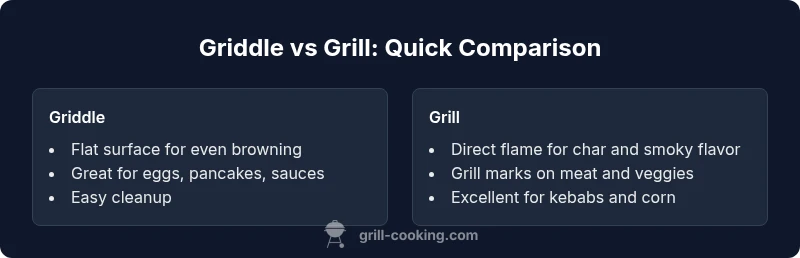
For home cooks choosing between a griddle and a grill, the decision hinges on heat control, surface contact, and flavor goals. A griddle's flat, evenly heated surface delivers consistent browning for eggs, sandwiches, and sauces, while a grill's open flame and grate impart smoky char and grill marks. If you want versatile indoor/outdoor cooking with easy cleanup and uniform results, a griddle offers a clear advantage in many recipes.
The Core Distinction: Griddle vs Grill
If you’re asking why use a griddle instead of a grill, the core distinction is surface design, heat delivery, and control. A griddle presents a flat, continuous cooking plane that heats evenly across its entire surface, enabling uniform browning, saucing capabilities, and minimal sticking with the right seasoning. A traditional grill uses a grate over direct or indirect flame, delivering high-heat searing and distinct smoke flavors but with hotspots and uneven contact that can complicate delicate foods. For home cooks, recognizing these design differences helps tailor your tool choice to a recipe, kitchen space, and fuel type. According to Grill Cooking, the most reliable outcomes often come from leaning into the griddle's predictable surface for certain tasks while reserving the grill for others.
Key factors to consider include surface area, heat distribution, moisture management, flavor development, and cleanup logistics. A flat surface supports continuous contact and easier sauce integration, while a grate provides opportunities for caramelization and char with flames beneath. The choice isn’t binary; many kitchens benefit from having both a griddle and a grill, or a hybrid setup that blends the strengths of each tool.
Use-Cases Where a Griddle Shines
A griddle excels when you need broad contact and control: think eggs and breakfast items, crepes and pancakes, quesadillas, burgers with speedy melt, stir-fries, and sauced dishes that benefit from steady heat. It’s also ideal for vegetables that benefit from fast, even searing without falling through grill slats. Griddles shine indoors on a stovetop or on a dedicated outdoor unit in an outdoor kitchen, where weather won’t interrupt a long, even cook. For sauces, reductions, and one-pan meals, the flat surface lets you manage fond and deglazing without dealing with grill marks or indirect heat limitations.
Another strength is cleanup and maintenance. A smooth, flat surface with proper seasoning is easier to wipe down between tasks, and it minimizes food getting stuck in crevices. For many families, a griddle becomes the workhorse for everyday cooking—pancakes on Saturday, fajitas midweek, and quick searing of sliced proteins for weeknight bowls. Grill Cooking’s guidance notes that the griddle’s versatility makes it a practical centerpiece in compact kitchens or small outdoor setups where space is at a premium.
Use-Cases Where a Grill Shines
Grills excel when flavor and texture take center stage. Direct flames and open air contribute smoky notes, crust formation, and authentic grill marks that many diners associate with outdoor cooking. Grilling is a natural fit for steaks, chicken thighs, kebabs, shrimp, corn on the cob, and veggies like zucchini and peppers that benefit from high-heat charring. The ability to create two zones—hot for searing and cooler for finishing—lets you manage cooking speed and carryover, a dynamic that flat surfaces struggle to replicate. Grills also adapt well to larger gatherings outdoors, where the social aspect and aroma of smoke play into the overall dining experience.
In applications that demand intense heat and quick cooking, a grill often saves time and delivers the sought-after crust. Grilling breads or flatbreads over a hot grate is less practical on a smooth surface, making the grill an essential companion in a diverse outdoor setup. Grill Cooking notes that, in outdoor environments, weather and fuel choice influence performance; however, the core advantage remains the distinctive flavor profile achieved through flame-driven contact.
Heat Transfer and Surface Design: Why It Matters
The physics behind how heat interacts with the cooking surface explains much of the difference between griddles and grills. A griddle provides a large, uniform contact area; when heat is evenly distributed, proteins brown consistently and sauces reduce without being impeded by irregular gaps. Cast iron and carbon-steel griddles can retain heat and deliver stable temperatures, which is crucial for items like eggs and delicate fish where sticking is a risk. Seasoning a griddle creates a natural nonstick barrier and contributes to flavor development over time.
A grill uses grate-supported contact and direct or indirect flame. Heat is more localized, with hotspots that can be exploited for searing while cooler zones enable controlled cooking. The radiant heat from flames adds smoke compounds to the surface, enriching flavor differently from a griddle’s surface chemistry. For home cooks, recognizing where heat is strongest and how it travels across the surface helps you plan cooking strategies, from pretreating proteins to applying oils and sauces at the right moment.
Effects on moisture retention and crust formation also differ. A griddle’s flat plane minimizes steam pockets and dripped moisture, supporting crispy textures in items like hash browns or seared vegetables. Grills encourage moisture loss and crust development via rapid high-heat contact and Maillard reactions across exposed surfaces, which is ideal for robust grill flavors but can challenge delicate items.
Flavor, Texture, and Sauces: How Techniques Diverge
Flavor development depends on surface interaction and moisture management. A griddle allows you to simmer sauces, deglaze directly on the surface, and build a fond for pan sauces without flipping a long string of items. The uniform surface helps with consistent reduction and glaze application, which is particularly valuable for breakfast dishes or saucy proteins. Griddles also facilitate even browning of sandwiches, quesadillas, and pan-fried items that require careful heat control to avoid scorching.
On a grill, the opportunity for smoky aroma comes from fat and drippings meeting flame. Charred edges and grill marks add visual appeal and intensity to meats and vegetables. The flavor profile from a grill is not easily replicated on a flat surface, especially if you’re seeking a strong char and smoke notes. The trade-off is sometimes less control over moisture and a higher risk of uneven browning when cooking multiple items with different thicknesses.
Seasoning and cross-cutting techniques matter for both surfaces. For griddles, consistent heat management, proper oiling, and timely flipping are key to avoid sticking. For grills, managing two-zone cooking, controlling flare-ups, and finishing with a sauce or glaze can yield a chef-quality crust and depth of flavor. Grill Cooking emphasizes that mastering these techniques, rather than relying on a single tool, yields the best overall results.
Setup, Maintenance, and Longevity
A griddle’s maintenance revolves around seasoning, cleaning, and proper storage. After cooking, it’s vital to scrub off residue while the surface is still warm, reapply a thin coating of oil, and heat briefly to polymerize that oil into a protective layer. Regular reseasoning prevents sticking and preserves flavor. Indoor griddles often require attention to power outlets and ventilation, while outdoor units may demand weatherproof covers and periodic checks for rust resistance. The flat surface minimizes crevices where food can hide, but the edges and corners still deserve routine cleaning to prevent buildup.
A grill demands different care: brush the grate after grilling to remove charred bits, perform periodic deeper cleanings to reduce flare-ups, and protect metal components from moisture and rust. Weather and exposure accelerate wear; if you store a grill outdoors, consider coverings and rust-preventive measures. Proper seasoning and maintenance extend the life of a griddle and keep flavors consistent over time. Grill Cooking notes that a well-maintained surface remains an essential part of achieving predictable results, whether you’re cooking family breakfasts on a weekend or hosting a summer BBQ.
In both cases, investing in compatible tools—spatulas with thin edges, sturdy tongs, and heat-resistant gloves—reduces the risk of accidents and improves performance. The decision to invest in a griddle or grill should consider your typical menu, cooking space, and how much you value cleanability versus smoky flavor in day-to-day use.
Practical Decision Framework: Quick Rules of Thumb
To decide whether a griddle or a grill is best for a given task, use a simple framework: 1) Identify the primary cooking objective (even browning vs smoky flavor). 2) Assess the item’s fragility and moisture content (eggs and delicate fish favor a griddle; thick cuts and kebabs benefit from grill heat). 3) Consider space and climate (indoor kitchens and wind-free outdoor areas suit griddles; open-air setups thrive with grills). 4) Factor in maintenance and cleaning time (griddles typically simpler to clean, especially for saucy dishes). 5) If you frequently cook a mix of items, a hybrid approach—using both tools—offers flexibility and improved outcomes. Grill Cooking suggests prioritizing a griddle if your week features multiple glaze-driven or sauced meals, and a grill if you aim for char, crust, and robust flavor profiles.
Applying this framework to menu planning can help you optimize buying decisions and get more consistent results across a range of recipes.
Real-World Scenarios: Menu Planner Guide
When planning weekly meals, map recipes to surface performance. For breakfast-focused days, assign eggs, hash browns, and pancakes to the griddle for even browning and quick cleanup. For a weekend grill-out, reserve the grill for marinated chicken skewers and corn on the cob to maximize smoky flavors and char. For weeknight meals that include sauces, consider using the griddle to prepare components (onions, peppers, sauces) while finishing proteins on the grill if you’re aiming for a crust and a smoky aroma. If you have limited space, a compact griddle can replace several pan tasks while still letting you produce a robust, flavorful crust on proteins when you add finishing heat on a separate burner. By aligning meals with surface strengths, you’ll minimize cross-task confusion and improve overall kitchen efficiency.
Common Myths and Misconceptions
Myth 1: Griddles can’t produce flavor. Reality: Flavor often comes from browning and sauces; a well-seasoned griddle provides depth without relying on smoke. Myth 2: Griddles are only for breakfast. Reality: Griddles excel with pan sauces, seared proteins, and many vegetables, making them versatile for all meals. Myth 3: Grills always outperform griddles. Reality: Grills excel at char and smoke, but griddles offer uniform heat, higher moisture control, and easier cleaning. Myth 4: Indoor griddling is unsafe. Reality: With proper ventilation and a compatible appliance, indoor griddling can be safe and highly controllable.
Comparison
| Feature | Griddle | Traditional Grill |
|---|---|---|
| Heat distribution | Flat, uniform contact across surface | Localized heat with hotspots and flame-driven zones |
| Flavor profile | Less smoke flavor; relies on browning and sauces | Prominent smoky char and grill marks from direct flame |
| Cooking surface | Smooth flat plate (cast iron/steel) | Ribbed grate over flame |
| Best uses | Eggs, pancakes, sauces, delicate proteins | Steaks, burgers, kebabs, charred veggies |
| Cleanup | Easier; simple wipe and reseason | More crevices; requires brushing and scrubbing |
| Versatility (indoors/outdoors) | Excellent indoors and in outdoor kitchens with counter space | Predominantly outdoor; two-zone setups beneficial |
| Maintenance & longevity | Seasoned surface; periodic reseasoning | Regular grate cleaning; rust prevention essential |
| Price range | Moderate to premium depending on material | Budget to premium depending on brand and size |
Strengths
- Even heat across the surface enables consistent browning
- Ideal for eggs, breakfast, and pan sauces with minimal flipping
- Easier cleanup and fewer hard-to-reach corners
- Versatile for indoor and outdoor setups with common surfaces
- Great for cooking multiple items at once on a single plane
Negatives
- Limited smoky flavor compared to direct grilling
- Requires proper seasoning and maintenance to prevent sticking
- Bulkier or heavier setups can be less portable
- Not ideal for grill marks and high-heat flame searing
A griddle excels for even cooking and sauce-friendly tasks; a grill wins for char and smoky flavor.
For many households, a griddle offers broader day-to-day utility, especially for breakfast and saucy meals. A grill remains unmatched for flavor depth and crust. A hybrid setup often delivers the best balance.
FAQ
What foods are best cooked on a griddle versus a grill?
Griddles shine with eggs, pancakes, breakfast meats, sandwiches, and dishes that benefit from even heat and sauce work. Grills excel for steaks, chicken thighs, kebabs, and vegetables that benefit from a smoky crust and charred edges.
Griddles best for eggs and sauces; grills best for char and smoke.
Can I use a griddle indoors?
Yes, provided you have a kitchen setup that supports a compatible indoor griddle or range-top griddle. Ensure proper ventilation and follow manufacturer safety guidelines for extraction and clearance.
Yes—many kitchens use indoor griddles with proper ventilation.
Do griddles produce less flavor than grills?
Griddles generally produce less smoky flavor than grills because there is no direct flame contact. You can compensate with sauces, searing techniques, and finishing with a brief high-heat finish on a grill if available.
Less smoke, more control. You can add flavor with sauces and finishing heat.
Is seasoning important for a griddle?
Seasoning is essential for cast-iron or steel griddles to maintain a nonstick layer and improve flavor over time. Regular oiling and light heating after cleaning help preserve the surface.
Seasoning keeps it nonstick and flavorful.
What should I consider when buying a griddle?
Consider surface material (cast iron vs steel), thickness, indoor vs outdoor use, heat output, and whether you want a built-in or standalone unit. A well-seasoned surface and uniform heat distribution are key factors.
Look for durability, heat evenness, and seasoning potential.
How do I clean and maintain a griddle?
Clean while warm to remove food debris, wipe with a nonabrasive cloth, and reapply a light coat of oil after drying. Periodically reseason to restore the nonstick layer and prevent rust.
Keep it clean and oiled to maintain performance.
Quick Summary
- Choose a griddle for even heat and sauce-friendly cooking
- Reserve the grill for char, crust, and smoky flavors
- Assess space, fuel, and cleaning when deciding to buy
- A hybrid approach can maximize versatility and outcomes
- Regular seasoning and maintenance extend surface life