What to Do If Your Grill Won't Light
Urgent, step-by-step guide to diagnose and fix a grill that won't light. Practical checks, safety tips, and when to call a pro from Grill Cooking.


Most grills won’t light because of a simple ignition or fuel-supply issue. Start by confirming the propane tank is open and the line is connected, the regulator isn’t blocked, and knobs are turned to ignite. Ensure the igniter is sparking and the burners are clean. If gas reaches the burners but won’t ignite, follow the diagnostic flow below.
Common Causes When a Grill Won’t Light
According to Grill Cooking, the most common reasons a grill won’t light are a fuel-supply problem or an ignition issue. A drained propane tank, a closed or kinked hose, or a faulty regulator can stop gas from reaching the burner. The ignition system may fail if the electrode is dirty, wiring is worn, or the spark module is cracked. Also, burner tubes may be clogged with grease, food debris, or spider webs. Knowing these culprits helps you triage quickly rather than guess. Start with the simplest fix: confirm gas flow, verify that the igniter sparks, and inspect burners for debris. If the grill still won’t light after these checks, move to the diagnostic flow below.
Pre-Light Setup: Quick Prep Checks
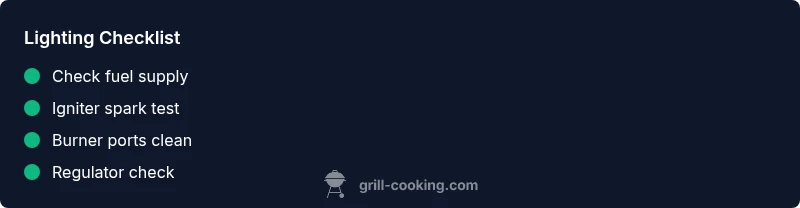
Before you blame the grill, step through these quick prep checks. Make sure the tank is not empty and open; confirm the line is connected; inspect hoses for cracks or kinks; verify the regulator lever is not closed. Confirm the control knobs are in the off position, then turn to ignition and count a few seconds while watching for a spark. If your grill uses push-button battery ignition, replace the battery or test by pressing the igniter with the hood open to isolate ignition. Finally, inspect the burner’s ports for grease buildup and scrub with a stiff brush.
Diagnostic Approach: Quick Checks and When to Move On
This section guides you through a flow: Is there a spark? Is fuel reaching burners? Are ports blocked? Start with spark; if no spark, fix igniter or electrode; if spark present but no flame, check gas supply; if gas flow is correct but flame still won’t light, clean the burner ports; test again. If you smell gas, immediately turn off the valve and air out the area; contact a pro if you can't locate the leak.
Safety, Maintenance, and When to Call a Pro
Lighting a grill is a potentially dangerous task when gas is involved. Always ensure good ventilation, keep flame away from your body, and have a fire extinguisher nearby. If you suspect a gas leak, turn off the tank, extinguish open flames, and call your local fire department or a licensed technician. For routine maintenance, clean burners, replace worn igniter parts, and inspect hoses for cracks. If the problem persists after basic checks, don't push your luck—professional service can prevent leaks and ensure safe operation.
Pro Tips for Reliable Lighting
Build a small pre-light routine: verify fuel, inspect ignition, and wipe burner ports clean. Regularly brush the burners, clean the burner ports, and replace worn igniters every season. Keep spare igniter batteries handy for quick swaps. Store propane tanks upright and off the ground; never store a tank indoors or near heat. With these habits, you’ll reduce the chances of a no-light moment and keep grilling hot, safe, and enjoyable.
Steps
Estimated time: 20-30 minutes
- 1
Verify fuel supply and valve position
Check the propane tank level, confirm the valve is fully open, and ensure the gas line is connected securely. If you have a disposable tank, swap it if it feels light. Listen for a hiss when you open the valve, but never rely on sound alone to confirm flow.
Tip: If you smell gas, turn off everything and move to a safe outdoor area before rechecking. - 2
Test ignition and spark
Turn the knobs to ignition and watch for a visible spark at each burner. If you don’t see a spark, the igniter or its wiring may be damaged. Replace the igniter battery if applicable and test again.
Tip: Open the hood to give the flame room to light and to observe the ignition more clearly. - 3
Inspect burner ports and clean
Remove the grate and access plates; use a stiff brush or a pin to clear clogged ports. Look for grease, debris, or spider webs. After cleaning, inspect the burner for any warping or damage.
Tip: Avoid using metal tools that can scratch or bend ports; gentle brushing works best. - 4
Check regulator and hoses
Inspect hoses for cracks, brittleness, or kinks. If you notice any damage, replace the hose or regulator per manufacturer guidelines. Do a simple leak test using a soap-water solution on connections—if bubbles appear, there’s a leak.
Tip: Never test a gas system with an open flame; use soapy water to detect leaks safely. - 5
Reassemble and test lighting
Reinstall any panels, reattach hoses, and attempt a light. If there’s no flame, proceed to professional help rather than forcing a light. Always keep a safe distance and watch for flare-ups.
Tip: If the grill lights briefly then goes out, recheck the regulator and thermistor if present. - 6
If still no light, call a pro
If you’ve exhausted basic checks and the problem persists, power down the system and consult a certified technician. Do not continue attempting to light a grill that appears unsafe.
Tip: Document any symptoms, such as smells or unusual sounds, to help the technician diagnose.
Diagnosis: Grill won't light even when gas is on and igniter is pressed
Possible Causes
- highGas supply issues (empty tank, closed valve, or disconnected line)
- highIgnition system failure (worn igniter, dirty electrode, or faulty spark module)
- mediumBurner ports clogged or obstructed
- lowRegulator or hose leak/defect
Fixes
- easyOpen fuel supply; reconnect or replace tank; test gas flow
- easyClean or replace the igniter/electrode; ensure spark jumps to burner
- easyClean burner ports and rerun ignition; remove grease, debris; scrub with stiff brush
- mediumInspect regulator and hoses for leaks/defects; replace if damaged
FAQ
What is the most common reason a grill won't light?
The most common issues are fuel supply problems or ignition failure. Start with the tank and valve, then test the igniter and burners.
The most common reasons are fuel supply problems or ignition failure. Start with the gas tank and valve, then test the igniter and burners.
Why won't my gas grill ignite even though the propane tank is open?
Check the regulator, hoses, and igniter. Ensure there are no leaks and that the burner ports aren’t clogged.
If the tank is open but it won’t ignite, inspect the regulator, hoses, and igniter, and look for clogged burner ports.
How can I tell if the ignition electrode is faulty?
If you don’t hear or see a spark when pressing the igniter, the electrode or wiring may be worn. Replace as needed.
If there’s no spark when you press the igniter, the electrode might be faulty and should be replaced.
Can debris or spider webs stop a grill from lighting?
Yes. Debris can clog burner ports and obstruct gas flow. Clean burners and ports regularly.
Yes, debris can block gas flow. Clean burners and ports regularly.
When should I call a professional?
If you smell gas, hear hissing, or can’t locate the issue after basic checks, stop and call a licensed technician.
If you smell gas or can’t identify the issue after checks, stop and call a professional.
Is it safe to keep using a grill that won’t light?
No. Do not continue trying to light it; shut off gas supply and seek a safe, professional diagnosis.
Not safe to keep trying—shut off the gas and have a pro diagnose.
Watch Video
Quick Summary
- Check fuel supply and valve position first
- Confirm ignition spark before diagnosing gas flow
- Clean burner ports to prevent obstructions
- Test for gas leaks and call a pro if needed