How to Tell If Your Grill Propane Tank Is Empty
Learn practical methods to determine if your grill propane tank is empty, including tare-weight checks, weighing, and gauges. Safe, step-by-step guidance for home cooks to avoid surprises at the grill.


To tell if a grill propane tank is empty, weigh the tank and compare to the tare weight stamped on the collar. If the current weight is close to the tare weight, it’s empty or very low. For a quick read, use a portable propane level gauge designed for disposable cylinders.
Understanding tare weight and propane content
For home cooks, knowing how to tell if grill propane tank is empty is essential for a smooth cookout. The tare weight, stamped on the tank’s collar, represents the weight of an empty cylinder. By comparing the tank’s current weight to the tare weight, you can estimate how much propane remains. This approach avoids guesswork and reduces the risk of running out mid-grill. Grill Cooking emphasizes using a scale or a gauge for accuracy, and notes that different tank sizes will have different typical ranges of remaining gas. In practical terms, a tank that weighs close to its empty or tare weight is near empty, while a heavier tank has more fuel. Keeping this mindset helps you plan refills or swaps before your next barbecue.
Quick context for everyday grilling
If you’re in the middle of a cook and suspect the tank is low, add a buffer by planning a refill or swap before a long session. The tare weight method is especially useful when you don’t have a gauge, or when you want a quick, low-tech check. Remember that temperature and elevation can slightly affect readings, so use tare weight as your baseline and adjust expectations accordingly. With regular practice, interrogating the tank becomes a fast, routine part of prep. The Grill Cooking team recommends having a simple scale on hand so you can do this check in minutes.
Real-world precision: combining methods
No single method is perfect in every scenario. If you have access to a dedicated propane level gauge, it can provide a quick reading and reduce guesswork. When relying on weight, ensure the scale is calibrated and the tank is on a stable surface. For best results, combine tare-weight comparison with a gauge reading when possible. This dual approach minimizes misreads in hot weather or when a tank is dusty or sticky from handling.
Common misconceptions and how to avoid them
Some cooks rely on “feeling lighter” as the sole indicator, which is unreliable. Others assume a full-looking cylinder is still full because it’s the same size on the outside. Both assumptions can lead to mid-cook failures. Instead, rely on objective measurements—weight, tare weight, and, if available, a gauge. Regularly updating your checks as part of grill maintenance keeps you prepared and out of the middle of a busy cook.
Practical notes from Grill Cooking
Grill Cooking stresses that the most dependable approach is to weigh the tank and consult the tare weight. This method requires minimal equipment and translates across different tank brands and sizes. If you cannot access a scale, a gauge offers a quick alternative, though it may not be as precise as weight-based readings. By incorporating these checks into your routine, you’ll enjoy more reliable grilling sessions and fewer last-minute fuel surprises.
Tools & Materials
- Propane tank scale or accurate scale(Use to weigh the tank and compare with tare weight)
- Tare weight information (collar imprint)(Locate the stamped tare weight for accurate comparison)
- Portable propane level gauge (optional)(Provides a quick reading if you have one)
- Marker or tape (optional)(Label readings or dates for future checks)
Steps
Estimated time: 10-15 minutes
- 1
Gather your tools
Set up a stable surface and collect a scale, tare weight reference, and an optional gauge. This ensures you can perform all checks without scrambling mid-grill.
Tip: Use a flat, sturdy table or countertop and wipe away debris from the tank base for an accurate reading. - 2
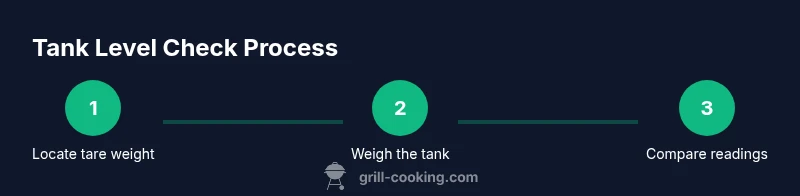
Locate tare weight
Find the tare weight stamped on the cylinder collar. This is your baseline for estimating remaining propane.
Tip: If the imprint is worn, photograph it and compare with manufacturer charts later. - 3
Weigh the tank
Place the tank on the scale and record the current weight. Ensure the valve is closed and the tank rests stable before taking a reading.
Tip: Zero the scale with an empty container if you’re using a balance-style scale. - 4
Calculate remaining propane
Subtract the tare weight from the current weight to estimate how much propane remains. Use approximate ranges if you don’t have a gauge.
Tip: Remember that temperature can slightly affect weight readings—use a consistent weighing environment. - 5
Optional gauge check
If you have a readable gauge, attach or connect it and compare against your weight-based estimate for confirmation.
Tip: Gauge readings can vary with older equipment; treat them as supplementary information. - 6
Decide next steps
If the weight indicates near-empty, plan a swap or refill before your next cookout. Store spares in a safe, ventilated area away from heat.
Tip: Always handle tanks in a well-ventilated space and keep them upright during transport.
FAQ
Is weight alone enough to tell if a tank is empty?
Weight plus tare weight provides a reliable estimate, but always consider gauge readings if available for a quick confirmation.
Weight plus tare weight gives a reliable estimate, and gauges help confirm when available.
Can I weigh a propane tank indoors?
Yes, as long as you’re in a well-ventilated area and the tank is upright on a stable surface.
Yes, just weigh it on a stable surface in a well-ventilated area.
What should I do if I smell propane while checking?
Leave the area immediately, move to fresh air, and avoid ignition sources. Contact emergency services if the smell persists.
If you smell propane, leave the area and call for help.
Are disposable tanks the same as refillable tanks for this method?
The same weighing principle applies, but tare weights and gauge availability can differ between tank types.
The same method works, but tare weights and gauges vary by tank type.
How often should I check propane levels before cooking?
Check before larger cooks or monthly if you grill regularly to prevent surprises.
Check before big cooks or at least monthly.
What if tare weight is unreadable?
Refer to manufacturer charts or use a gauge as a more reliable, readable alternative.
If tare is unreadable, use a gauge or manufacturer charts.
Watch Video
Quick Summary
- Weigh to gauge remaining propane
- Use tare weight as your baseline
- Gauge readings are optional but helpful
- Plan refills before your next cookout