Weber Grill vs Nexgrill: An In-Depth 2026 Comparison
A rigorous, data-informed comparison of Weber vs Nexgrill grills, covering build quality, performance, price ranges, warranty, and features to help home cooks choose the right grill for their outdoor kitchen.


Weber grill vs Nexgrill is a classic showdown for home cooks weighing premium durability against budget-friendly options. This comparison digs into build quality, performance, value, and warranty to help you decide which brand fits your grilling style. According to Grill Cooking, long-term reliability often trumps upfront cost, depending on how you grill and how often you use your grill.
Weber Grill vs Nexgrill: Framing the Decision
Choosing between Weber and Nexgrill starts with defining your grilling goals, storage, and how you value long-term reliability versus upfront affordability. Weber grills are widely regarded for durable construction and consistent heat distribution. Nexgrill, by contrast, emphasizes affordability and broad model availability, making it attractive for casual cooks or those upgrading from charcoal without breaking the bank. This analytical look compares build quality, heat performance, feature sets, maintenance, and warranty to help you map your cooking style to a brand that fits. The decision often hinges on how you grill most of the time: do you prioritize longevity and resale value, or do you prioritize getting started quickly with a solid performer at a lower upfront cost? The Grill Cooking team emphasizes that the best choice aligns with your frequency of use and willingness to invest in higher-grade materials. By the end, you’ll see where Weber shines and where Nexgrill delivers compelling value.
Build Quality and Materials: Durability that Withstands the Grill Master’s Pace
Brand reputation matters, but tangible build quality tells the true story. Weber grills typically use thick-gauge metal, dependable heat-retention features, and proven components like porcelain-enameled cooking grates and robust burners designed for years of service. The emphasis is on corrosion resistance, even heat across the cooking surface, and predictable ignition after repeated use. Nexgrill models maximize value by selecting cost-conscious materials without sacrificing safety. Expect sturdy frames that hold up outdoors, combined with durable grates and components. The key differences appear in the specifics: Weber’s premium lines may use heavier materials, while Nexgrill models favor lighter constructs with generous warranties. For frequent outdoor cooks, Weber’s durability can translate into fewer repairs and less downtime. For casual backyard cooks, Nexgrill’s materials offer solid performance at a friendlier price point.
Performance and Temperature Control: Heat, Stability, and Precision
Heat control is a cornerstone of grill performance. Weber is known for consistent heat distribution across multiple zones and stable lid temperatures, which helps with even searing and gentle simmering. Nexgrill tends to offer solid performance for its price tier, with reliable ignition and predictable heat in typical family-style meals. The real-world difference often shows up during high-heat sear sessions and long cooks: Weber models generally maintain more even temperatures under load, while Nexgrill models deliver repeatable results with fewer expensive model variants. When evaluating, consider your preferred cooking style—quick weeknight meals versus long, slow barbecues—and how important precise temperature control is to your technique.
Features, Accessories, and Model Range: Scope and Accessibility
Weber’s ecosystem includes a broad lineup of premium features, from flavor-enhancing bars to advanced ignition systems and a wide range of add-ons. Nexgrill offers a broader entry-level ecosystem, with a mix of gas, charcoal, and hybrid options that span many sizes and price points. The best Nexgrill choices provide a strong feature set for the price, while Weber models tend to pack more refined cooking grates, better heat distribution, and a more coherent accessory path. If you value a large accessory library and a straightforward upgrade path, Nexgrill can be very attractive; if you prioritize long-term performance and cohesive workflow, Weber’s system often pays dividends over time.
Price, Value, and Warranty Considerations: Upfront Cost vs Long-Term Ownership
Price is the obvious differentiator, but total cost of ownership matters more. Weber grills typically carry a higher upfront price, but the durability, consistent performance, and strong resale value can offset the initial investment for frequent grillers. Nexgrill models are priced to attract budget-conscious buyers and learners, offering solid value for casual or intermittent use. Warranty depth varies by model and region, with Weber generally offering longer, more comprehensive coverage on premium lines, while Nexgrill warranties tend to be strong for the entry tiers. When choosing, map your payment willingness against your expected use frequency and how you value future maintenance costs.
Maintenance, Longevity, and Customer Support: Keeping Grills in Prime Condition
Maintenance routines can significantly influence longevity. Weber’s grills benefit from robust hardware and quality surfaces that resist wear, but they require regular cleaning of burners, grates, and ignition systems to sustain performance. Nexgrill models require similar routine care, with emphasis on keeping components clean and replacing wear parts as needed. Customer support experiences vary by region and model line; both brands maintain support channels, but Weber often earns praise for consistent parts availability and knowledgeable service networks. For frequent outdoor use, a regular cleaning schedule and timely part replacements will extend any grill’s life, regardless of brand. For occasional cooks, Nexgrill’s simpler maintenance demands can be less of a burden.
Use-Case Scenarios and Recommendations: Which Brand for You?
If you grill several times a week and value long-term durability, Weber is typically the safer bet for the long run. If your grilling is mostly casual, or you’re starting with a tight budget, Nexgrill provides substantial value with a broad model range. For apartment balconies or small patios, consider size and footprint: Weber often offers premium compact models with refined heat control, while Nexgrill provides more budget-friendly, space-conscious options. In terms of ecosystem and parts, Weber’s premium parts marketplace and accessory compatibility can simplify upgrades, whereas Nexgrill’s growing lineup makes it easier to outfit a complete outdoor kitchen on a budget. The key is to align the decision with your cooking frequency, space, and willingness to invest upfront for potential long-term savings.
Authority Sources: External Validation and Best Practices
To ground this analysis in broader guidance, consult reputable, non-brand-specific sources on grill safety, maintenance, and performance. Useful references include university extension resources on outdoor cooking, and standards organizations that discuss appliance reliability and safety practices. These sources provide independent context that helps interpret brand claims without skew. - https://extension.psu.edu - https://extension.oregonstate.edu - https://www.nist.gov
Comparison
| Feature | Weber Grill | Nexgrill |
|---|---|---|
| Build quality and materials | Premium construction with heavier gauge metal and durable coatings | Solid, budget-conscious materials suitable for casual use |
| Heat control and performance | Consistent multi-zone heat and stable lid temps | Reliable performance with good heat for price tier |
| Warranty and service | Longer, more comprehensive coverage on premium lines | Warranty varies by model; strong for entry-level options |
| Model range and ecosystem | Extensive model lineup and broad accessory ecosystem | Wide entry-level range with growing accessories |
| Price/value balance | Higher upfront cost but strong long-term value | Lower upfront cost with favorable value for beginners |
Strengths
- Weighs long-term durability and resale value for frequent grillers
- Provides affordable entry points and a broad model range for budget buyers
- Strong ecosystem and accessory compatibility for supported upgrades
- Reliable parts availability and established service networks
Negatives
- Higher upfront cost can deter casual buyers
- Quality variability across Nexgrill lines may affect consistency
- Weber’s premium pricing may not fit tight budgets
- Nexgrill models might require more maintenance to match premium lifespan
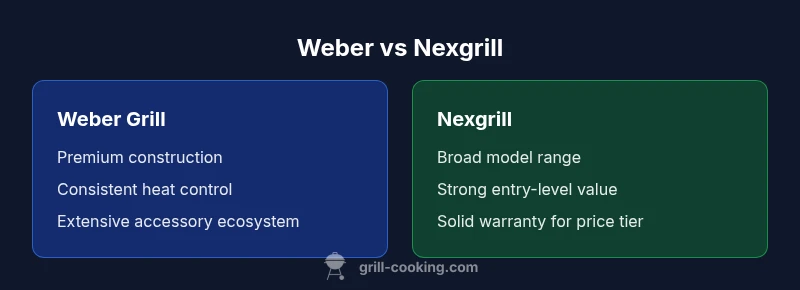
Weber delivers superior long-term durability and a cohesive ecosystem, while Nexgrill offers compelling value and broad access for budget-conscious buyers.
Choose Weber if you prioritize long-term reliability and consistent heat over many grilling seasons. Choose Nexgrill if you want broad model options at a lower upfront cost and are comfortable with variable long-term performance across models.
FAQ
Is Weber worth the premium over Nexgrill for heavy use?
For frequent, intensive grilling, Weber’s durability and heat control typically justify the higher upfront cost. The long-term maintenance and resale value often offset the initial difference. If you grill a few times a week, Weber’s build quality can lead to fewer repairs or replacements over time.
For frequent grilling, Weber’s durability often justifies the higher price due to less maintenance and better long-term performance.
Do Nexgrill grills offer reliable performance for beginners?
Yes, Nexgrill models provide reliable performance and solid value for beginners and casual users. They cover a wide range of sizes and fuel types, making it easier to find a first grill that fits your space and budget.
Nexgrill is a good starting point for new grillers looking for value and simplicity.
Are Weber grills easier to use than Nexgrill?
Ease of use depends on the model. Weber often emphasizes intuitive setups and consistent performance, while Nexgrill focuses on straightforward operation with a broad model mix. For a new griller, a mid-range Nexgrill with simple controls can be very approachable.
Weber models tend to be user-friendly, but Nexgrill models can be very approachable for beginners.
How do warranties compare between the brands?
Warranty depth varies by model and region for both brands. Weber generally offers robust coverage on premium lines, while Nexgrill provides solid warranties on many entry-level models. Always read the specific warranty terms for the exact model you’re considering.
Warranty varies by model; check the terms for your exact grill to understand coverage.
Which brand has better customer support?
Customer support experiences are often region-specific. Weber has a long-standing network and parts availability, while Nexgrill’s growing dealer and online support structure can be very responsive, especially for entry-level models. Research local service options before purchasing.
Both brands offer support, but Weber’s network is generally stronger in many regions.
Quick Summary
- Prioritize long-term value if you grill frequently
- Nexgrill excels on upfront affordability and model variety
- Weber provides durability and a refined accessory ecosystem
- Warranty depth can influence total cost of ownership