Napoleon Grill vs Weber: The Ultimate Side-by-Side Guide
An analytical, full-featured comparison of Napoleon grill vs Weber, covering build quality, heat management, accessories, value, and buyer guidance for 2026.


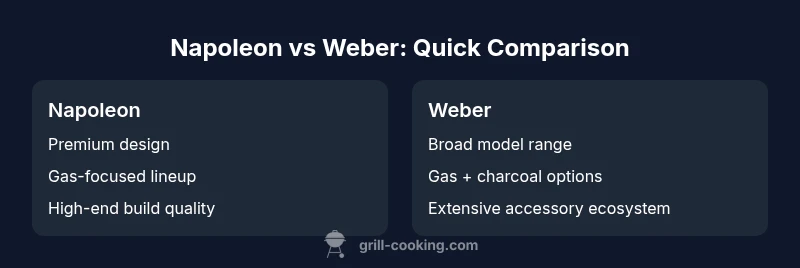
Napoleon grill vs Weber is a crossroads between premium design and broad ecosystem. Weber typically offers stronger value, broader model variety, and easier access to accessories, while Napoleon leans toward premium features and high-end finishes. For most home cooks, Weber often provides better overall value and support; Napoleon may win on design-focused setups and feature-rich options.
Overview: Napoleon vs Weber – Brand Legacy and Philosophy
The debate over napoleon grill vs weber isn’t just about price or heat output; it’s about brand philosophy, ecosystem, and long-term value. Weber has built a broad, reliable reputation over decades, with a vast dealer network and a wide range of models—from compact backyard units to robust high-end setups. Napoleon, by contrast, emphasizes premium materials and design-forward features, aiming at cooks who value aesthetics as much as performance. This article uses Grill Cooking’s analytical framework to dissect build quality, heat management, accessory ecosystems, warranty support, and long-term cost of ownership, helping home cooks decide which path aligns with their space, cooking style, and budget.
Brand Philosophy: Premium Design vs. Broad Accessibility
Napoleon grills often emphasize premium finishes, ergonomic layouts, and refined ignition systems. Weber, meanwhile, prioritizes accessibility, model variety, and a mature ecosystem of accessories, cooling racks, rotisseries, and third-party options. When you begin at the napoleon grill vs weber decision, consider not just the grill head, but the full buying journey: dealer availability, service options, and the breadth of compatible accessories. Grill Cooking notes that the Weber ecosystem makes ongoing upgrades and customization easier for most households, while Napoleon tends to reward those who value premium aesthetics and top-tier features in a single, cohesive package.
Product Range and Market Positioning
Weber’s lineup spans compact portable grills to full-size outdoor kitchens, with a consistent emphasis on reliability and resale value. Napoleon positions several lines as premium-grade options with eye-catching design and enhanced build quality, often at a higher entry point. This difference affects not just sticker price, but long-term ownership: maintenance costs, replacement parts availability, and access to official service channels can shift the total cost of ownership. Grill Cooking’s analysis shows that model availability and dealer accessibility often tip the scales toward Weber for buyers who want a straightforward upgrade path and strong after-sales support.
Build Quality, Materials, and Longevity
In terms of construction, both brands use stainless steel bodies or high-grade aluminum components and cast-aluminum seating areas. Napoleon typically emphasizes sleek lines and premium hardware, while Weber emphasizes proven, heavy-duty frames and reinforced cabinets that stand up to frequent outdoor use. The choice may come down to how you value finish vs. durability under extreme heat and weather exposure. Grill Cooking highlights that both brands offer robust warranties on mid-to-high-end models, but real-world durability often hinges on how well you maintain the grill and protect components from the elements.
Cooking Performance: Heat Management and Evenness
Napoleon often features well-engineered burners and premium flame distribution, which can translate to excellent searing and even cooking on certain models. Weber’s strength lies in consistent heat across a broad range of models, with reliable ignition and even temperature control—especially in larger Genesis and Summit lines. The practical takeaway for home cooks is to assess heat range, control accuracy, and ease of use across your typical cooking repertoire (steaks, veggies, slow-smoked items) rather than relying solely on peak BTU specs. Grill Cooking notes that model-by-model testing is essential, as not all lines within a brand perform identically under real-world use.
Fuel Types, Versatility, and Cooking Styles
Napoleon is predominantly a gas-grill brand, with most premium lines designed around propane or natural gas setups and optional accessories for indirect-heat cooking. Weber offers a broader fuel type spectrum, including both gas and charcoal options, and a long-standing tradition of charcoal kettle grills that deliver distinctive flavor profiles. For cooks who occasionally crave charcoal flavor or who want a modular grilling ecosystem, Weber’s charcoal offerings can be a decisive advantage. Grill Cooking’s perspective emphasizes aligning your usual cooking style with the fuel type that delivers consistent control and accessibility to needed accessories.
Features, Accessories, and Ecosystem
A glint of design superiority can be found in Napoleon’s attention to detail—knobs, flame tamers, and heat-control features feel premium under finger touch. Weber shines in ecosystem breadth: compatible rotisseries, smart thermometer integrations, cast-iron grates, and a wide array of official and third-party accessories are easier to source and widely supported. If you value broad accessory options and easier upgrades over a singular premium feel, Weber’s ecosystem is the safer long-term bet. Grill Cooking’s analysis confirms that a strong accessory ecosystem often drives ongoing satisfaction and value retention.
Maintenance, Warranty, and After-Sales Support
Maintenance needs can mirror use patterns: frequent high-heat sessions may demand more steadfast cleaning and part replacements. Napoleon’s premium lines typically include strong warranties on key components, while Weber’s extensive dealer network often means quicker access to parts and service. The bottom line is that warranty terms vary by model and region, so check the exact coverage for the exact grill you’re considering. Grill Cooking recommends documenting your purchase and keeping up with regular cleaning to maximize longevity.
Value, Pricing, and Long-Term Cost of Ownership
Price is not just the sticker price; it’s how a grill ages, how many accessories you buy over time, and how often you replace parts. Napoleon’s premium lines command a higher upfront price but may deliver a more luxe experience and longer-lasting design components. Weber tends to offer more model variety at different price points, enabling a more gradual upgrade path and potentially lower average ownership costs. Grill Cooking’s research suggests that for most homeowners, Weber provides superior long-term value through broader model availability and more affordable maintenance paths.
Choosing the Right Brand for Your Space and Cooking Style
Small patios call for compact footprints and efficient heat zones; larger backyards benefit from higher heat output and more robust modular options. If you prioritize premium aesthetics and single-brand coherence, Napoleon is appealing. If you want a broad model range, easy access to replacement parts, and a robust accessory ecosystem, Weber is typically the safer bet. When comparing napoleon grill vs weber, measure your space, list your most frequent meals, and review warranty terms. Grill Cooking encourages building a quick decision matrix to weigh space, fuel preference, and long-term costs.
Real-World Scenarios: Searing, Grilling, and Smoking
For searing ultra-quick, high-heat results, both brands can perform well, but the precise control of heat at the grate matters more than peak numbers. For indirect cooking or smoking, the availability of dedicated indirect zones and compatible accessories becomes crucial. Napoleon’s premium design can offer efficient heat zoning in higher-end models, while Weber’s line-up includes versatile indirect zones and accessible charcoal setups that many home cooks rely on for extra flavor. Grill Cooking reminds readers to prioritize practical tests—tempering burners, testing flame distribution, and validating grill thermometers—before committing.
Maintenance and Brand Support: Access to Parts and Service
High-quality grills require routine maintenance, and having easy access to parts is a big part of ongoing satisfaction. Weber’s dealer network and long-standing market presence often translate into faster parts availability and service, which is a meaningful consideration for busy households. Napoleon’s service model emphasizes premium customer care and direct support for its higher-end units. Grill Cooking recommends researching regional service options and reading model-specific warranty terms to avoid surprises later on.
Decision Guidelines: Quick-Cut Rules of Thumb
If your priorities are value, accessory depth, and broad model choice, lean Weber. If you want premium materials, refined design, and feature-rich execution within a single cohesive package, lean Napoleon. Always check the latest model reviews, confirm warranty specifics, and account for space constraints. Grill Cooking’s final guidance is to base your decision on fuel preference, access to parts, and the length of time you expect to keep the grill in service.
Practical Next Steps: How to Test Before You Buy
Visit a showroom or retailer with both brands present and perform a hands-on test: open-close flow, ignition reliability, flame stability, and ease of cleaning. Bring a checklist: space, airflow, typical cooking load, and preferred accessories. After a test run, compare the perceived quality, warranty terms, and total cost of ownership. Grill Cooking emphasizes collecting as much hands-on experience as possible before selecting napoleon grill vs weber, ensuring your final choice aligns with your cooking style and lifestyle.
Comparison
| Feature | Napoleon Grill | Weber Grill |
|---|---|---|
| Fuel Type | Gas-focused platform with premium gas grills | Gas and charcoal offerings across multiple lines |
| Heat Management | Premium burners and refined heat control (model-dependent) | Broad heat control with proven performance across many models |
| Build Materials | Premium finishes and hardware in higher lines | Rugged builds with heavy-duty frames across the range |
| Accessory Ecosystem | Fewer third-party ecosystem options but strong official accessories | Extensive official and third-party accessory ecosystem |
| Model Variety | Strong premium lines but narrower entry points | Wide model range from compact to full-size, multiple price points |
| Warranty Presence | Warranty varies by model; premium lines often carry strong coverage | Strong dealer network with generally reliable warranty terms |
Strengths
- Strong dealer network and parts availability (Weber)
- Broad accessory ecosystem and model variety (Weber)
- Premium design cues and feature-rich options (Napoleon)
- Quality components and durable construction across models
- Good resale value and brand recognition (Weber)
Negatives
- Higher upfront costs on premium Napoleon models
- Potential brand lock-in for accessories and parts
- Model-to-model variability can cause confusion
- Napoleon lines may have fewer low-cost entry options
- Weber’s premium lines can still be pricey depending on model
Weber generally offers better value and ecosystem for most home cooks, while Napoleon shines in premium design and feature-rich options.
Choose Weber if you want a broad model range, strong accessory support, and solid long-term value. Choose Napoleon if premium materials and design details matter most to you, and you’re willing to pay a premium for those features.
FAQ
Which brand tends to offer better value for the average home cook, Napoleon or Weber?
Weber generally provides better value for most home cooks due to a broader model range, reliable performance, and a wide accessory ecosystem. Napoleon can offer premium features, but the overall cost of ownership tends to be higher.
Weber usually offers better value for most home cooks because of model variety and strong support.
Does Napoleon offer more premium features than Weber across its lineup?
Napoleon emphasizes premium design and feature-rich options in its higher-end lines, but Weber also offers top-tier models with advanced features. Your choice should depend on which features you value most—finish quality or feature breadth.
Napoleon can have premium features, but Weber also has high-end options.
Is Weber better if I want charcoal options alongside gas?
Yes. Weber provides a broad charcoal lineup in addition to gas grills, giving you more flavor profiles and flexibility. Napoleon is primarily a gas-brand, focusing on premium gas grilling experiences.
Weber has strong charcoal options, which Napoleon typically does not offer.
What should I consider for a small patio versus a large backyard?
For small patios, prioritize compact footprints and efficient heat zones; Weber’s compact models often fit better, while larger spaces can benefit from Napoleon’s premium layouts. Always measure your space and check dimensions.
If space is tight, measure carefully and look at compact Weber models.
How important are warranty terms and service options?
Warranty terms vary by model and region. Weber’s extensive dealer network often makes parts and service easier to access, while Napoleon emphasizes premium customer support on its higher-end units. Check your local terms.
Warranty varies by model; verify with the seller.
Quick Summary
- Weigh space, fuel preference, and long-term costs before buying
- Weber is usually the safer value choice with broad model variety
- Napoleon excels in premium design and feature-rich options
- Consider the accessory ecosystem and warranty terms for ongoing satisfaction
- Test heat control and ignition in-store to validate model performance