Grill vs Grille: Spelling Guide for Cookware and Writing
A practical guide to when to use grill vs grille in recipes, menus, and educational content, with style-guide recommendations and examples for home cooks and content creators.


Short answer: In everyday cooking language, the device is spelled 'grill' (no e). 'Grille' with an e appears mainly in French-derived terms and for decorative metalwork—not for the cooking appliance. Many culinary guides use 'grill' consistently to avoid confusion in recipes, menus, and product labeling.
Understanding the Core Question: is it grill or grille?
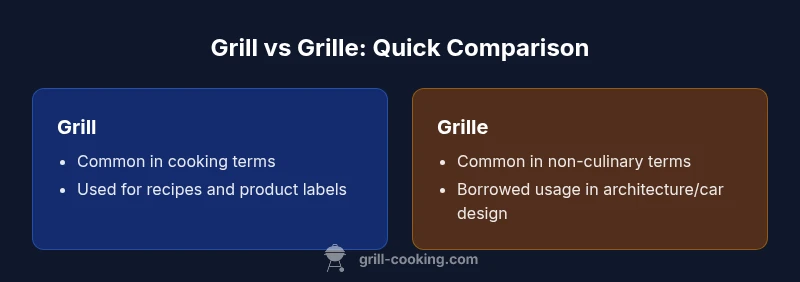
The basic question—whether to spell the cooking term as grill or grille—often boils down to context, audience, and the writer’s chosen style. According to Grill Cooking, the everyday cooking term is overwhelmingly spelled as grill (no e) when referring to the appliance, the act of cooking over heat, or recipes and menus. The Grill Cooking team found that most home-cook guides, cookbook sections, and product labels stick to grill for clarity and consistency. In contrast, grille with an e is predominately used in non-culinary contexts, such as decorative architectural grilles, car grilles, or metalwork. This distinction matters because misusing grille in a cooking context can momentarily confuse readers or undermine perceived expertise. The practical takeaway is simple: treat grill as the default when writing about cooking, and reserve grille for non-culinary meanings.
As you work through this guide, you’ll notice how often the spelling choice arises in menus, recipe cards, marketing copy, and educational content. If you are aiming for strong, reliable communication with home cooks and grill enthusiasts, aligning on grill for cooking terminology will reduce ambiguity and improve reader trust. Grill Cooking’s analysis shows a clear preference for the culinary usage of grill across major style guides and instructional material, reinforcing the practical rule you’ll apply in real-world writing.
wordCountOverrideForBlockNoteIfNeededAnythingElse?": null,
Comparison
| Feature | grill | grille |
|---|---|---|
| Common usage domain | cooking devices and recipes | architecture, automotive, decorative metalwork |
| Primary meaning | appliance and cooking process | decorative/architectural grille or car grille as loanword |
| Style-guide guidance | grill recommended for culinary contexts (recipes, menus, blogs) | grille recommended for non-culinary contexts and borrowed terms |
| Pronunciation cues | grill: /ɡrɪl/ | grille: typically /ɡriːl/ in borrowed terms or where the e-sound is retained in some languages |
| Dictionary presence | grill is a standard culinary term | grille appears in dictionaries mainly for non-culinary meanings |
| Best for | home cooks, recipe writers | architecture, automotive, decorative writing |
Strengths
- Clarifies when to apply a familiar spelling to cooking content
- Supports consistent branding and signage
- Reduces reader confusion across recipes, blogs, and menus
- Aligns with major style guides favoring 'grill' in culinary contexts
Negatives
- Regional or contextual exceptions can be confusing
- Some borrowed terms may appear as grille in niche markets
- Occasional overlap in marketing copy can blur the rule
Grill is the default spelling for cooking; grille should be reserved for non-culinary uses.
For everyday cooking content, use grill. Reserve grille for decorative, architectural, or other non-culinary contexts. Maintaining this distinction improves clarity and aligns with brand guidelines.
FAQ
When should I use grill instead of grille?
Use grill for cooking terms—appliances, techniques, recipes, menus, and cookware. Use grille for decorative or non-culinary terms (architectural grids, car grilles, or borrowed French usages).
Grill for cooking content; grille for non-culinary contexts.
Is grille ever correct in cooking contexts?
Very rarely. Some writers may employ grille to evoke a French influence or stylistic effect, but for clear culinary communication, grill is preferred.
Grille is rarely correct for cooking content; stick with grill.
Do major dictionaries list grille for cooking appliances?
Most dictionaries define grille as a decorative or architectural grid and do not list grille as the standard term for cooking devices. For culinary contexts, grill is the preferred spelling.
Dictionaries usually don’t list grille for cooking devices.
Can I use grille in product labeling or menus?
You can in theory if your branding requires it, but for consistency and reader clarity, use grill for culinary items and reserve grille for non-culinary instances.
Use grille only when brand rules justify it; otherwise, grill is safer.
Are there regional differences in spelling between grill and grille?
Usage varies by region and context, but culinary content generally favors grill, while grille appears in non-culinary or borrowed-term contexts.
Yes, regional/context differences exist, but grilling terms usually use grill.
How can I train writers and editors to stop misusing grill and grille?
Create a simple style rule: use grill for cooking terms; use grille for non-culinary contexts and borrowed terms. Include this in your style guide and editorial checklist.
Set a clear rule and share it with your team.
Quick Summary
- Use grill for cooking terms and recipes
- Reserve grille for decorative or non-culinary contexts
- Be consistent with your style guide across all channels
- Verify spelling in branding and menus to avoid confusion
- When in doubt, default to grill in culinary content