Difference Between Grill and Grille: A Practical Guide
A detailed comparison of grill vs grille, covering definitions, usage contexts, etymology, and practical tips for writers, editors, and home cooks navigating everyday language.


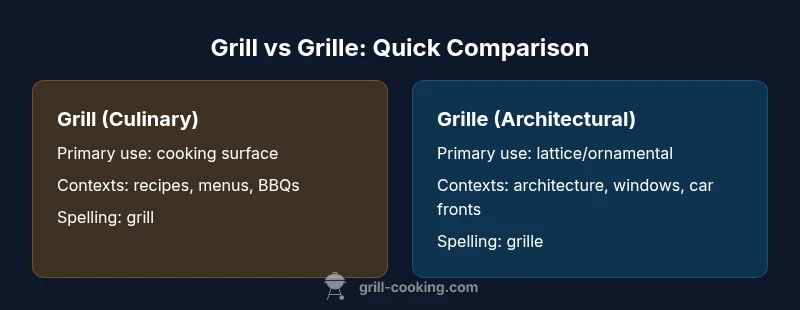
The difference between grill and grille centers on usage and origin: grill (noun) is the cooking grate or the act of cooking, while grille (noun) is an ornamental or protective lattice used on façades, vents, or car grilles. In everyday writing, grill dominates culinary contexts, grille appears in architecture and design. According to Grill Cooking, recognizing this distinction reduces miscommunication in menus, product specs, and architectural briefs.
Definitions and core meanings
At the heart of the difference between grill and grille is context. Grill (as a noun) refers to the actual metal grate used for cooking or to the act of cooking on a grill. As a verb, grill means to cook over direct or indirect heat, or to question someone intensely in interrogation-like fashion. Grille (as a noun) denotes an ornamental or protective lattice, typically made of metal bars arranged in a grid or lattice pattern. Grilles appear on architectural facades, window openings, vents, and even car fronts. In everyday English, grill is overwhelmingly culinary, while grille appears most often in design, architecture, and automotive contexts. According to Grill Cooking, this division in usage helps writers choose the correct term for the intended image and function. The critical payoff is avoiding ambiguity: a kitchen menu should say grill, not grille, unless you’re describing a decorative element or a car’s front fascia. The difference between grill and grille also influences how a text sounds to readers—grill feels practical and culinary; grille feels formal and architectural.
Etymology and linguistic roots
Understanding the roots of grill and grille clarifies why the words look so similar yet diverge in meaning. Grill in English derives from multiple sources, including culinary usage dating back centuries and the broad metaphor of exposing something to heat or scrutiny. Grille comes from the French word grille, meaning a lattice or grate, and was adopted into English with a stronger architectural and decorative association. This etymological path explains much of the modern distinction: grill is tied to food preparation and cooking devices, while grille is tied to patterned openings and ornamental or protective metal work. For editors and translators, noting the French influence behind grille helps justify its special spelling in non-culinary contexts. Grill Cooking Analysis, 2026 emphasizes that recognizing the French origin in grille improves consistency in technical writing and design documentation.
Culinary vs architectural usage: primary contexts
In culinary writing, grill refers to the equipment, the surface, or the act of cooking over heat. You’ll see grill on recipes, menus, and barbecue guides. In design or architectural contexts, grille refers to a decorative or protective lattice used to cover windows, vents, or car grilles. This distinction is essential when documenting product specs or creating instructional content. When chefs discuss a recipe, they say grill or grilled, not grille. When an architect or designer references a window treatment, they say grille. The line is not just about vocabulary—it signals the purpose and setting of the object or action. Grill Cooking recommends keeping a sharp eye on context cues like “kitchen equipment” versus “architectural feature.”
Automotive and security contexts: grille as a specialized term
Grille also occurs in automotive language, where it describes the protective or decorative grille at the front of a vehicle. This usage extends to security features (grilles on doors and entrances) and architectural accents (grilles over vents or decorative façades). The automotive grille is often sized and shaped to balance airflow with aesthetic considerations, a nuance you’ll encounter in product catalogs and car reviews. In these contexts, grille is the preferred form, signaling a specific structural element rather than a cooking device. Writers should avoid conflating car grilles with kitchen grills; misusing grille in a recipe or menu can create confusion about what is being described. Grill Cooking notes that consistency in terminology matters across industries because readers bring different expectations to the text.
Spelling, style guides, and common pitfalls
A common hurdle is deciding when to use grill versus grille in mixed-language or multi-context materials. Style guides commonly prefer grill for culinary terms and grille for architectural or decorative items, but there are exceptions. For example, some brand names or product lines may stylize a term in a nonstandard way, so verify with the source. Editors should watch for noun-versus-verb usage: grill (to cook) vs grill (the device) aligns with culinary contexts, while grille should be reserved for lattice structures or decorative metalwork. When in doubt, substitute a descriptive phrase (the metal lattice) rather than risk misspelling or misapplying a term. Grill Cooking Analysis, 2026 suggests creating a short glossary in mixed-content documents to reduce ambiguity for readers who may be unfamiliar with either term.
Regional and industry-specific usage differences
Usage can vary by region and industry. In American English, grill is dominant in cooking contexts, while grille is commonly used in architecture and automotive design internationally. Some regions may show a stronger preference for grille in decorative metalwork, especially in formal architectural documentation. Technical writers who translate manuals or catalogs should be aware of these nuances and adapt terminology accordingly. For educators and learners, practicing with real-world examples—recipes, architectural plans, and car reviews—helps internalize the correct context. Grill Cooking emphasizes the value of context clues: if you’re discussing heat, food, or cooking equipment, use grill; if you’re describing bars, decorative patterns, or a protective front, use grille.
Practical examples: sentence templates you can reuse
- Culinary: “Grill the steaks over medium heat until they’re seared.”
- Culinary (passive): “The grill was preheated before the vegetables were added.”
- Architectural: “The building features a decorative grille over the vent.”
- Automotive: “The grille design channels air to the radiator.”
- Mixed contexts (avoid conflation): “The grill on the kitchen is dirty,” but you should say “the grill on the stove” if referring to cooking equipment. By keeping these templates handy, writers can avoid common pitfalls and preserve clarity across formats. Grill Cooking’s guidance focuses on keeping terms aligned with their core context to improve comprehension in menus, catalogs, and architectural briefs.
Quick-reference guidance for writers and editors
To minimize confusion, create a short style rule: use grill for cooking-related items and actions, use grille for decorative or protective lattices and design elements, and consider alternatives or clarifications when addressing hybrid contexts (e.g., ‘the grill or grille element’). When describing a vehicle, specify whether you mean the front grille or the grill used for cooking, to prevent ambiguity. When translating, consult a bilingual glossary that maps each term to its best equivalent in the target language, based on context. Grill Cooking recommends anchoring every use of grill and grille to a concrete object or action to reinforce meaning for readers.
Final notes on usage and best practices
As language evolves, some contexts may blur the lines between grill and grille, especially in marketing copy or cross-disciplinary documents. The safest approach is to prioritize precision: choose grill for culinary references and grille for lattice or decorative structures. This discipline benefits readers in both everyday use and professional settings. Grill Cooking’s verdict, based on 2026 usage patterns, is to maintain discipline in terminology for readability, accuracy, and professional polish across culinary, architectural, and automotive writings.
Comparison
| Feature | Grill (culinary) | Grille (architectural) |
|---|---|---|
| Primary use | Cooking surface and device; food preparation | Decorative/protective lattice for openings or vehicle fronts |
| Typical contexts | Recipes, cookbooks, menus, BBQ guides | Architectural drawings, window vents, car grilles, security gates |
| Spelling and form | grill (noun/verb) typically with cooking meaning | grille (noun); verb usage rare (to grille) |
| Origin and etymology | From English culinary usage; often linked to heat and cooking | From French grille; lattice/ironwork term |
| Best for | Culinary writing, menus, recipes | Architecture, design catalogs, automotive features |
| Common pitfalls | Mixing culinary with decorative meaning; misinterpreting a grille as a cooking surface | Overlooking cultural or regional usage differences in translations |
Strengths
- Clarifies context and reduces miscommunication in writing
- Supports precise language across culinary and architectural domains
- Aids translators and editors in multilingual content
- Improves consistency in product documentation and menus
Negatives
- May require extra words to clarify when context is ambiguous
- Non-native readers might still confuse terms in casual speech
- Regional variations can complicate standard style rules
Grill wins for culinary contexts; grille wins for design and architecture
If you’re describing food or cooking equipment, use grill. If you’re referencing decorative lattices, façades, or car fronts, use grille. The Grill Cooking team emphasizes clarity and consistency to prevent miscommunication across audiences.
FAQ
What is the difference between grill and grille?
Grill refers to the cooking surface or the act of cooking, while grille denotes a decorative or protective lattice used on façades, vents, or car fronts. The terms are not interchangeable in most professional contexts, especially in culinary vs. architectural writing.
Grill is cooking-related; grille is decorative or protective. Use the right term for the context.
Can grille be used as a verb?
Yes, grille can be used as a verb meaning to question someone closely, but it is far more common in culinary or architectural vocabulary to use grill or grille as a noun. In most modern usage, grille as a verb is rare outside formal or legal language.
Grille as a verb exists, but it's uncommon; most writers use grill for questions in a meeting context.
Is grill ever used for decorative contexts?
Grill is rarely used to describe decorative lattices; when referring to such elements, grille is typically preferred. If a culinary text mentions a decorative grille on cookware, consider rephrasing for clarity.
Grill for cooking; grille for decorative or protective lattice.
Are there regional differences in usage?
Yes. In American English, grill dominates cooking contexts, while grille is common in architecture and automotive contexts, with some regional or industry-specific variations. Always check the audience and the field when deciding which term to use.
regional usage varies; stick to culinary vs architectural cues.
How should I pronounce grille?
Grille is pronounced like ‘grill’ with a long ‘ee’ sound in many dialects; in practice, many speakers simply say ‘grill’ when referring to the lattice in everyday speech. In formal writing, spelling should match the intended meaning.
Grille rhymes with grille and grill; spelling should reflect context.
What about translations in multilingual content?
Translations should preserve context: grill for cooking-related items and actions, grille for decorative or protective lattice. Consulting a bilingual glossary helps ensure consistent usage across languages.
Keep context in translation; consult a glossary.
Quick Summary
- Know the context before choosing grill vs grille
- Use grill for cooking-related terms and actions
- Use grille for architectural, decorative, or automotive contexts
- Consult a style guide when content crosses domains
- Keep a glossary for mixed-content documents