Open vs Closed Lid: A Practical Guide to Grilling Techniques
Explore when to grill with the lid open or closed. This in-depth comparison covers heat, searing, moisture retention, timing, and safety for home cooks.


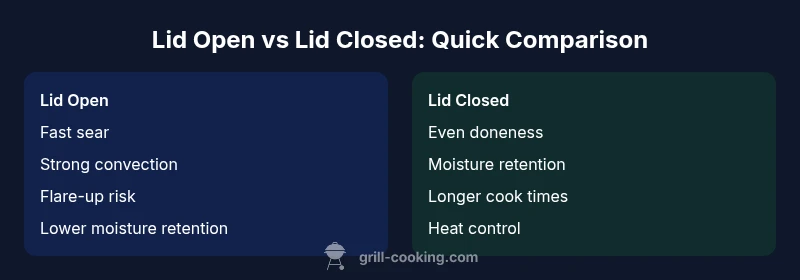
Is it better to leave grill open or closed? The short answer is nuanced: there isn’t a universal rule. The choice depends on heat, time, and the food. Open-lid grilling (lid up) is ideal for fast searing and flame management, while closed-lid grilling (lid down) promotes even cooking and moisture retention for thicker cuts. Grill Cooking’s analysis emphasizes adapting the lid position to the food and goal rather than sticking to one default.
The core question is practical for every cook
For many home grills, the decision between leaving the lid open or closed hinges on two things: how hot your grill is and how thick the food is. According to Grill Cooking, the lid is not a luxury but a tool that changes air flow, heat distribution, and moisture loss. The Grill Cooking team found that novice cooks often use the lid like a light switch—on or off—without adjusting for food type. In reality, is it better to leave grill open or closed depends on your goal: speed, sear, evenness, or moisture retention. Start with a clear objective (searing, finishing, roasting) and then choose lid behavior that supports it. The approach should be flexible, not dogmatic, because different grill designs—gas, charcoal, and pellet—respond differently to lid position. For the modern backyard, understanding the balance between lid position and flame exposure is the fast track to better results.
How heat and airflow interact with lid position
Heat on a grill is never a single number; it’s a system of radiant heat, convection, and contact with the cooking surface. With the lid open, convection is strong and heat rises rapidly, which is useful for quick charring and high-heat finishes. With the lid closed, you trap heat and create a micro-oven effect, enabling gentler, more uniform cooking. Grill Cooking’s tests show that lid-down cooking reduces spikes in surface temperature, which helps when you’re cooking thicker steaks, bone-in cuts, or roasts. The trade-off is you may sacrifice some of the dramatic surface sear you can achieve with lid-up methods. The key is recognizing when to exploit each mode to reach the desired internal doneness while avoiding uneven results.
When you might want the lid open for searing and flame control
Opening the lid gives you direct access to the flame, allowing quick surface caramelization and browning. This is particularly useful for thin steaks, burgers, and vegetables that benefit from a bold finish in minutes. The open-lid method also gives you tactile control: you can see flare-ups and manage them with a quick adjustment of vents or flipping the food. For very high-heat grills, an initial lid-open sear can create dramatic grill marks, followed by a short lid-down phase to pull heat into the center. Grill Cooking recommends using short, controlled bursts of lid-open heat to avoid excessive moisture loss and burning.
When you should keep the lid closed for even cooking
Closed-lid grilling creates a stable, even temperature that helps cook thicker cuts and tougher connective tissue. This approach minimizes surface moisture loss and encourages uniform doneness from edge to center. For roasts, bone-in ribeyes, pork shoulders, and chicken pieces with bone, the lid-down method reduces the risk of undercooked centers. It’s also advantageous for foods that benefit from gentle simmering under heat, allowing intramuscular fat to render slowly. The Grill Cooking team emphasizes preheating the grill, maintaining consistent heat, and timing the finish with a quick lid-open check as needed.
Food-type considerations: meat, fish, and vegetables
Different foods respond differently to lid position. Lean fish fillets, when placed on a hot surface, can benefit from brief searing with the lid down to preserve moisture, then finish with a quick lid-open finish to avoid overcooking. Vegetables often do well with lid-open temperatures or a partial lid-down to balance char with tenderness. Thick cuts of meat—like steaks, roasts, or pork shoulders—generally respond best to a lid-down strategy for most of the cook, then a brief open-lid finish at the end to maximize crust formation. The goal is to tailor lid behavior to the protein’s geometry and fat content.
Cooking methods tied to lid position: reverse sear, indirect heat, and smoke
Some techniques intentional rely on lid position for success. A reverse-sear approach starts with lid down to bring the interior to temperature, then finishes with a high-heat lid up sear for crust and color. Indirect-heat cooking relies on the lid to trap heat and guide the meat through a longer cook without direct flame contact. Smoking or low-and-slow sessions use a closed lid to conserve heat and smoke exposure for depth of flavor. Understanding these methods helps you choose when to open or close the lid based on the culinary objective rather than habit alone.
Practical step-by-step guidelines for choosing lid position
- Preheat and plan: decide your target internal temperature and cut size. 2. Start with a lid position that matches your goal: lid-open for sear, lid-closed for finish. 3. Watch for visual cues: crust formation, smoke density, and color. 4. Flip and reposition as needed to manage hotspots. 5. Use vents and fuel management to maintain a stable environment. 6. End with a quick check and, if needed, a short finish with either lid position to reach the final doneness. 7. Always consider food safety and resting before slicing.
Flavor and moisture outcomes: does lid position affect taste
Lid position dramatically influences flavor development and moisture retention. Searing with the lid open yields bold surface char, while closing the lid retains more moisture and enhances uniform doneness. The Maillard reaction benefits from high surface temps, which lid-open grilling can deliver, but the risk of moisture loss is higher. Conversely, lid-down cooking preserves juiciness and allows flavors to penetrate deeper, especially with thicker pieces or fatty meats. The key is balancing crust, interior doneness, and moisture through deliberate lid use.
Safety, energy use, and maintenance considerations
Safety should guide your lid decisions as well. Leaving the lid off can increase flare-ups if grease accumulates, while keeping it closed during high heat can trap heat and cause unintended flame-ups if the grill isn’t monitored. Energy efficiency can improve with a closed lid for longer cooks, but you’ll want to monitor for overheating. Regular cleaning of grates and vents is essential to maintain consistent airflow and temperature control, regardless of lid position. Grill maintenance supports predictable outcomes and reduces the risk of cooking errors.
Common mistakes and how to fix them
Common errors include flipping too often, opening the lid too frequently, and ignoring hotspot behavior. Fixes include planning a heat map of your grill, using two-zone setup, and giving foods time to rest after removal from heat. Another frequent pitfall is relying on time alone rather than checking the internal temperature with a reliable thermometer. Remember that lid position is a flexible tool: use it to dial in doneness without sacrificing crust or moisture.
Real-world scenarios: applying lid position to weeknight and weekend meals
For weeknight chicken thighs, a brief lid-down phase to bring the exterior into safe temperature range, followed by a quick open-lid finish, yields crisp skin and juicy meat. For a weekend ribeye, start with a high-heat sear lid-open, then a longer lid-down cook to finish through with even doneness. For salmon, a light lid-down approach during initial cooking can protect moisture, then lift the lid for a final glaze or crust. The key is adapting to your grill’s heat curve and the cut’s geometry.
Putting it all together: a practical decision framework
Use the lid position as a dial rather than a rule. Start with the food type and thickness, then choose lid position to control heat, moisture, and surface texture. If the objective is a crust and quick finish, begin with lid-open and end with a brief lid-down rest. If the goal is uniform doneness through thick cuts, begin with lid-down and flip to lid-up for a finishing sear if needed. With practice, you’ll instinctively adjust lid behavior to reach target doneness with optimal flavor.
Comparison
| Feature | Lid-open grilling (lid up) | Lid-closed grilling (lid down) |
|---|---|---|
| Heat retention | Lower heat retention; faster temperature shifts | Higher heat retention; steady, even temps |
| Airflow control | Strong convection; more flare-ups risk | Constrained airflow; smoke and flavor confined |
| Sear quality | Excellent for quick sear and flame-kissed crust | Good sear later; crust may be less intense at first |
| Evenness of cooking | Less even for thick cuts | Excellent for even cooking, especially indirect heat |
| Moisture retention | Moisture can be lost faster | Better moisture retention during longer cooks |
| Cooking time | Shorter cook times for thin cuts | Longer, slower cooks for thick cuts |
| Best for | Thin steaks, burgers, quick finishes | Thick cuts, roasts, bone-in meats, smoking |
Strengths
- Allows rapid surface browning and crust formation when lid is up
- Provides consistent cooking for thick cuts with the lid down
- Offers flexibility to switch modes as cooking progresses
- Helps manage flare-ups through controlled airflow and timing
Negatives
- May cause moisture loss and uneven doneness if used incorrectly
- Can lead to overheating if not monitored on closed settings
- Requires vigilance to avoid over-reliance on one method
- Some grills have hotspots that interact differently with lid position
Lid-down grilling is the generally safer default for even cooking and moisture control; lid-up excels for fast searing and quick finishes.
Choose lid-down for thicker cuts, roasts, and longer cooks. Use lid-up for high-heat searing and fast-paced finishes. Adapt based on the food and grill type for best results.
FAQ
When should I grill with the lid open versus closed?
Use lid-open when you want rapid surface browning or flare control for thin cuts. Switch to lid-down when you need even heat and moisture retention for thicker pieces.
Open lid for quick sears and flame management; close the lid for even doneness on thicker cuts.
Does leaving the lid open affect flavor?
Yes. Lid position influences smoke exposure and moisture balance, which in turn affects flavor development. Open lids expose more flame and smoke; closed lids concentrate heat and flavors interiorly.
Lid position changes how much smoke and moisture your food gets, shifting flavor a bit one way or the other.
Can I leave the grill open for long cooks?
It's possible but not ideal for most foods. Long open-lid cooks risk uneven doneness and moisture loss. Closed-lid sessions are typically preferred for longer cooks to maintain even temperature.
For long cooks, close the lid to keep things even and juicy.
Is lid-down grilling safe for beginners?
Yes, with caution. Start with stable heat, monitor flames, and use vents to control airflow. Keep a timer and thermometer handy to prevent overcooking.
Yes. Watch the heat, monitor the flames, and use a thermometer to stay safe and accurate.
What foods benefit most from lid position changes?
Thin cuts and high-heat finishes benefit from lid-open searing, while thick cuts, roasts, and fatty meats respond better to lid-down cooking.
Thin meats seal well with the lid up; thick cuts finish better with the lid down.
How can I practice balancing heat with lid position?
Start with a two-zone setup and a thermometer. Practice toggling lid position at prescribed intervals to see how doneness and crust form.
Use two zones and a thermometer, then practice toggling lids to learn the effect.
Quick Summary
- Decide your goal before choosing lid position
- Lid-down suits thick cuts and longer cooks
- Lid-up is ideal for fast searing and crust development
- Practice with both modes to learn your grill's behavior