When to Use Blackstone vs Grill: A Comprehensive Guide
Explore when to use a Blackstone griddle versus a traditional grill. Compare surface, heat, flavor, maintenance, and weather considerations to decide the right tool for your cooking goals.


When to use Blackstone vs grill depends on your cooking goals. If you primarily do breakfast items, stir-fries, or need a large flat cooking surface, a Blackstone griddle shines. If you want smoky flavor, fast searing, and portable outdoor grilling, a traditional grill wins. For many cooks, a hybrid setup offers the best of both worlds, with thoughtful space planning and safety in mind.
Why the Choice Between Blackstone and Grill Matters
According to Grill Cooking, choosing between a Blackstone griddle and a traditional grill hinges on your cooking style, space, and climate. The surface you select shapes what you cook most efficiently, how you season, and how easy cleanup will be after a long cook. In practice, many home cooks underestimate how much the cooking surface influences flavor, texture, and time-to-table. A flat top like a Blackstone delivers a seamless surface for eggs, reheating tortillas, or searing vegetables; a grate-based grill excels at high-heat searing and smoky flavor. This article unpacks when to use Blackstone vs grill with practical scenarios, rules of thumb, and a framework you can apply to your kitchen or back porch. The Grill Cooking team found that clarity on intended use, storage space, and weather exposure before purchasing helps ensure your tool matches everyday cooking goals. The decision matters because the tool you pick determines how many dishes you can craft without switching setups. When to use Blackstone vs grill will surface across sections to reinforce that the choice is conditional on menu and environment.
Core Differences in Surface, Heat, and Flavor
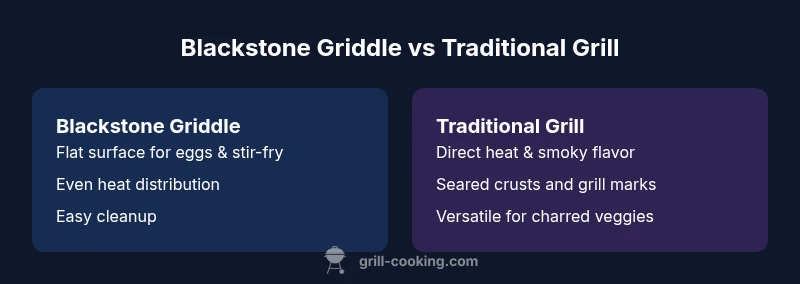
At a high level, the surface is the most obvious distinction between a Blackstone griddle and a traditional grill. The Blackstone presents a large, flat stainless or steel plate that radiates heat evenly, making it ideal for eggs, pancakes, quesadillas, and stir-fries. A traditional grill uses grates over an open flame, delivering direct heat, grill marks, and a smoky profile that many cooks associate with outdoor cooking. Heat management on a flat top tends to be uniform across the surface, which helps with precision control for delicate foods. Grills, by contrast, can develop hotter zones near the flames, creating opportunities for quick searing and charring. Flavor is another differentiator: a griddle yields clean, even browning without smoke, while a grill delivers a pronounced smoky aroma and characteristic grill marks. Grill Cooking Analysis, 2026 suggests that upkeep and seasoning habits can vary substantially between the two, influencing long-term performance. When to use Blackstone vs grill depends on whether you prioritize even surface cooking or the flavor advantages of open flame. For most households, it’s about balancing surface area with aroma potential and weather constraints.
When Blackstone Shines: Breakfast to Stir-Fry
For cooks who start the day with eggs, hash browns, and breakfast burritos, the Blackstone shines due to its expansive, flat surface and easy-to-clean finish. It also handles stir-fry work, fajitas, and vegetable medleys with consistent heat, allowing you to move ingredients around without worrying about crowding or flipping. If you’re cooking for a family and want to serve a cohesive skillet-style meal, a Blackstone offers efficiency and speed. The surface’s even heating lets you toss and sauté without hotspots, which is a major time-saver for weeknight dinners. When you consider when to use Blackstone vs grill, think about the menu: if the dish centers on a uniform browning surface rather than smoke, the griddle is often the better choice. For those who value speed and the ability to prepare several items in one contiguous space, the Blackstone becomes a hero in the kitchen or patio. Grill Cooking’s team notes that flat-top cooking can reduce the number of pans you need, simplifying cleanup and organization. The key is planning: prep ingredients in advance so your griddle can stay hot and productive throughout the meal.
When a Traditional Grill Shines: Searing and Smoky Grilling
A traditional grill excels where high-heat searing and smoky flavors are desirable. Steaks, chops, burgers, and vegetable skewers often benefit from direct flame and grill grate contact, which creates robust browning and those coveted char lines. If your goal is outdoor barbecue with a complex flavor profile, a grill offers advantages that a flat top can’t easily replicate. The ability to control heat zones, close the lid for reverse-searing, or add smoke from wood chips makes the grill a natural choice for weekend cookouts and special occasions. When to use Blackstone vs grill in this context means recognizing that a grate system can produce deeper, more nuanced flavors through fat dripping and surface caramelization. Grilling also typically pairs well with oil-based marinades and sauces that can cling to the grate and caramelize quickly under direct heat. Grill Cooking’s pragmatic approach emphasizes evaluating the recipe requirements: if the dish relies on bark, crust, and intense aroma, the grill often wins. Remember to manage wind and weather, as these factors influence flame behavior and heat consistency. A solid windbreak or covered area can extend your grilling sessions and protect your investment from the elements.
Weather, Space, and Setup: Practical Constraints
Outdoor cooking is as much about environment as it is about equipment. Weather conditions, space, and storage influence which option makes the most sense for a given week. A Blackstone griddle often requires a stable, level surface and adequate space for pan-style cooking; it might be less practical on a narrow balcony or a breezy patio where wind could affect gas flow around a grill. Conversely, a traditional grill, especially a charcoal model, benefits from a well-ventilated area but can be bulky and space-hungry. If you’re short on outdoor square footage, a compact gas grill may suffice, while a larger family with a covered porch might justify a dedicated flat-top counter space alongside a grill. The Grill Cooking team stresses that budgeting for weather protection, storage, and accessibility is essential—your setup should accommodate frequent use, not just occasional weekend barbecues. When planning where to place equipment, consider the proximity to prep areas, garbage disposal for cleanup, and the reach of the gas line or fuel source. Weather resilience, storage, and safety concerns are not afterthoughts; they fundamentally shape how you’ll cook when to use Blackstone vs grill on a regular basis.
Maintenance, Cleaning, and Longevity
Maintenance quality often determines the lifespan of your cooking setup. A Blackstone griddle requires regular seasoning of the cooking surface to maintain a nonstick layer and corrosion resistance; clean it while it’s still warm to prevent a crust from forming. Griddle surfaces benefit from a routine of oiling after use and thorough cleaning to remove stray bits that could burn at the next session. On a traditional grill, you’ll manage grate cleanliness, ash disposal (for charcoal), and occasional burner maintenance if you’re using gas. Both surfaces demand heat-safe tools, proper ventilation, and safe storage when not in use. Grill Cooking Analysis, 2026 indicates that consistent maintenance, including timely grease management and replacing worn parts, extends the life of either appliance and preserves performance. A critical distinction is weather exposure: stainless steel components on a grill may resist rust better than untreated surfaces; however, a covered outdoor kitchen reduces wear for either option. A disciplined cleaning routine, proper seasoning, and careful storage are the best investments you can make to preserve your investment over time.
Budgeting, Space, and What to Buy First
When you’re deciding how to allocate budget for Blackstone vs grill, start by listing your primary meals and available space. A Blackstone griddle in the 28–36 inch range is a solid choice for families that love breakfast-for-dinner and quick stir-fries, while a mid-range gas or charcoal grill has broad appeal for classic outdoor cooking. If you’re tight on space, consider a small grill alongside a compact griddle or a combo unit that includes a flat top and a grill surface. Budget ranges can vary significantly by brand, materials, and features, but you’ll typically see options far cheaper than professional-grade appliances. The Grill Cooking team recommends evaluating long-term costs: fuel, maintenance, and the expected lifespan. This helps you avoid buyer’s remorse and ensures you select a setup that matches both your menu and your lifestyle. By weighing the space you have, your dining habits, and environmental constraints, you’ll arrive at a decision that balances practicality with flavor potential. When to use Blackstone vs grill should reflect both current needs and future cooking ambitions, not just a trend or a single-season impulse.
Real-World Cooking Scenarios: Sample Weeknight Menus
To illustrate practical application, consider a sample week where you alternate between Blackstone and a grill. Monday might feature a breakfast-for-dinner situation on the griddle—eggs, potatoes, peppers, and sausage all cooked in one large pan. Tuesday could switch to a quick grilled dinner: marinated chicken thighs, corn on the cob, and peaches for dessert, all seared with direct flame for a smoky finish. Wednesday could be a stir-fry night on the Blackstone to keep vegetables vibrant and evenly cooked. Thursday returns to the grill for burgers and grilled onions, with a side of charred zucchini. Friday can be a fish night—seasoned fillets on the grill to accent smoke, followed by a skillet dessert on the griddle. The aim is to show how to sequence meals to leverage the strengths of each surface. In practice, you may reach for one tool more often, but having a plan helps you maximize both flavor and efficiency. When you know what you’ll cook, deciding when to use Blackstone vs grill becomes intuitive rather than guesswork.
How to Transition: Hybrid Kitchen Setups and Accessories
Many households adopt a hybrid approach, using both a Blackstone griddle and a traditional grill to cover a wide range of cooking tasks. A practical hybrid setup might feature a compact gas grill for high-heat searing and a portable griddle for breakfast items and quick weekday meals. Accessories such as griddle scrapers, high-heat spatulas, and appropriate covers support long-term performance and safety. When deciding how to transition between setups, plan for storage and ventilation: keep tools that require different fuels accessible, but avoid clutter near grilling heat sources. If you have the space and budget, a permanent outdoor kitchen layout with a built-in griddle and a separate grill can maximize efficiency. Grill Cooking emphasizes that your final arrangement should reflect your cooking philosophy and weekly rhythm, not merely the latest trend. By aligning your tools with your actual menus, you’ll improve consistency, reduce cleanup time, and enjoy more flavorful results.
Comparison
| Feature | Blackstone Griddle | Traditional Grill |
|---|---|---|
| Surface Type | Flat steel/iron griddle surface | Open grate with removable or fixed grates |
| Heat Management | Even, uniform heat across a flat surface | Direct heat with possible hot spots and zone control |
| Best For | Breakfast items, stir-fries, one-pan meals, large batch cooking | Searing, smoky flavor, quick weeknight grills |
| Maintenance & Cleaning | Seasoning required; easier to wipe; simple oiling | Requires grate cleaning; ash management (charcoal) or burner upkeep (gas) |
| Fuel Type & Operating Cost | Gas or electric options; moderate ongoing cost | Gas or charcoal; variable costs based on fuel and usage |
| Flavor & Sear Profile | Milder, less smoky browning; even crusts possible | Distinct smoky flavor; attractive grill marks |
| Space & Footprint | Typically larger footprint; needs flat, stable surface | Can be more compact; adaptable to patios/balconies with ventilation |
| Ideal Setup | Busy family kitchens; homestyle breakfasts; multi-item meals | Traditional outdoor BBQ settings; high-heat searing; char-focused meals |
Strengths
- Expands cooking versatility with a wide flat surface for eggs, pancakes, and sautéed dishes
- Provides fast, even heating and simple cleanup for weeknight meals
- Delivers authentic smoky flavor and chef-like searing for meats and vegetables
- Supports high-volume cooking on a single flat area
- Can serve as a central entertaining station when paired with a grill
Negatives
- Requires more space and a dedicated prep area
- Less smoke flavor and grill marks compared to a traditional grill
- Seasoning and maintenance routines add routine care
- Wind and weather can affect performance more on grills than on covered griddles
Blackstone vs grill: choose based on menu and environment, with a hybrid approach if possible
If your cooking leans toward breakfast items and quick sautéed dishes, the Blackstone has the edge. For smoky flavor and classic grill marks, the traditional grill wins. In many kitchens, a hybrid setup offers the most flexibility and efficiency.
FAQ
What foods are best suited for a Blackstone griddle compared to a traditional grill?
Blackstone excels with breakfast items, eggs, pancakes, and stir-fries due to its large flat surface and even heat. It also handles one-pan meals, fajitas, and a wide array of veggies efficiently. Traditional grills shine with steaks, burgers, kebabs, and foods where direct flame and grill marks enhance texture and flavor.
Best for breakfast and stir-fries, but for steaks and burgers, go with the grill.
Is it easier to clean a Blackstone than a traditional grill?
Generally, a Blackstone is easier to clean after cooking because you’re dealing with a flat surface that can be scraped and wiped down. Grills require more effort to clean grill grates and, for charcoal setups, ash disposal. Regular seasoning and wiping help both stay in good condition.
Flat tops clean up quickly; grills take a bit more elbow grease.
Can I use a Blackstone outdoors in bad weather?
Outdoor use is possible, but wind, rain, and cold can affect performance and safety. A covered, wind-protected area helps. If you frequently cook outdoors in poor weather, a protected space with proper ventilation is crucial for both surfaces.
Yes, with shelter and proper safety, you can cook outside in any weather.
Does a Blackstone require different fuel than a grill?
Blackstones can run on gas or electricity, depending on the model, while traditional grills may be propane, natural gas, charcoal, or a combination. Fuel choice affects maintenance and operating costs and should align with your outdoor space and usage patterns.
Fuel depends on the model; plan for ongoing costs.
How should I decide which to buy first for a small patio?
Start with your most frequent meals. If you mostly cook breakfast and quick sautéed meals, a Blackstone may be the best first purchase. If you grill for flavor and weekend gatherings, a compact grill could be a better starting point. A thoughtful plan reduces buyer’s remorse.
Pick the tool that matches your weekly routine.
Can I replicate grill flavor on a Blackstone?
You can approximate some smoky flavors by finishing foods with a brief high-heat sear on the Blackstone or by using smoke-infused finishing sauces. However, the full smoke aroma and grill marks of an open flame are hard to replicate exactly on a flat top.
You can get close, but you won’t perfectly mimic true grill smoke.
Quick Summary
- Match surfaces to your menu (flat top for eggs/stir-fries)
- Choose a grill when smoky flavor and high-heat searing matter
- Plan storage, space, and weather protection before buying
- Consider a hybrid setup for maximum versatility
- Maintain surfaces with proper seasoning and regular cleaning