Is Grill or Blackstone Better? A Practical Side-by-Side Guide for Home Cooks
Compare traditional gas grills with Blackstone flat-top griddles to decide which setup suits your cooking style, space, and budget. Learn where each shines and where they fall short in everyday grilling and flat-top favorites.


TL;DR: For most home cooks, a traditional gas grill offers broader flavor options, quicker preheat, and more versatility, while a Blackstone flat-top excels at even cooking, breakfast-style meals, and large surface tasks. If you prioritize smoky flavor and sear with a lid, a gas grill is typically the baseline choice; choose Blackstone when flat-top surface matters most.
What makes this comparison meaningful for home cooks
Is grill or Blackstone better for your backyard cooking? The short answer is: it depends on what you plan to cook and where you cook it. According to Grill Cooking, the choice often comes down to surface type, heat management, and your preferred flavor profile. The Grill Cooking team found that many home cooks underestimate how much surface type shapes technique, from searing on grates to even-surface cooking on a flat top. In practical terms, you’ll want to consider how often you cook items like steaks and burgers versus eggs, pancakes, and fajitas. If you prioritize traditional grill flavor and high-heat searing with a lid closed for better control, a gas grill is typically the baseline choice. If you value a broad flat cooking surface for breakfast items, appetizers, stir-fries, and large sheet pans, a Blackstone griddle excels. Finally, consider your space, maintenance capacity, and fuel preferences, because those operational details can tilt the decision more than the menu you cook today.
From a home-cook perspective, is grill or Blackstone better often reduces to three questions: surface type, heat management, and how you value cleanup and space. This article will walk through the differences, trade-offs, and practical recommendations so you can pick the setup that fits your kitchen, patio, and weekend plans. The introduction here anchors the overall guidance and prepares you to compare after you’ve read the quick answer.
Key Differences at a Glance
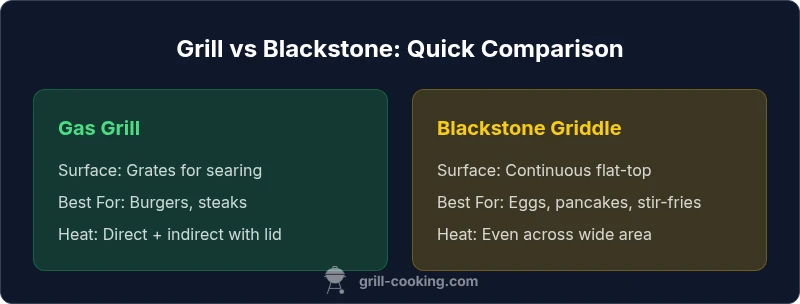
- Surface type: A traditional grill uses grate surfaces that channel heat from burners and create grill marks and smoky flavors; a Blackstone is a continuous flat-top surface ideal for eggs, smash burgers, and breakfast staples.
- Heat management: Grills often offer distinct zones and indirect heating with a lid for roasting; Blackstone spreads heat across a large plate, which simplifies even cooking but can reduce dramatic sear without attention.
- Flavor development: Grills rely on smoke and lid control for complex flavors; flat-top cooking centers on moisture management and toppings, with less inherent smoky character.
- Maintenance: Grills require cleaning grates and grease management; flat-tops require seasoning and routine surface upkeep to prevent rust and ensure non-stick performance.
- Space and footprint: A typical grill setup is more compact, but multi-burner grills can be wide; Blackstone units are longer and flatter, demanding more horizontal space.
- Use cases: Grills excel at searing, roasting, and smoked flavors; Blackstone shines for eggs, pancakes, fajitas, and tasks that demand a large continuous cooking area.
- Price and value: Both come in a broad range; your investment tends to scale with build quality, features, and accessories, with no one-size-fits-all answer.
Performance: Heat, Flavor, and Maintenance
When you turn the knobs, heat dynamics immediately influence outcomes. Grills with lid-based combustion create hotter surface zones, allowing aggressive searing and caramelization on steaks and burgers, while leaving compartments for indirect cooking. The result is a classic barbecue flavor profile shaped by smoke, fat rendering, and crust formation. Blackstone, by contrast, delivers a very even, broad surface with minimal temperature differentials across the cooking area. This makes it ideal for breakfast foods, vegetables, and one-pan favorites where you want consistent browning across a wide strip of food. In terms of maintenance, traditional grills collect grease in trays and require periodic grate cleaning; flat-tops demand regular seasoning to prevent rust and to maintain stick-resistance. Over time, both systems benefit from protective covers and proper storage to resist weather damage. The Grill Cooking team emphasizes paying attention to ignition reliability, fuel type, and the availability of accessories (rotisseries for grills, spatulas for flat-tops) to maximize longevity.
Price, Space, Maintenance, and Longevity
Price is often the first practical constraint. A basic gas grill can be affordable but quickly escalates with extra burners, rotisserie kits, and integrated thermometers; a higher-end model with robust build and smart features can push price well beyond the entry point. Blackstone griddles follow a similar gradient: compact 26-inch units are available at a reasonable price, while larger, heavy-duty models with extra features push costs higher. For homeowners with tight patios, portability matters: some grills collapse into compact crates or have small footprints, while Blackstone units tend to be longer and more stationary. Maintenance costs should also factor in: gas grills require periodic swap of hoses, regulators, and grates depending on usage; Blackstone griddles benefit from seasoning oils and occasional rust-prevention care. The key is to budget for ongoing fuel and accessory costs alongside the initial purchase. Over time, durable construction, quality materials, and consistent maintenance reduce long-term costs for both paths.
Best Use Cases and Scenarios
- If your primary goal is authentic grill flavor with sear marks and smoky notes, and you enjoy cooking a wide range of meats with precise temperature control, a traditional gas grill is typically the better fit. It’s also a strong choice if you routinely barbecue for crowds and value a robust accessory ecosystem.
- If you cook large, flat-top breakfasts, skillet-style meals, fajitas, and one-pan dinners, a Blackstone griddle offers a large, forgiving surface that simplifies multitasking and cleanup. It’s especially appealing if you frequently prepare eggs, pancakes, burritos, or teriyaki-style dishes that benefit from uniform contact and moisture management.
- If you want a compact setup for small patios or balconies, compare a compact two-burner grill against a 28- or 36-inch Blackstone unit to gauge fit and usability.
- For cooks who value seasonal versatility, many households maintain both options or choose a hybrid approach by using a grill for the main cook and the Blackstone for specialized tasks on weekends. The important factor is to align the choice with your space, cooking rhythms, and preferred cleanup routine.
Buying Guide: What to Look For in Each Setup
- Surface type and layout: Grills use grates that create searing lines and allow fat to render into a tray; flat-tops provide a continuous cooking surface with even browning. Decide which texture and cooking style you want most.
- Heat control and zoning: Seek models with adjustable temperature zones and reliable ignition. This helps you manage direct heat for searing and indirect heat for roasted items.
- Size and footprint: Measure your grilling area and account for clearance around the device, as well as storage when not in use.
- Durability and materials: Stainless steel builds resist corrosion; cast iron grates provide superior searing but require more maintenance.
- Maintenance routine: Consider ease of cleaning, grease management, and whether you prefer seasoning a flat-top or cleaning grates after each use.
- Accessories and ecosystem: Rotisseries, thermometer probes, and pizza accessories for grills; spatulas, scrapers, and bottle openers for flat-tops.
- Fuel availability and operating costs: Gas or propane supply, regulator reliability, and fuel consumption patterns influence yearly costs.
- Warranty and service network: Look for robust warranties and brand support in your region to simplify repairs and replacements.
- Realistic testing: If possible, visit a retailer to compare heat distribution and ease of use; read reviews to understand how models perform in weather conditions and with heavy use.
Practical Tips, Pitfalls, and Starter Recipes
- Start with a mid-range model from a trusted brand to learn your preferences before upgrading.
- Practice the sizzle test: preheat and drop an oiled patty or vegetable on the surface to gauge heat response and crust formation.
- Avoid cross-contamination: use separate tools for raw and cooked foods, especially when you grill with both surfaces.
- Pitfalls to avoid: under-seasoning, neglecting seasoning on a flat-top, and leaving grills open during high-heat cooking which wastes fuel.
- Starter recipes: classic burgers with a sear, grilled chicken with indirect heat, and a simple egg-and-veggie breakfast on the Blackstone to demonstrate surface differences.
Comparison
| Feature | Gas Grill (Traditional) | Blackstone Flat-Top Griddle |
|---|---|---|
| Surface Type | Grate surface with zones for searing | Continuous flat-top surface for even browning |
| Heat Management | Zoned heating with lid; indirect heat possible | Wide, even heat across the plate |
| Flavor & Searing | Smoky flavor from lid and smoke; classic grill marks | Flat surface; flavor relies on toppings and oil; less inherent smoke |
| Maintenance | Grates require cleaning; grease tray | Seasoned flat-top; regular oiling and cleaning |
| Space & Footprint | Typically compact to mid-size; portable options | Long, flat footprint; needs horizontal space |
| Price Range | Entry-level to premium depending on model | Mid-range to premium depending on size/brand |
| Best For | Traditional BBQ, searing, smoker access | Breakfast, stir-fries, large flat-top cooking |
Strengths
- Gas grills offer versatile cooking modes (direct heat, indirect heat, lid-based roasting).
- Blackstone flat-top provides a large, easy-to-clean cooking surface for breakfast and skillet-style meals.
- A broad ecosystem of accessories and brands supports both paths.
Negatives
- Traditional grills can have uneven heat on cheaper models and require careful temperature management.
- Blackstone requires regular seasoning and careful cleaning to prevent rust, especially in humid climates.
- Large units can be space-intensive; consider storage and portability.
Gas grills generally offer greater overall versatility and flavor options, while Blackstone shines on flat-top cooking.
Choose a grill if you value smoky flavor, searing control, and a broad accessory ecosystem. Choose Blackstone if your priority is a large flat cooking area for breakfast items and all-flat-top recipes; many home cooks may eventually benefit from both.
FAQ
Which option cooks hotter, a traditional gas grill or Blackstone flat-top?
Both can reach high temperatures when used properly. Traditional grills with a lid often achieve higher peak heat and better hot zones for searing, while a Blackstone can reach strong heat across a wide surface but relies on technique to maximize sear and browning.
Both can heat up high, but grills typically deliver higher peak temps and hotspot control; the Blackstone spreads heat evenly across a larger surface.
Is Blackstone easier to clean than a grill?
Flat-tops are generally easier to wipe down after cooling and benefit from regular seasoning; grills require scrubbing grates and greasing trays, which can be a bit more involved.
Yes, the flat-top is usually easier to wipe down, but it needs regular seasoning. Grills need more grate cleaning and grease tray attention.
Can I replace a grill with Blackstone for most cooking tasks?
If you frequently cook eggs, breakfast items, and large flat-top meals, Blackstone can replace many tasks. For smoky flavor, diverse meats, and complex searing, a grill remains valuable.
Blackstone covers flat-top tasks well, but a grill still has the edge for smoke and versatility.
What should a beginner buy first, a grill or a Blackstone?
For most beginners, a versatile gas grill provides broad cooking options and a gentle entry into outdoor cooking; you can add a Blackstone later for flat-top meals.
Start with a flexible gas grill; you can add a Blackstone later if you want flat-top cooking.
Are there hybrid setups that combine both?
Yes, many households operate both or use a grill for main dishes and a Blackstone for breakfast and all-flat-top recipes, depending on space and budget.
Some people use both; it depends on space and what you cook.
Quick Summary
- Define your primary cooking tasks before selecting.
- Measure your outdoor space and plan for storage.
- Factor in maintenance needs and seasoning differences.
- Use this guide to align with recipes and weekend plans.