When to Grill vs Griddle: A Practical Guide for Home Cooks
A practical, analytical comparison of grilling and griddling to help home cooks decide when to use each tool for searing, flavor, and even browning.


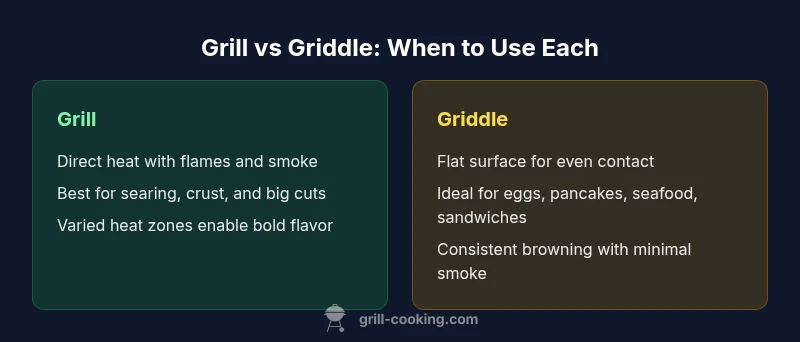
Grill for searing, smoky flavor, and dramatic crust; griddle for even browning and delicate items. The best approach depends on your goal: use a grill when you want char and deep flavors from direct flames, and pull out a griddle when you need flat, uniform contact and quick multitasking. For versatility, keep both.
What are Grill and Griddle? Defining the tools and their heat dynamics
Grilling and griddling are two distinct approaches to cooking over heat, but they share a common goal: delicious, satisfying results. When you hear the phrase when to grill vs griddle, you’re weighing how heat is delivered, how flavor develops, and which foods respond best to a given surface. According to Grill Cooking, the decision hinges on flavor goals, equipment availability, and kitchen setup. A grill uses radiant heat from flames with heat zoning that creates char and smoke, while a griddle relies on a flat surface that heats evenly for uniform contact. Understanding these fundamentals helps you choose the right tool for the moment and avoid common rookie mistakes.
In modern outdoor kitchens, owners often compare a traditional charcoal or gas grill against a flat-top griddle (often cast iron). The choice isn’t merely about taste; it’s about heat behavior, surface contact, and how you manage moisture and timing. By recognizing the strengths and limits of each surface, you can plan menus that play to the right tool and minimize cross-usage errors. This article uses the phrase when to grill vs griddle to frame how to optimize flavor and texture across proteins, seafood, vegetables, and breakfast items.
Flavor, Texture, and Heat Transfer: The physics behind the difference
The core distinction between grilling and griddling is how heat reaches the food and what happens on the surface. Grills rely on direct radiant heat from flames or hot charcoal with variable airflow, often creating convection and smoky flavors. Griddles deliver a uniform, flat surface that conducts heat evenly across contact points, yielding consistent caramelization and browning. The Maillard reaction—the browning that builds depth—can occur rapidly on a hot grill, but even browning on a griddle can produce a reliable crust without heavy charring. Grill Cooking Analysis, 2026 emphasizes that flavor goals largely determine which method wins: a bold, smoky crust or an even, controlled sear. When you plan a cookout, this framework helps you assign dishes to the surface that yields the desired texture and aroma.
Surface geometry also matters: a grill grate creates open space around the food, allowing fat to baste and flame flare-ups to contribute taste. A griddle’s dense surface keeps fat close to the food, helping you press, sear, and brown with minimal flare. Understanding these dynamics lets you optimize both surfaces in your kitchen and avoid common pitfalls, such as over-smoked foods on a windy day or uneven browning on a cramped grill grate.
From a practical standpoint, your choice should align with the dish’s moisture content and finish. Lean cuts that benefit from rapid high heat respond well to grilling, while foods that require steady, even contact—like eggs, pancakes, or delicate fish—are better suited to a griddle. Grill Cooking’s approach to this topic centers on matching heat behavior to culinary goals, which is why the question when to grill vs griddle tends to come up during menu planning and meal prep.
When to Reach for a Grill: Best scenarios
Grills excel when you want flavor to be the star. The high-heat sear on a grill creates the classic crust and a smoky, charred profile that cannot be replicated on a flat surface. This makes grills ideal for thicker cuts like ribeye, porterhouse, and bone-in chicken, as well as burgers where you want pronounced crust lines and a blue-smoke aroma. Char and crust are easiest to achieve with direct heat and occasional flame exposure, especially when you can manipulate heat zones and close the lid for a convection effect. Grilling also lends itself to larger batches and social cooking, where the grill acts as a performance centerpiece and a source of drama and flavor accumulation over time.
Technique matters here: preheat the grill to high heat for initial searing, then move to indirect heat to finish, allowing internal juices to distribute without excessive charring. Managing flare-ups with air control—whether via vent settings on a kettle grill or lid position on a gas model—lets you steer the char without burning. In addition to meat, heavily charred vegetables like corn on the cob, peppers, and zucchini steaks add color and intensity that are difficult to replicate on a flat top with the same level of smoky nuance. Grill Cooking’s guidance highlights that if your goal is that quintessential outdoor-cookout flavor, the grill remains the best tool for the job.
When to Reach for a Griddle: Best scenarios
A griddle shines when you need a broad, flat surface and predictable heat. For breakfast items like eggs, omelets, pancakes, and French toast, a griddle provides consistent browning and minimal sticking. Flat-top cooking is also excellent for delicate seafood fillets, shrimp, and small fish that might otherwise fall through grill grates. Burgers and sandwiches can benefit from the contact surface, which helps achieve a compact crust and uniform color across the patty, while grilled cheese can melt evenly without leaning on smoke for flavor. Vegetables sliced thinly, like peppers, mushrooms, and onions, brown more evenly on a griddle as the surface holds a stable, high temperature with less risk of scorching from flare-ups. Griddle cooking also supports “teppanyaki-style” techniques, where ingredients are spread in a single layer for fast, even caramelization. Grill Cooking Analysis, 2026 notes that griddles are especially effective for foods that require steady contact and time-efficient browning, complementing the grill’s bold, smoky capabilities.
Equipment Considerations: Fuel, heat zones, and maintenance
Choosing between grill and griddle is also about equipment layout and maintenance requirements. Gas grills offer quick temperature changes and precise control, with multiple burners and heat zones for indirect cooking. Charcoal grills provide maximal flavor influence and the potential for deep smoky notes but demand more attention to airflow and smoke management. A dedicated flat-top griddle—often a heavy cast-iron or steel surface—delivers a large working area with uniform heat, but it requires regular seasoning and careful cleaning to prevent sticking and rust.
For home cooks building a two-surface setup, an outdoor kitchen with a grill and a separate cast-iron or stainless steel griddle expands menu options dramatically. In smaller spaces, a good grill pan on a stove can approximate some griddle capabilities, but the surface area and heat distribution differ from a proper flat-top griddle. Maintenance is a consideration for both surfaces: griddles accumulate burnt-on fond that benefits from seasoning and thorough scraping; grills require grate cleaning and periodic ash disposal for charcoal setups. Grill Cooking recommends evaluating your typical cook load, weather exposure, and time budget to determine whether you should own both tools or optimize a single surface with smart technique.
Food Categories: Proteins, Seafood, Vegetables, and Sandwiches
Different foods respond differently to grill vs griddle, and knowing where each shines helps with planning. Proteins like steaks and thick chops benefit from grill heat where the surface can render fat and develop crust with a smoky edge. Chicken thighs, wings, and whole birds can cook well on either surface, but a grill’s direct heat helps achieve crisp skin with a char that many home cooks crave. Seafood—particularly shellfish and salmon fillets—often performs better on a griddle when you want uniform browning and delicate handling, though a quick sear on a hot grill can also be spectacular if you manage heat carefully. Vegetables such as corn, peppers, zucchini, and mushrooms brown nicely on both surfaces; the griddle provides steadier contact, while a grill adds a hint of char. For sandwiches and burgers, a griddle can seal and caramelize evenly, while a grill imparts signature grill marks and that signature smoke. Desserts and breakfast foods—pancakes, French toast, and hash browns—typically favor the griddle’s flat surface for consistent contact and even browning. ”,
Comparison
| Feature | Grill | Griddle |
|---|---|---|
| Heat source and distribution | Flames/charcoal with zones and smoke | Flat, even surface with direct contact |
| Best for | Searing with smoke and crust on larger cuts | Even browning and delicate items |
| Flavor profile | Bold, smoky, charred notes | Clean browning with reduced smoky flavor |
| Control & responsiveness | Heat zones and lids; more variables | Simple, uniform heat across surface |
| Ideal foods | Steaks, burgers, ribs, peppers | Eggs, pancakes, fish fillets, sandwiches |
| Cleanup & maintenance | Grates, ash management; seasoning often needed | Scrape, clean, and season; requires oiling |
| Space/setup | Requires grill space; weather dependent | Requires flat surface; portable options available |
Strengths
- Offers superior smoky flavor and crust development
- High-heat searing for steaks and burgers
- Versatile for large meals and outdoor entertaining
- Direct flame control enables rapid flavor adjustments
Negatives
- Can produce overwhelming smoky flavors on delicate foods
- Requires more setup, weather planning, and cleanup
- Heat management can be challenging with uneven grills
- Storms or wind can disrupt performance on open grills
Grill for flavor and searing; griddle for even browning and delicate items; the best setup is to own both if space and budget allow.
Prioritize a grill when you want char and smoke; a griddle excels at uniform browning and breakfast-style cooking. If you can, pairing both tools covers the broadest range of dishes and cooking styles for home cooks.
FAQ
What is the primary difference between grilling and griddling?
Grilling uses direct radiant heat from flames or charcoal with potential smoke, producing char and a smoky aroma. Griddling uses a flat surface to deliver even heat and consistent contact, yielding uniform browning with less smoke.
Grilling uses flames for char and smoke; griddling relies on a flat surface for even browning.
Which foods are best on a grill vs a griddle?
Grill foods: thick cuts, steaks, burgers, ribs, and veggies that benefit from sear and smoke. Griddle foods: eggs, pancakes, delicate fish, shrimp, and sandwiches that need even contact.
Grills are for searing and smoke; griddles are great for eggs and pancakes.
Can I use a grill pan as a substitute for a griddle?
A grill pan on a stove can mimic some grill flavors and searing, but it won’t match the flat-top surface for large-area browning. It's a useful substitute when outdoor equipment isn’t available.
A grill pan on the stove helps, but it isn’t a perfect stand-in for a real flat-top griddle.
How do I control temperature differently on grill vs griddle?
On a grill, manage temperature with vents, flame height, and lid position. On a griddle, control is mainly about surface heat and preheating time; adjust with the thermostat or burners if using a griddle‑top station.
Grill temps are variable; griddles offer more uniform surface heat.
Is weather a factor when choosing between grill and griddle?
Yes. Grilling is more forgiving in calm weather but flare-ups and wind can affect heat and smoke. Griddling is less weather-dependent, especially with a covered outdoor setup or indoor stove-top option.
Weather affects grilling more; griddling is usually steadier indoors or under cover.
How should I clean and maintain grill vs griddle?
Clean grates after use and perform occasional seasoning. For griddles, scrape, wipe, and season the surface to prevent sticking. Regular maintenance helps preserve flavor and surface integrity.
Clean after use and season surfaces to prevent sticking.
Quick Summary
- Choose grill for smoky flavor and crust
- Choose griddle for even browning and delicate foods
- Use heat zones and lid for best grill control
- Flatten your cooking surface for pancakes and eggs on the griddle
- Maintain and clean surfaces regularly to extend life