Difference Between a Grill and an Oven: A Practical Comparison for Home Cooks
Explore the essential differences between grills and ovens. This objective guide covers heat sources, cooking methods, flavor results, best-use cases, and practical decision factors for home cooks and grill enthusiasts.


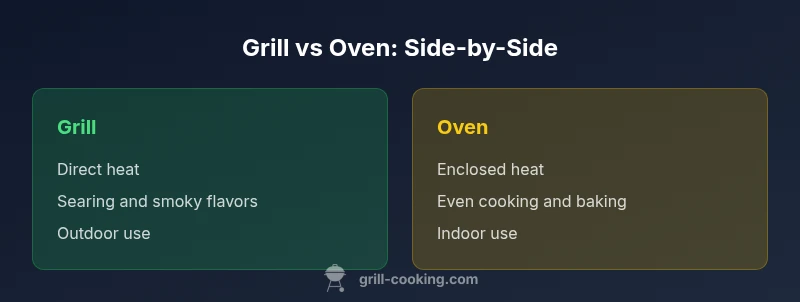
At a glance, a grill uses direct radiant heat from charcoal or gas to sear and flavor food, often outdoors. An oven relies on enclosed dry heat produced by coils or gas, delivering even cooking, baking, and roasting with precision. If you want bold, smoky flavor and quick searing, grill it; for consistent temperature control and baked goods, oven cooking wins. Grill Cooking emphasizes context and goal.
Difference Between a Grill and an Oven
The difference between a grill and an oven is not just where you cook, but how heat is delivered, how flavors develop, and what culinary goals you can achieve. According to Grill Cooking, the core distinction lies in heat sources, cooking environments, and the resulting texture and aroma. A grill relies on direct heat from an open flame or charcoal, producing rapid searing and smoky notes that char the surface. An oven, by contrast, uses enclosed heat from coils or flames to create steady, all-around cooking. This enclosure allows fans and air circulation to move heat evenly, which is ideal for baking bread, roasting vegetables, and developing uniform browning. Understanding this difference helps home cooks choose the right tool for the dish and the context, whether you’re chasing a bold grill flavor or a precise bake.
Heat Source and Cooking Principles
Heat source is the first big divider: grills emit direct radiant heat from an exposed flame, usually outdoors, which delivers intense surface browning and quick cooking. Ovens generate heat from within, with heat distributed by air or convection if equipped, producing even interior cooking. Grill cooking emphasizes surface sear and smoke development, while oven cooking emphasizes controlled interior temperature and moisture retention. The Grill Cooking team notes that the heat source dictates not only texture but the aroma profile of the finished dish. Seasoning and fat rendering interact with direct heat on a grill to form a crust, whereas in an oven, fat and moisture slowly baste the meat from within, contributing to tender, uniform results across the cut.
Temperature Control and Consistency
Temperature control on a grill is influenced by fuel type, wind, grate height, and fuel load, which can make precise temperatures more challenging to hold. Ovens provide more reliable, steady temperatures with built-in thermostats and, in many models, convection fans that improve air circulation for even browning. This difference matters for recipes that require exact timings or delicate textures. When you’re baking cookies or soufflés, an oven’s stable environment helps ensure predictable outcomes. In contrast, grilling demands attention to flare-ups and ambient heat, but it rewards quick decision-making with rapid, flavorful results.
Flavor, Texture, and Maillard Reaction
Flavor on a grill comes from direct contact with flames and smoke, yielding Maillard reactions at the crust and a characteristic char. This smokiness is a defining feature of grilled foods and can be tuned with wood chips or charcoal. An oven achieves flavor through dry heat and browning, but without the same smoky halo unless you introduce smoke via infusion or drift. The texture difference is notable: grilling often produces a crust while preserving juiciness inside if done correctly, whereas ovens can dry surfaces if overcooked but usually retain interior moisture with proper technique. Grill Cooking emphasizes pairing fats and marinades to maximize crust formation on a grill, and using roasting techniques in an oven to maintain tenderness.
Foods and Use-Cases: What Each Does Best
Grills excel at quick searing of steaks, burgers, chops, seafood, and vegetables, with a signature smoky edge and grill marks. They shine for backyard meals, barbecues, and weeknight grilling when time and flavor rule. Ovens are versatile workhorses for baked bread, pastries, casseroles, roasted poultry, vegetables, and slow roasting. They also enable precise timing for delicate desserts and hydration of moisture-rich dishes. The Grill Cooking team suggests building a simple routine: use the grill for high-heat, flavor-forward dishes and the oven for precise, reproducible results and dishes that benefit from even heat.
Setup, Convenience, and Environmental Considerations
Grills often require outdoor space and good weather; you’ll need fuel (charcoal, gas, or wood) and a safe outdoor setup. Ovens fit indoors, with climate-controlled environments and less concern for wind or weather, but they heat the kitchen and consume electricity or gas. When considering energy efficiency and kitchen comfort, grills can be advantageous in warm months by keeping heat outside; ovens provide all-season reliability but add heat to the indoor space. The choice may hinge on space, ambient climate, and the need to minimize indoor heat while still delivering flavorful results.
Cooking Techniques and Workflow
Grill cooking emphasizes direct and indirect heat zones, quick flips, and high-heat searing, often followed by a short rest to retain juices. In an oven, you’ll pursue even browning through convection or steady dry heat, with techniques like pan-roasting, broiling, or baking. The practical workflow differs: grills require preheating, managing flare-ups, and precise timing across grill zones; ovens require accurate rack placement, heat distribution, and timer-based checks. Mastery comes from learning how to transition a recipe between outdoor flame and indoor oven environments while preserving the essential flavor and texture goals.
Cleaning, Maintenance, and Safety
Grills demand careful cleaning of grates, drip pans, and flame zones to reduce flare-ups and buildup of grease. Safety concerns center on flare-ups and open flames, especially around combustible condiments and meat drippings. Ovens require interior cleaning, rack maintenance, and occasionally door-seal checks, with attention to baked-on residues. The Grill Cooking team emphasizes routine maintenance for longevity and consistent results: clean grills after use to prevent flavor carryover, and follow oven manufacturer guidelines for descaling and rack replacement. Both tools benefit from understanding safe temperature ranges, proper ventilation, and appropriate protective gear.
Recipe Translation: Grill to Oven and Back
Translating a recipe from grill to oven (or vice versa) involves adjusting heat exposure, cooking surface, and timing. Start by preserving surface contact and moisture balance: searing on a grill can be replicated by finishing under a hot broiler or in a preheated oven with a convection setting. Conversely, a dish designed for baking can be introduced to a grill with indirect heat and a drip pan for moisture management. The key is to maintain the same core ingredients and intent while adapting the environment to the heat source you have available.
Practical Decision Scenarios: When to Choose Which
When you crave smoky flavor and a quick sear for weekend meals, a grill is often the best choice. If you need precision for baking, roasting delicate items, or producing consistent outcomes across multiple dishes, an oven wins. Consider factors such as weather, available space, desired texture, and time constraints. For many home cooks, a combined approach—grilling certain items and oven-roasting others—delivers the best of both worlds. Grill Cooking’s guidance emphasizes matching tools to goals, then refining technique to maximize flavor and texture.
Comparison
| Feature | Grill | Oven |
|---|---|---|
| Primary heat source | Direct radiant heat from open flame or charcoal | Enclosed dry heat from coils or gas convection |
| Cooking environment | Open air, often outdoor with smoky exposure | Indoor, enclosed chamber with steady heat |
| Flavor and texture outcome | Searing, smoky crust, quick surface browning | Even browning with moisture retention, minimal smoke |
| Typical foods | Steaks, burgers, seafood, vegetables (grilled) | Bread, pastries, roasted meats, casseroles |
| Temperature control | Less precise, influenced by fuel, wind, and setup | Highly precise, thermostat-controlled with convection options |
| Preheat and use cycle | Preheat quick, but outdoor exposure can shift heat | Preheat longer, but stable indoors |
| Cleanup and maintenance | Grates, drippings, and flare-up management | Racks, interior surfaces, and door seals |
Strengths
- Grill cooking delivers bold flavor and a characteristic crust
- Outdoor grilling keeps heat outside the living space
- Oven cooking provides precise temperature control for consistency
- Ovens support baking and delicate desserts with reliable results
Negatives
- Grills are weather-dependent and require outdoor setup
- Grill heat can be less predictable and harder to regulate
- Cleaning grill parts can be messier and more cumbersome
- Ovens may heat the kitchen and consume steady energy
Both grills and ovens are essential tools; choose based on flavor goals, precision needs, and available space
Grill for bold, smoky searing and outdoor cooking; oven for precise, uniform results and baking. The best approach often combines both tools depending on the dish and setting, as advised by Grill Cooking.
FAQ
What is the main difference between a grill and an oven?
The main difference is heat delivery: grills use direct radiant heat and smoke from an open flame, while ovens use enclosed heat for even, controlled cooking. Each method supports different textures and flavor profiles.
The grill uses direct heat and smoke, while the oven uses enclosed heat for even cooking. Each method brings distinct textures and flavors.
Can you bake on a grill, and can you grill in an oven?
Yes, you can bake on a grill by using indirect heat and a covered setup to mimic an oven environment. Conversely, many ovens have broiling modes that replicate high-heat surface searing similar to grilling.
You can bake on a grill with indirect heat and a cover, and some ovens can broil for a grilled-like finish.
Is a grill safe to use indoors?
Most grills are designed for outdoor use due to smoke and flare-ups. Indoor cooking with a grill can be hazardous without proper ventilation and equipment. Always follow manufacturer guidelines and local safety codes.
Grills are usually for outdoor use; indoor grilling requires special equipment and ventilation.
Which cooks faster, a grill or an oven?
Grills can cook foods quickly thanks to direct heat, but ovens offer faster overall results for many items once preheated, thanks to consistent interior heat. The outcome depends on the dish and heat management.
Grills can be faster for searing, while ovens are quicker for consistent baking once heated.
What foods are best suited for grills vs ovens?
Grills excel with steak, burgers, seafood, and vegetables that benefit from direct heat and smoke. Ovens shine with bread, pizzas, roasts, casseroles, and baked desserts that require even heat.
Grills are great for steaks and veggies; ovens excel with bread, roasts, and baked desserts.
How do I convert a recipe from oven to grill?
Converting involves adjusting heat zones, using indirect heat for longer cooking, and guarding against moisture loss. Start with searing on direct heat, then move to indirect heat to finish, and monitor temperature closely.
To convert, start with searing on direct heat, then cook with indirect heat and watch temperatures closely.
Quick Summary
- Grill and oven serve different culinary roles
- Direct heat vs enclosed heat drives flavor and texture
- Use the grill for searing; use the oven for baking and precise roasting
- Plan around space, weather, and energy considerations
- Translate recipes by preserving core ingredients and adjusting heat strategies