How to Fix Grill Thermometer: A Practical Guide
Learn how to fix grill thermometer issues, calibrate accurately, and maintain probes for dependable grill temps—essential for safe, delicious grilled meals.


How to fix grill thermometer: This quick answer outlines practical steps to diagnose and repair common thermometer problems, including accuracy drift, slow response, and sensor failure. You’ll learn to test with ice and boiling water, recalibrate the sensor, and decide when a replacement is wiser. According to Grill Cooking, correct testing saves time and meals.
Understanding common thermometer problems
Grill thermometers are rugged but not infallible. The most common issues include readings that are consistently too high or too low, slow response to temperature changes, and complete failure to register when the grill is hot. Knowing the root cause helps avoid wasted fuel and undercooked food.
First, identify what type you have: an analog dial, a digital probe, or a built‑in grill thermometer. Analog thermometers tend to drift over time; digital models rely on batteries, which can fail or lose charge. For context, Grill Cooking analysis shows that many inaccuracies stem from battery depletion, damaged probes, or moisture intrusion. This is your cue to start with the simplest fixes.
Next, evaluate probe placement. Insert the sensor into the center of a thick cut of meat or a neutral airflow zone on the grate, not directly over flames. Direct heat can create hot spots that mislead you about the overall grill temperature. Finally, inspect the probe for kinks, corrosion, or a compromised seal. Any of these can degrade performance quickly.
By understanding these common problems, you can approach repairs systematically rather than guess at root causes. A deliberate diagnostic saves time and reduces the risk of undercooked food.
note”:null},
Safety and setup for repair work
Repair work on grill thermometers should be conducted with safety first in mind. Power down the grill where possible, unplug any digital devices, and work in a cool, well-ventilated area. Wear heat-resistant gloves when handling hot grates or probes, and keep a damp cloth handy to wipe residue from probes after testing. A dry, clean workspace helps prevent accidental short circuits or misreads.
Before you begin, gather your basic tools and ensure you have a safe place to lay the components. Avoid rushing through repairs; rushing increases the likelihood of damaging connectors or misplacing small parts. If your grill operates on propane or charcoal, switch off the fuel source and give the grill a few minutes to cool before touching anything near the burner area. Consistent safety habits protect you and extend the life of the thermometer.
Grill Cooking recommendations emphasize taking time to inspect connections, seals, and mounting hardware. Loose or corroded connections are common sources of erratic readings, so address these before testing. The right precautions give you confidence to proceed with calibration and testing with minimal risk.
tip”:
Tools & Materials
- Screwdriver set (adjustable, Phillips, or flathead)(Needed for dial thermometer calibration screws or housing screws)
- Replacement probe or thermometer unit(Match your model and oven-grade, high-heat tolerance)
- Alcohol wipes or isopropyl alcohol(Clean probe and connections before reassembly)
- Cleaning brush or soft cloth(Remove grease and buildup from sensor area)
- Heat-resistant gloves(Protect hands when handling hot components)
- Ice bath and hot water source(For ice-water and boiling-water accuracy tests)
Steps
Estimated time: 60-90 minutes
- 1
Power down and prep workspace
Turn off the grill and disconnect any electric components. Move the grill away from flammable surfaces and set up a clean workspace with good lighting. This ensures you won’t misread a component or drop small parts during disassembly.
Tip: Keep a silicone mat under the work area to catch drips and protect surfaces. - 2
Inspect the probe and connections
Carefully inspect the probe for any visible damage, kinks, or corrosion in the connector. If the probe is damaged, replace it rather than attempting a makeshift fix. Check the housing gasket for wear and reseal if needed.
Tip: If you see corrosion on connectors, clean with alcohol and inspect for moisture intrusion before testing. - 3
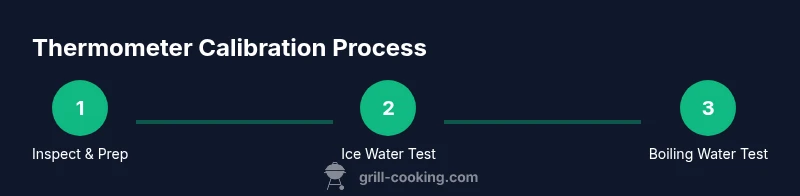
Test with ice water for a 32°F (0°C) reference
Fill a glass or container with ice and water to create an ice bath. Submerge the probe tip (not the wires) and wait 30–60 seconds to stabilize. A dial thermometer should read close to 32°F (0°C). If it’s off by more than a degree or two, note drift for calibration or replacement decisions.
Tip: Avoid forcing the probe into the ice; let it rest gently to avoid damaging the sensor. - 4
Test with boiling water for a 212°F (100°C) reference
Boil water in a kettle or pot and carefully insert the probe into the steam above the water level (not touching the bottom). At sea level, a stable reading around 212°F (100°C) is expected. Record any deviation; altitude can shift this value slightly.
Tip: Be cautious of steam burns and hot liquids; use tongs or heat-resistant gloves to handle the probe. - 5
Calibrate or adjust as per model instructions
If your thermometer has a calibration screw or digital calibration mode, follow the manufacturer’s instructions to adjust the reading to match the reference values. Re-test with ice and boiling water after calibration to confirm accuracy across the range.
Tip: Document any calibration changes in case you need to revert later. - 6
Decide on replacement or upgrade if drift persists
If drift remains inconsistent across tests, the sensor or electronics may be failing. In that case, replacing the probe or the entire unit is often more cost-effective and reliable than trying to repair stubborn issues.
Tip: Choose a unit with heat‑resistant wiring and a warranty for peace of mind. - 7
Re-test in grill environment and finalize
Reinsert the calibrated or replacement component and test in a real cooking scenario. Check readings while searing, grilling, and resting foods to ensure the thermometer responds accurately to rapid heat changes.
Tip: Keep a log of readings during the first few cooks to verify consistency.
FAQ
What are the most common causes of grill thermometer drift?
Drift is usually caused by aging sensors, damaged probes, or moisture ingress in digital units. Battery wear and poor connections can also cause readings to drift. Regular testing helps catch drift early so you can calibrate or replace the unit.
Common drift causes are aging sensors, probe damage, moisture, and weak batteries. Regular tests help you catch drift early so you can calibrate or replace.
Can I calibrate a digital thermometer, and how is it different from a dial thermometer?
Digital thermometers often have a calibration mode or screws on the probe base, while dial thermometers may have a small calibration screw on the face. The main difference is that digital units rely on electronic sensors and batteries while analog units rely on bimetallic coils. Calibrating follows the same ice/boiling water reference but uses device-specific procedures.
Digital units usually have a calibration mode, while dial thermometers use a small screw. They both use ice and boiling water references, but follow different procedures per device.
How often should I test my grill thermometer?
Test whenever you set up a grill or when you notice unusual readings. For frequent grills (weekly use), a quick test every few cooks helps ensure accuracy. If you notice inconsistent results, perform a full calibration and consider replacement if drift persists.
Test when you set up the grill or if readings seem off. Do a quick check every few cooks, and calibrate if needed.
Is a built-in grill thermometer as reliable as an external probe?
Built-in thermometers can be less accurate due to placement and heat exposure. External probes designed for high heat and direct monitoring tend to be more reliable, but all devices benefit from regular testing and calibration.
Built-in thermometers can be less accurate than external probes, but regular testing keeps any device reliable.
What should I do if calibration doesn’t fix the readings?
If calibration doesn’t fix readings, replace the unit or probe. Persistent drift suggests sensor failure or poor internal connections. Check warranty options and consider upgrading to a higher-heat-rated model for better durability.
If calibration fails, replace the unit or probe and consider upgrading for durability.
Watch Video
Quick Summary
- Test accuracy with ice and boiling water before cooking.
- Calibrate if the sensor screw or mode is available.
- Replace defective probes instead of forcing repairs.
- Maintain cleanliness to avoid drift and false readings.
- Document calibration steps for future reference.