Does BBQ Need Refrigerated Storage? A Home Cook's Guide
Discover how long cooked BBQ lasts, when to refrigerate leftovers, proper reheating temperatures, and storage tips to keep food safe and flavorful.


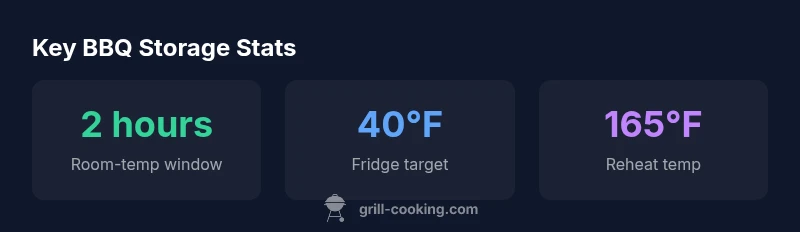
Yes. After barbecuing, refrigerate leftovers promptly to minimize bacterial growth. According to Grill Cooking, perishable BBQ items should not sit at room temperature for more than two hours (one hour if ambient temperatures exceed 90°F/32°C). Cool leftovers quickly and store in airtight containers, then reheat to 165°F before serving.
Understanding the basics: does bbq need to be refrigerated
If you're asking does bbq need to be refrigerated, the simple answer is yes for leftovers. Grilled foods left at room temperature can cross into the danger zone where bacteria multiply rapidly. Grill Cooking guidance for home cooks emphasizes prompt cooling, proper storage, and reheating safety to protect flavor and health. The takeaway is clear: don’t leave cooked barbecue out overnight; refrigerate or freeze promptly. Leftovers that are properly cooled and stored retain more of their original texture and moisture, which makes reheating easier and tastier.
In practical terms, the moment you pull the last piece off the grill, you should start thinking about safe handling. If you are serving guests, divide large portions into smaller pieces so they cool faster. Use shallow, breathable containers to speed cooling and ensure even chilling. For busy cooks, a quick rule of thumb is: the sooner you get to refrigeration after grilling, the better your leftovers will be both in safety and quality.
Temperature fundamentals for leftovers
Food safety experts agree that the so‑called danger zone for perishable foods is roughly between 40°F and 140°F (4°C to 60°C). Bacteria can double in number every 20 minutes in this range, so the goal is to minimize the time cooked barbecue spends there. The refrigerator should be set to 40°F (4°C) or below, and the freezer to 0°F (-18°C) for long‑term storage. Additionally, large cuts should be portioned into smaller pieces to cool faster. If you’ve left BBQ at room temperature for more than two hours, discard it to avoid risking illness, especially in hot weather.
Grill Cooking emphasizes consistency: label leftovers with the date, use airtight containers, and avoid stacking hot items on top of each other, which insulates heat and slows cooling. Cold air needs to circulate to drop the temperature quickly, so avoid deep containers that trap heat at the center.
How to cool barbecue rapidly
Speed is safety when it comes to cooling. Here are practical steps:
- Divide into shallow layers: Transfer meat into multiple thin containers to maximize surface area for faster cooling.
- Use an ice bath for sauces or soups: Place the container in a larger bowl filled with ice to drop temperature quickly.
- Add cold ingredients strategically: If you’re storing sliced meat with vegetables, layer vegetables between portions to help dissipate heat.
- Chill before refrigerating: If you can’t fit everything, move to the fridge first, then to the freezer for longer storage.
- Don’t cover until cooled: Keep containers uncovered or loosely covered while cooling to avoid trapping heat and promoting bacteria growth.
Following these steps helps ensure that does bbq need to be refrigerated is answered promptly with safety in mind, reducing waste while preserving flavor.
Refrigeration vs. freezing: when to freeze?
Refrigeration is ideal for leftovers you plan to eat within a few days. To extend shelf life beyond 3–4 days, freezing is your best option. Divide into meal-sized portions, wrap tightly, and store in a labeled freezer bag or container. Freezing maintains most of the meat’s quality if used within 2–6 months, depending on the type of meat and preparation. Thaw safely in the fridge overnight or use the defrost function on your microwave if you’re in a hurry.
If you plan to reheat from frozen, allow extra time and heat evenly to the recommended internal temperature. Grilling enthusiasts can batch cook on weekends and freeze portions for quick weeknights, reducing daily heat and post‑cook hassles.
Storage guidelines for different meat types
Different meats have slightly different shelf lives after cooking, though all benefit from prompt refrigeration. For most cooked beef, pork, or lamb, aim for 3–4 days in the fridge. Poultry leftovers should also be kept for 3-4 days, as white meats can be a bit more perishable. When freezing, most cooked meats hold quality well for 2–6 months for beef and pork, and 1–3 months for poultry. Always store meat in airtight containers or bags, with the date clearly labeled. Fatty cuts can sometimes separate upon thawing, but proper packaging minimizes moisture loss and freezer burn.
A final note: sauces and glazes can be stored separately in the fridge, but once combined with meat, they share the same storage limits. If you’ve mixed a sauce with meat, treat it as a single item for storage timing and reheating.
Reheating safely: how to bring leftovers back to safe temperature
Reheating is a critical step for safety and quality. Reheat leftovers to an internal temperature of 165°F (74°C) throughout. When reheating, use a method that heats evenly—stovetop, oven, or air fryer work well for shredded or sliced meat. If you’re reheating multiple portions, rotate and stir to prevent cold spots. Use a thermometer to verify the temperature in the thickest part of the meat. Avoid reheating leftovers more than once, as repeated cooling and heating compromises texture and increases safety risks. Also, if a sauce contains dairy or eggs, ensure it’s heated through to a safe temperature.
Reheating at the right temperature not only ensures safety but also revitalizes flavors, so don’t rush the process. A gentle, even heat is usually better than boiling, which can dry out the meat.
Common mistakes and troubleshooting
Home cooks often repeat a few familiar mistakes when handling BBQ leftovers. Common errors include leaving meat out too long, refrigerating in large, dense blocks, and not using airtight containers. Another pitfall is reheating leftovers in a microwave without stirring, which can leave pockets of cold meat that harbor bacteria. A simple troubleshooting tip: when in doubt, throw it out. If you are unsure about the safety of a leftover, discard it rather than risk illness. Finally, invest in shallow, stackable containers to promote rapid cooling and even refrigeration.
Storage guidelines for BBQ leftovers
| Scenario | Recommended Time Window | Notes |
|---|---|---|
| Room Temperature | 2 hours max (1 hour if hot) | Move to refrigerator promptly; discard if longer than window. |
| Refrigerator (40°F / 4°C) | 3-4 days | Store in airtight containers; label date. |
| Freezer (0°F / -18°C) | 3-6 months | Freeze in portions; wrap well; label date. |
FAQ
How long can BBQ leftovers stay in the fridge?
Most cooked BBQ leftovers stay safe in the fridge for 3–4 days when stored properly in airtight containers. If you’re unsure about any item, it’s best to discard. Always use a thermometer to ensure the interior reaches safe temperatures when reheating.
Most leftovers are good in the fridge for about 3 to 4 days; if in doubt, throw it out and reheat to 165°F.
Can you freeze BBQ leftovers?
Yes, you can freeze most cooked BBQ leftovers. Freeze in meal-sized portions, remove as much air as possible, and label with the date. For best quality, use within 2–6 months for beef and pork, 1–3 months for poultry.
Yes, you can freeze leftovers. Use airtight packaging and label the date.
What about sauces and marinades with BBQ leftovers?
Sauces and marinades mixed with leftovers follow the same fridge rules, typically 3–4 days in the fridge. If the sauce contains dairy or eggs, reheat thoroughly to 165°F and avoid leaving it at room temperature.
Sauces with leftovers follow the same fridge rules; reheat thoroughly.
Is it safe to leave BBQ out overnight?
No. Perishable BBQ should not be left out more than two hours (one hour if hot). Bacteria can grow quickly at room temperature, increasing the risk of foodborne illness.
No, don’t leave it out overnight. Two hours is the limit (one hour if hot).
Does refrigeration affect meat quality after grilling?
Refrigeration can affect texture and moisture, especially for fatty or sauced meats. Proper sealing and rapid cooling help preserve tenderness. Freezing can improve shelf life but may change texture upon thawing.
Chilling can affect texture a bit, but proper storage keeps it safe and tasty.
“Proper handling of barbecue leftovers is a daily safety practice that home cooks can master with simple steps—from prompt cooling to correct reheating.”
Quick Summary
- Refrigerate leftovers promptly after grilling.
- Keep fridge at 40°F (4°C) and freezer at 0°F (-18°C).
- Use airtight containers and label dates.
- Reheat leftovers to 165°F (74°C) before eating.
- When in doubt, discard questionable leftovers to stay safe.