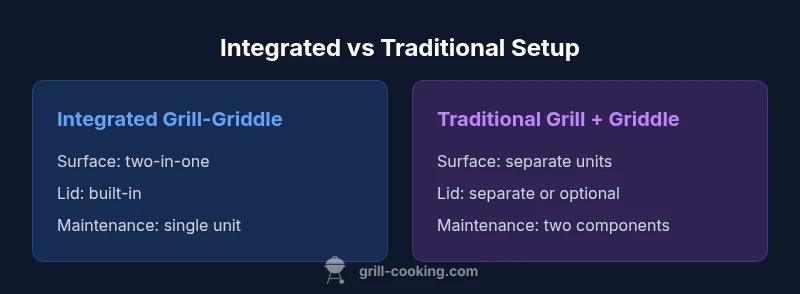
Grill and Griddle Combo with Lid: Side-by-Side Comparison for Home Cooks
Compare grill and griddle combo with lid setups to traditional grills. Analyze features, versatility, price ranges, and maintenance to choose the best lid-equipped cooking solution for home cooks.


For most home cooks, a grill and griddle combo with lid offers the best of both worlds: searing on grill grates and finishing on a flat-top, all under a single lid. This comparison weighs integrated lid-equipped units against traditional setups to help you decide which fits your space and cooking style.
Why a grill and griddle combo with lid matters for home cooks
In today’s backyard kitchens, space is a premium and versatility is king. A grill and griddle combo with lid provides a compact, all-in-one cooking station that can handle sizzle and sauté without the clutter of multiple devices. The lid isn’t just a weather shield; it traps heat to accelerate cooking on the flat-top and helps manage airflow during high-heat searing. According to Grill Cooking, many home cooks value the simplicity of a single unit that can switch from burgers to breakfast without rearranging equipment. This section sets the stage for a practical, evidence-based comparison between integrated lid-equipped models and traditional setups, focusing on real-world workflows, maintenance, and value. Expect to see how lid design, surface configuration, and build quality influence everyday cooking.
Key design features to compare
Design choices drive performance in lid-equipped combos. The most important features to evaluate include surface configuration (grill-only, flat-top-only, or a true two-in-one), lid quality (solid hinge, weather resistance, and sealing), material selection (stainless steel, cast iron, or aluminum), heat source compatibility (gas, charcoal, or hybrid), and grease management (drip tray vs trough). A well-designed unit blends fast heat-up with uniform distribution, while the lid helps push heat inward for even cooking on both surfaces. In this section, we’ll translate those specs into practical expectations for everyday meals and weekend gatherings. Grill Cooking Team members emphasize that a robust lid and sturdy construction are worth paying for when you plan to cook at varying heights and temperatures.
Surface configuration and versatility
A lid-equipped grill-griddle combo can combine two distinct cooking surfaces in one footprint. Some models offer a true two-zone surface with an integrated flat top adjacent to a raised grill, while others use a reversible or removable plate that doubles as a griddle. The key advantage is a seamless workflow—sear on the grill, switch to the griddle for eggs, pancakes, or sautéed vegetables, then close the lid to retain heat and finish. The tradeoffs typically involve overall footprint and potential limits on the maximum flat-top area. Home cooks should map their typical meals to determine whether an integrated surface best suits their weekly menus or if flexibility wins the day.
Real-world usage scenarios
Consider how you cook during a typical week. If you regularly prepare a breakfast-for-dinner lineup, a lid-equipped combo saves space and time by letting you fry eggs and crisp bacon while simulating a pan-sear on the grill side. For weeknights, an all-in-one unit can cut down on prep steps and post-cook cleanup, since you’re dealing with one appliance rather than multiple devices. However, if your kitchen space can accommodate separate culinary zones or if you frequently need to upgrade components (e.g., larger griddle plates or specialized heat shields), a traditional two-piece setup might deliver greater long-term value. Grill Cooking Analysis, 2026 notes that homeowners on smaller patios often prefer integrated lids for their practicality, but those with growing outdoor kitchens may prioritize modularity.
Durability and warranty expectations
Durability begins with the choice of materials. Stainless steel frames resist weathering, while cast iron surfaces retain heat but require seasoning and careful rust prevention. A lid with a robust seal and reliable hinges reduces heat loss and contributes to quieter operation. Warranty terms vary by brand and model but generally favor units sold as a single package with a unified warranty, which can simplify customer service if a component fails. When evaluating, compare coverage windows, what’s included (lid, grates, heat plates), and whether the warranty transfers should you upgrade your outdoor cooking area.
Heat distribution and lid behavior
Heat distribution matters most when you cook across two surfaces. The lid helps create a quasi-ovens-like effect, enabling indirect cooking on the flat-top while the grill side handles direct heat. For thicker proteins or delicate items resting on the flat top, the lid helps maintain moisture and prevents scorching. The strongest lid-equipped designs avoid hot spots by ensuring even lid pressure and a well-engineered air gap. Grill Cooking Team’s experience suggests looking for models with reinforced hinges, tight seals, and a lid that remains stable under frequent opening and closing.
Comparison
| Feature | Grill-and-Griddle Combo with Lid | Traditional Grill + Separate Griddle Plate (no integrated lid) |
|---|---|---|
| Surface versatility | Integrated two-in-one surface (grill + flat top) | Two separate surfaces (grill + detachable griddle) |
| Heat control with lid | Lid enables indirect heat control and moisture retention | Lid is optional or not included; indirect heat depends on design |
| Cleaning complexity | Single unit; fewer parts to manage | Two surfaces; more components and joints |
| Space efficiency | Compact footprint; all-in-one solution | Requires footprint for two devices |
| Price range | Mid-range to high (integrated) | Low to mid-range (separate components) |
| Best for | Small spaces and streamlined workflow | Flexibility and upgrade paths |
| Durability/warranty | Unified warranty on one unit | Separate warranties on each component |
Strengths
- Maximized space efficiency in compact patios
- Streamlined workflow with fewer parts to manage
- Built-in lid improves heat control and moisture retention
- One warranty can simplify claims
- Easier setup for absolute beginners
Negatives
- Higher upfront cost and potentially fewer upgrade options
- Limited surface area on compact units
- Repairs can be more complex if a single unit fails
- Less flexibility than modular setups
Integrated grill-griddle lid combos offer space efficiency and cohesive heat control, with tradeoffs in cost and modularity.
Choose an integrated unit if you have limited space and want a single, all-in-one cooking station. If you value maximum flexibility and lower upfront cost, a modular approach might serve you better.
FAQ
What is a grill and griddle combo with lid?
It's a single cooking unit that combines grill grates and a flat-top surface, both covered by a lid to control heat and moisture. It aims to deliver two cooking methods in one footprint.
It's a two-in-one cooking station with searing and flat-top cooking under one lid.
Is a lid necessary for even cooking on a combo?
A lid helps maintain consistent temperatures and moisture, which improves even cooking on larger cuts. If you primarily sear and use the flat top for quick items, a lid may be less critical.
Yes, the lid helps with even cooking and moisture control.
Can I use a grill-griddle combo for breakfast and burgers?
Absolutely. The flat-top surface excels at eggs, pancakes, and sautéed vegetables, while the grill handles burgers, steaks, and veggies. Plan your heat zones to avoid cross-contact and manage timing.
Yes—cook eggs on the flat top, burgers on the grill, with proper heat zoning.
How do I clean an integrated grill-griddle with lid?
Let the unit cool, then wipe surfaces with non-abrasive cleaners. Remove grates and rinse, then reseason cast iron surfaces if present. Dry thoroughly to prevent rust and follow manufacturer maintenance instructions.
Cool, wipe, remove and clean components, then dry and reseason if needed.
Are portable versions available with lids?
Yes, several portable models include lids, but they may sacrifice some surface area or stability. Weigh portability against cooking volume and heat retention.
There are portable lids, but check size and heat retention.
What should I consider when choosing size and materials?
Consider your cooking volume, storage space, and weather exposure. Materials like stainless steel resist corrosion, while cast iron offers heat retention but requires seasoning.
Think about space, weather, and material durability.
Quick Summary
- Assess space first to decide integrated vs modular.
- Prioritize lid quality for even cooking.
- Compare price ranges and warranty coverage.
- Test cleaning ease to lower maintenance over time.