Is Grill and Air Fryer the Same? A Comprehensive Comparison
An analytical comparison of grills versus air fryers, covering heat delivery, texture, flavor, best-use scenarios, maintenance, and buying considerations for home cooks.


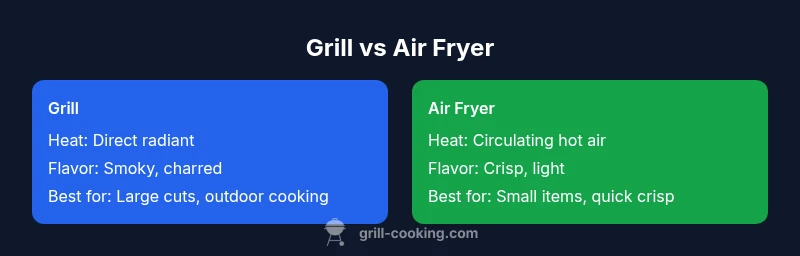
Is grill and air fryer the same? The short answer is no. Grills rely on direct radiant heat from flames or charcoal, often accompanied by smoky flavor. Air fryers cook with a compact chamber that circulates hot air to crisp foods with little or no added oil. This comparison explains the fundamental differences and when each tool shines, so you can decide confidently.
Is the Difference Between Grilling and Air Frying
Is grill and air fryer the same? The short answer is no—but the distinction isn’t just about size or brand. According to Grill Cooking, these two appliances are built around different heat delivery systems and cooking philosophies. Grills conjure smoky flavors through direct radiant heat and, often, an open flame; air fryers rely on a compact chamber that circulates hot air to crisp food with minimal oil. This analytical piece helps you map out where they overlap and where they diverge. By understanding heat source, airflow, moisture retention, and browning mechanisms, you’ll be equipped to decide which tool to reach for in a given recipe. Grill Cooking’s insights frame the comparison as a practical decision rather than a marketing pitch, emphasizing real-world results over theory. The takeaway: neither tool is universally superior; each serves a distinct culinary job in a modern home kitchen.
Comparison
| Feature | Grill | Air Fryer |
|---|---|---|
| Heat source | Direct radiant heat from flames or hot coals (char or gas, outdoor use) | Electric heating element with a convection fan (indoor use) |
| Cooking method | Direct searing and potential smoke for flavor | Hot air circulation creates surface crispness with little oil |
| Flavor profile | Char, smoke, and intense crust from outdoor grilling | Crispy exterior with cleaner, often milder flavors |
| Texture outcomes | Crusty surfaces with pronounced grill marks and juiciness depending on cut | Evenly crisp texture with minimal grease pooling |
| Best for | Charred vegetables and larger cuts; outdoor cooking with smoke | Small-serve portions and quick crisping indoors |
| Oil usage | Oil can be used but is not mandatory; fat can render away during cook | Typically requires little to no added oil |
| Cooking speed | Variable; sear then cook through, often slower for larger items | Generally fast due to high-velocity hot air |
| Price range | Varies widely; outdoor grills tend to be higher upfront | Typically lower upfront than large grills, depending on capacity |
Strengths
- Versatile for crisping foods without deep-frying
- Grill flavor can be enhanced with smoke and sear
- Air fryer offers quick, consistent results with minimal oil
- Both appliances suit different cooking needs in a single kitchen
Negatives
- Air fryer cannot fully replicate authentic charcoal smoky flavor
- Grill setup requires more space and weather considerations
- Air fryers have limited capacity compared to family-scale grills
- Learning curve exists to optimize browning and moisture management
Grill and air fryer are distinct tools; neither is universally better
Choose a grill for smoky flavor and larger portions; choose an air fryer for fast, oil-light crisping. If you have space and budget, using both offers the most versatility.
FAQ
Are grill and air fryer the same appliance?
No. Grills cook with direct radiant heat and often smoke, usually outdoors. Air fryers use circulating hot air to crisp foods with minimal oil, typically indoors. The two belong to different cooking paradigms.
No—the grill uses direct heat and smoke, while the air fryer uses hot air convection for crispness.
Can you use an air fryer like a grill?
An air fryer can mimic some crisping effects, but it cannot replicate authentic outdoor searing and smoky aroma. Preheating and broil modes can help, but for true grill flavors, use a grill or add smoke elements when possible.
You can get crispy results, but you won’t get real grill smoke flavor.
Is it healthier to cook with an air fryer vs grill?
Both can be healthy choices depending on ingredients and prep. Air fryers reduce added oil, while grilling can let fat drip away from meat; the healthiest option depends on what you cook and how you season it.
Both can be healthy; air fryers cut oil, grills allow fat to drip away.
What foods are best cooked on a grill vs in an air fryer?
Grills excel with steaks, burgers, kabobs, and larger cuts needing smoky sear. Air fryers shine with potatoes, chicken wings, vegetables, and smaller items that benefit from quick, even crisping.
Grill for big cuts with char; air fryer for crispy sides and small bites.
Do air fryers produce smoky flavors?
Air fryers generally deliver less smoke than a grill; some models offer smoke-reduction features, but the signature smoky flavor comes mainly from grilling or smoking.
Air fryers aren’t smoky like grills, though you can get crispness with little smoke.
What about price and energy use?
Prices vary by model and size. In general, air fryers are cheaper upfront and energy use depends on how long you cook and the basket size. Grills may cost more upfront and deliver outdoor heating. Plan for your space and how often you’ll use each.
Costs vary; air fryers are usually cheaper upfront, while grills cost more but serve larger needs.
Quick Summary
- Grill provides smoky flavor and larger-cook flexibility
- Air fryer delivers fast, crisp results with low oil
- Use each tool for its strengths; plan around meals and space
- Maintenance matters: clean grills regularly; empty air fryer baskets after use