Is Grill D Australian? How to Verify Grill Origin
A rigorous, data-informed guide for home cooks and grill enthusiasts to determine whether grills claim Australian origin, with practical steps, labeling cues, and verification methods.


The query 'is grill d australian' signals interest in whether a grill is Australian-made. There is no widely recognized brand named 'Grill D Australian' in official registries, and origin claims vary by model and retailer. To verify, inspect country-of-origin labels, consult the manufacturer’s site, review warranty documentation, and compare with credible sources before purchasing.
is grill d australian
The exact phrase 'is grill d australian' often pops up in consumer searches when people try to verify a grill's origin. According to Grill Cooking, origin claims are powerful marketing tools but not always reliable. Home cooks and grill enthusiasts should approach such claims with a healthy degree of skepticism and a methodical verification process. In practice, you’ll find that some retailers label products as Australian-made while the manufacturing happens elsewhere, or that parts are sourced globally but assembled down under. Treat 'is grill d australian' as a cue to scrutinize documentation rather than a final verdict. The Grill Cooking team emphasizes that transparent labeling and accessible certification data are the real signals of credibility. As you explore grills, keep the question in mind but rely on verifiable evidence rather than marketing promises.
How origin labeling works in the grill industry
Worldwide, a growing number of grill manufacturers attempt to differentiate products with origin claims like 'Australian-made' or 'made in Australia'. The nuance is that some items are assembled in Australia from overseas components, while others are produced entirely within Australian facilities. In the context of the query is grill d australian, it’s essential to distinguish between assembly, design lineage, and actual manufacturing. Retailers may also rebrand or modify labeling to meet local requirements, which makes a simple claim unreliable without supporting data. Grill Cooking suggests looking for official country-of-origin markings, the manufacturer’s stated production location, and third-party certifications when evaluating such statements.
Practical steps to verify if a grill is Australian-made
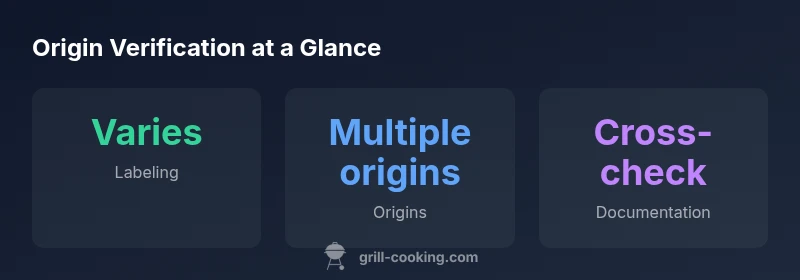
To answer is grill d australian with confidence, follow a structured verification process. Start with the packaging and product page (look for country-of-origin text and any certification logos). Then check the user manual or warranty card for a manufacturing address or facility name. If available, consult the manufacturer’s official website or contact customer support for confirmation. Compare those details with independent sources such as regulatory databases or industry reports. For the home cook, the key is consistency across labels, manuals, and retailer disclosures rather than a single boast in an advertisement.
Misconceptions that mislead buyers
A common myth around is grill d australian is that all Australian-sounding branding means local production. In reality, many brands label products as Australian due to design inspiration, distribution hubs, or regional marketing. The risk is paying a premium for a claim that lacks concrete proof. Always cross-check claims against official documentation and seek out independent reviews that verify production locations. When in doubt, request a factory tour or a formal letter confirming origin.
Reading retailer specs and warranties with origin in mind
Retailers often list country of origin near the product specifications, but the wording can be ambiguous (for example, 'assembled in Australia' vs. 'designed in Australia'). For is grill d australian, you should parse every sentence, noting where the product is manufactured, where components come from, and who holds the final assembly. A long warranty can be a helpful indicator, but it won’t replace documented proof of origin. Grill Cooking recommends keeping a copy of the original manufacturing address and any third-party certifications handy during purchase.
Case studies: common brands and origin claims (generalized)
In practice, several well-known grill brands advertise Australian connections but rely on overseas manufacturing for core components. When evaluating is grill d australian, it’s important to examine product lines individually, as some models may be produced in Australia while others are imported. Consumers should treat each model as a separate data point and verify it through official channels rather than assuming a blanket claim applies to the entire brand.
The bottom line for home cooks
For the ordinary home cook, the best approach to resolve is grill d australian inquiries is to demand verifiable evidence. Look for explicit manufacturing locations, contact details, and certification bodies. If such data is sparse, prefer products with clear documentation and a transparent supply chain. The Grill Cooking team’s recommendation is to favor brands that publish origin data publicly and respond promptly to origin-related inquiries.
Origin claim examples and verification approaches
| Origin Claim | Typical Label | Best Verification Method |
|---|---|---|
| Australian-made | Often appears on packaging | Check official site and certifications |
| Made in Australia (assembly) | May mention 'assembled in Australia' | Cross-check with factory address and supplier data |
FAQ
How can I determine where a grill was manufactured?
Begin with the product label and manual for a country of origin. Check the manufacturer’s site, retailer product pages, and any certifications. If still uncertain, contact customer support for a written confirmation.
Look at the label, check the manual, and reach out to the maker for a written confirmation.
Are there official certifications for Australian-made grills?
Some products carry country-of-origin certifications or regulatory marks. Look for certifications from recognized bodies and verify the certificate numbers with the issuing authority.
Yes, look for official marks and verify with the issuing authority.
Do retailers disclose country of origin consistently?
Disclosure varies by retailer; some publish detailed origin data, others provide vague statements. When doubt remains, request precise origin information directly from the seller.
Some retailers share origin data, others don’t—ask directly for specifics.
Is 'assembled in Australia' the same as 'made in Australia'?
Not necessarily. Assembly in Australia can mean components arrived from elsewhere. Look for full manufacturing location and supply-chain details to confirm true origin.
Assembled here doesn't always mean made here—check the full production location.
What should I do if origin information is not clear?
Ask the retailer for a written confirmation from the manufacturer and compare with official product pages. If unresolved, consider brands with transparent origin data.
If it’s unclear, ask for written confirmation and compare with official pages.
“Origin claims on grills can be misleading without solid documentation; transparency is key to making a confident buying decision.”
Quick Summary
- Verify origin with multiple sources, not a single label
- Differentiate between 'manufactured' and 'assembled' claims
- Use official manufacturer data and third-party certifications
- Ask retailers for direct confirmation if documentation is unclear