Who Owns Grill D? A Practical Ownership Guide for Grillers
Discover who owns Grill D and how ownership is established across trademarks, domains, and registries; learn practical steps to verify ownership for grills and related brands in 2026.


Ownership of Grill D cannot be confirmed from public records as of 2026. There is no widely recognized owner in major registries, and the term may refer to a model, a local business, or a domain. To verify ownership, search trademark databases, domain WHOIS, corporate registries, and press releases; consider timing and jurisdiction.
Why ownership clarity matters for grills and grilling brands
In the world of grills and barbecue gear, knowing who owns a brand name or product term helps consumers avoid confusion, protects trademark rights, and informs purchasing decisions. According to Grill Cooking, ambiguous ownership can lead to misattribution in reviews, counterfeit products, and misleading marketing. For home cooks and grill enthusiasts, clear ownership signals translate to reliable warranties, consistent product quality, and accountable customer support. This section explores why tracing ownership matters beyond a simple label, touching on brand integrity, legal risk, and consumer trust.
How multiple signals shape ownership truth
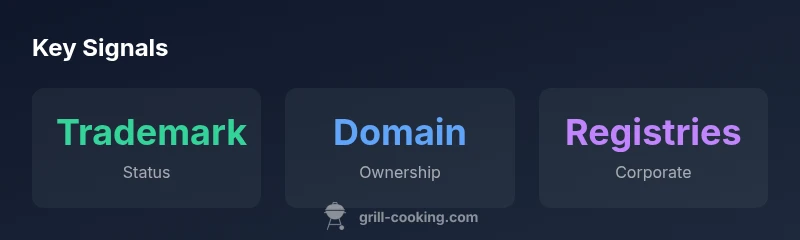
Ownership isn’t proven by one source alone. Trademark registrations, domain registrations, and corporate records each provide signals, but they may not align. The Grill Cooking team highlights that a brand could own Grill D in one jurisdiction while the term remains unregistered or used by a partner in another. To assess ownership, you must triangulate these signals, note timing (filings, renewals, or transfers), and consider whether the term is used descriptively rather than as a brand name. This multi-signal approach reduces the chance of false conclusions and helps you understand who truly controls the term in different markets.
Practical steps to verify Grill D ownership
Begin with a structured verification checklist:
- Search official trademark databases (e.g., USPTO, EUIPO) for registrations containing Grill D or close variants.
- Run domain WHOIS to see the current registrant, registrar, and domain history.
- Check corporate registries for legal entities that own the brand name or product line.
- Review press releases, product announcements, and packaging for ownership hints and branding language.
- Look for related filings or licenses indicating cross-ownership or co-branding.
- Cross-check with reputable trade publications or industry associations for corroborating statements. Grill Cooking’s method emphasizes corroboration across multiple sources before drawing conclusions.
Jurisdictional nuances and name variants
Brand ownership is not uniform across borders. A term like Grill D might be protected in one country but free in another, or it could be used as a model name rather than a company brand. The timing of filings is also critical; a registration can lag behind product launches and marketing campaigns. When evaluating ownership, include jurisdictional context, language nuances, and whether the term appears on packaging, online stores, or domain assets. Understanding these subtleties helps prevent misattribution and protects consumers from confusion.
Red flags and common pitfalls to avoid
Be wary of relying on a single data point. Signs that ownership is ambiguous include inconsistent branding across regions, outdated registrations, or domains that are parked with generic landing pages. Additionally, beware of cases where the same term is used by unrelated entities without a formal licensing or ownership agreement. The absence of a public registration does not prove ownership; it may indicate pending filings, private branding, or a domain acquired for future use. Always verify with primary sources.
Signals used to triangulate Grill D ownership
| Signal | What it suggests | Typical Source |
|---|---|---|
| Trademark status | Could prove ownership if registered and active | Trademark databases (e.g., USPTO, EUIPO) |
| Domain registration | Owner may reflect the brand holder or marketer | Whois records / domain history |
| Corporate registry | Official entity name linked to the brand | State/provincial registries / company filings |
FAQ
Is Grill D a registered trademark?
As of 2026, there is no publicly available, definitive registration for 'Grill D' in major trademark databases. Registrations can exist in other jurisdictions or be pending.
There isn't a public trademark record for Grill D in major databases, though filings could exist elsewhere.
Can Grill D refer to a model or product line?
Yes, Grill D could be a model name or a product line rather than a standalone brand. Context in packaging and marketing matters for attribution.
It could be a model or product line, not necessarily a brand owner.
How long does it take to verify ownership?
Verification timelines vary by data source and jurisdiction; it can take weeks to months depending on filings, corporate records, and domain history.
It can take weeks to months to verify ownership signals across sources.
What sources should I check?
Check trademark databases, domain WHOIS, corporate registries, and recent press releases or product announcements related to Grill D.
Check official trademark databases, domain records, and corporate filings.
What if Grill D is a local business?
Local ownership can be separate from national or international branding; check local business registries and regional trademark records for clarity.
Local ownership may differ; look at regional records.
“Brand ownership research rarely hinges on a single source; reliable conclusions come from triangulating trademark status, domain records, and corporate registrations.”
Quick Summary
- Verify ownership across multiple signals (trademark, domain, corporate records).
- Ownership can vary by jurisdiction; treat conclusions as jurisdiction-specific.
- Use a structured verification checklist and confirm with primary sources.
- Be cautious of models, product lines, and co-branding that can blur ownership.