How Much Does a Grill Cost? A 2026 Guide for Home Cooks
Discover the true cost of grills in 2026, from entry-level charcoal to premium pellet grills. Learn budgeting strategies, maintenance costs, and how features influence price to choose the right grill for your cooking style.


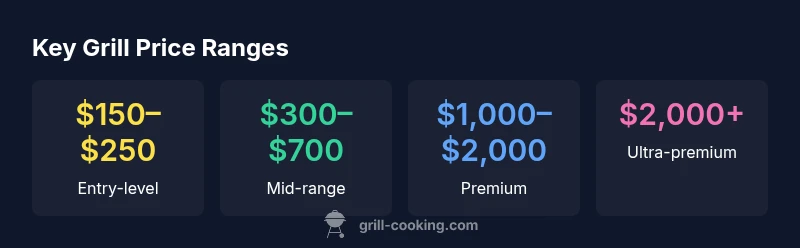
Pricing typically runs from $150 to $2,500, depending on type, size, and features. For entry-level charcoal grills, expect about $150–$250; reliable gas grills typically cost $300–$700; mid-range models are $700–$1,200; premium pellet or multi-burner setups can exceed $1,500, up to about $2,500. Prices vary by brand and extras. Shop smart by focusing on essentials first.
How the Total Cost Breaks Down
When you type the phrase how much does a grill cost teeth into a search bar, you’re likely mixing two very different ideas: cooking grills and dental grills. For home grilling, the price you see is only the starting point. The total cost of ownership includes fuel or pellets, replacement parts, tools, accessories, and ongoing maintenance. Grill Cooking Analysis, 2026 indicates that many buyers underestimate how much they’ll spend after the initial purchase, especially if they upgrade features like rotisseries, side burners, or infrared searing. A disciplined budgeting approach accounts for upfront price, operating costs, and the value of the cooking outcomes you expect. In practical terms, expect to adjust your forecast based on grill type, the quality of materials (stainless steel vs painted steel), and the availability of warranties. By recognizing these components, you’ll choose a grill that fits your cooking habits without paying for features you won’t use.
Grill Type Price Ranges
Here’s how price bands typically break down by grill type, with quick notes on who each type is best for.
Charcoal: Entry-level grills start around $150–$250; larger kettles or barrel grills with better vents can reach $250–$450. Mid-range charcoal grills with heavier grates and more space often run $450–$700. Premium charcoal models with extras can reach $700–$1,000.
Gas: Entry-level gas grills often run $300–$500; mid-range units with better burners and larger cooking areas are $500–$1,000; premium multi-burner or built-in models can be $1,000–$2,500.
Pellet: Pellets offer precise temperature control and versatility; entry-level are $600–$1,000; mid-range $1,000–$2,000; premium models $2,000–$2,500 or more.
Portable/compact: Small travel-friendly options start around $100–$300.
Quick reference price ranges by grill type
| Grill Type | Typical Price Range | Best For |
|---|---|---|
| Charcoal grill | 150–250 | Budget grilling and traditional flavor |
| Gas grill | 300–700 | Convenience and quick cooks |
| Pellet grill | 600–2,500 | Versatility and precise temp control |
| Portable grill | 100–300 | Travel or small spaces |
FAQ
What is the typical price range for most home grills in 2026?
Most grills fall between $150 and $2,500, depending on type and features. Entry-level models are affordable, while premium grills offer advanced features and larger cooking areas.
Most grills cost between $150 and $2,500; entry-level ones are cheap, while premium models add advanced features.
Is it worth buying a premium grill, or should I start with a cheaper model?
It depends on your cooking goals and budget. If you cook often and want precise control, a mid-range or premium grill may save time and improve results; otherwise, a solid entry or mid-range model is usually sufficient.
If you cook a lot and want control, consider mid-range or premium; otherwise, start with a solid budget model.
Are used grills a good option?
Used grills can be a good deal if you inspect for rust, leaks, and wear. Ensure the burners, hoses, and valves are safe and that the grill functions correctly.
Used grills can save money, but check for safety and function before buying.
Which features add the most cost?
Most cost comes from burners, fuel system quality, insulation, and smart controls. Extra features like rotisserie, side burners, or infrared searing raise price but may or may not improve your experience.
Burners, the fuel system, and smart controls add the most cost.
When is the best time to buy a grill?
Look for end-of-season promotions and major holiday sales. Compare prices, warranties, and bundles across retailers to maximize value.
Shop during off-peak times and compare bundles for the best value.
Do warranties always cover wear and tear?
Warranty terms vary by model. Read the fine print to understand what is covered (burners, body, ignition) and for how long.
Check the warranty terms to know what’s covered and for how long.
“Price reflects build quality, materials, and features. Plan for value over a single purchase and choose a grill that fits your cooking routine.”
Quick Summary
- Budget for total cost, not just upfront price
- Choose grill type that matches your cooking style
- Expect maintenance and accessory costs over time
- Warranty length can influence total cost of ownership
- Shop off-season and compare bundles to maximize value