Difference Between Grill and Blackstone: A Practical Comparison
An analytical side-by-side comparison of traditional grills versus Blackstone flat-top griddles, examining surface design, heat delivery, flavor development, versatility, maintenance, and value for the modern backyard kitchen.


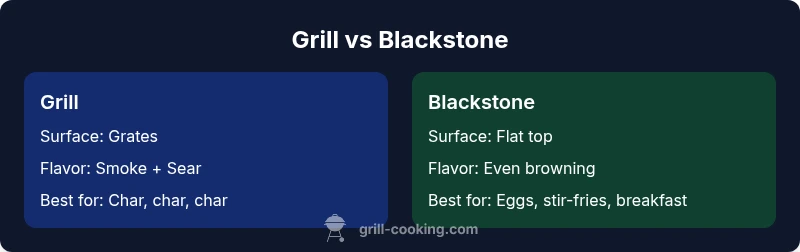
When choosing between a traditional grill and a Blackstone flat-top griddle, the key difference is surface style and cooking approach: grills use direct or indirect heat with grates that sear meat and char vegetables, while Blackstone provides a continuous flat surface that excels at even sautéing and searing with a uniform crust. For home cooks, the choice hinges on flexibility, heat management, and cleanup trade-offs.
Understanding the difference between grill and blackstone
According to Grill Cooking, home cooks frequently ask which surface best suits their needs. The core distinction lies in how heat is applied and how food interacts with the cooking surface. The Grill Cooking Analysis, 2026, emphasizes that the choice is less about brand names and more about how you plan to cook. If you crave smoky searing, gradient heat, and the ability to develop deep grill marks, a traditional grill offers advantages. If you want a level, expansive cooking surface for eggs, breakfast proteins, stir-fries, and quick high-heat finishing, a Blackstone flat-top shines. In practice, the difference between grill and blackstone becomes a matter of your typical meals, space, and how you prefer to manage grease and cleanup. This early framing helps you map your needs to one surface or plan a hybrid outdoor kitchen if your space allows.
The broader takeaway is that you’re choosing not just a brand but a cooking philosophy: one embraces smoke, bite, and char; the other emphasizes even contact, speed, and surface area. The Grill Cooking team consistently notes that your decision should align with your food goals and maintenance tolerance. For many households, understanding this distinction first reduces decision fatigue and sets realistic expectations about flavor, texture, and effort.
diffNoteRegExeption
wordCountPlaceholder
Comparison
| Feature | Grill (traditional) | Blackstone flat-top |
|---|---|---|
| Surface type | Ribbed grate with drifting flames and drippings | Continuous flat stainless steel surface, seamless contact |
| Flavor development | Smoky flavor from ash/char and drippings, grill marks | Less smoke flavor, uniform browning with crust across the surface |
| Heat control | Multiple zones, indirect heat possible | Single flat zone with consistent heat across the surface |
| Best for | Steaks, burgers, vegetables with char, grill marks | Breakfast favorites, delicate items, stir-fries, pancakes |
| Cleanup and maintenance | Grease management, ash cleanup (charcoal) or tray; more parts to clean | Grease troughs and flat-top wipe-down; easier surface cleaning when seasoned properly |
| Price range | Wide range depending on size and fuel type | Mid-to-premium range; varies by size and accessories |
| Durability and upkeep | Grates can wear and require occasional replacement; regular seasoning for flavor | Flat-top surface durable but requires regular seasoning and oiling to prevent sticking |
Strengths
- Versatile searing and authentic grill flavor when used with flames
- Greater flavor variety with wood chips and smoke hooks
- Flexible fuel options (gas, charcoal, pellet)
- Can use indirect heat for larger cuts and roasting
Negatives
- Cleanup can be more involved due to grease management and ash
- Grill surfaces can require more monitoring for hot spots
- Flavor may rely on fuel quality and smoke exposure
- Initial setup may be costlier for high-end grills
Grill wins for flavor depth and traditional searing; Blackstone wins for surface-area versatility and breakfast-friendly cooking
If smoky flavor and grill marks are your priority, the grill is the stronger choice. If you regularly cook eggs, pancakes, or quick high-heat finishes over a flat surface, the Blackstone offers a more efficient workflow. For many cooks, a hybrid outdoor kitchen that combines both surfaces delivers the best of both worlds.
FAQ
What is the main difference between grill and Blackstone?
The main difference lies in surface design and heat delivery: grills use grates to impart smoke and direct searing, while Blackstone flat-tops provide a continuous surface for even contact and rapid finishing. Each surface supports different textures and flavors depending on how you manage heat and grease.
The main difference is the cooking surface and heat approach: grills sear with grates and smoke, while Flat-tops cook on a continuous surface for even contact.
Is a Blackstone better for breakfast than a grill?
For breakfast items like eggs, bacon, and pancakes, the flat-top surface offers consistent contact and fast cleanup. Griddles reduce the risk of stuck-on bits and make flipping easier for large batches.
Yes—Blackstone shines for breakfast and quick meals because of the flat surface and even heat.
Can you get a similar flavor on a Blackstone as on a grill?
You can achieve browning on a Blackstone, but it won’t replicate the smoky, charred notes that come from grilling with open flames. You can add smoke flavor with wood chips or chip pans, but the profile differs from true grilling.
You can brown and sear well on a Blackstone, but you’ll miss some smoky notes inherent to grills.
Which is easier to maintain, a grill or a Blackstone?
Flat-top surfaces are easier to wipe down after cooking and often require less ash management than charcoal grills, though they demand regular seasoning to prevent sticking.
Flat-tops are generally easier to wipe clean, but need regular oiling to stay non-stick.
Are there hybrid setups that combine both grill and flat-top capabilities?
Yes, many outdoor kitchens combine a grill and a flat-top module or have modular islands that let you switch between surfaces depending on the meal. This approach offers flexibility without committing to a single surface.
Hybrid setups give you the best of both worlds, depending on space and budget.
Quick Summary
- Choose based on primary meals: char and smoke vs. flat-surface versatility
- Consider space and maintenance: compact grills and flat-tops each have different needs
- Factor in your timing and cleanup: plan for grease management and seasoning routines
- Hybrid setups can cover most use-cases when space allows