Difference Between Grill and Air Fryer: An In-Depth Comparison
Explore the difference between grill and air fryer, covering heat sources, texture, speed, energy use, and best-use scenarios for home cooks and grill enthusiasts.


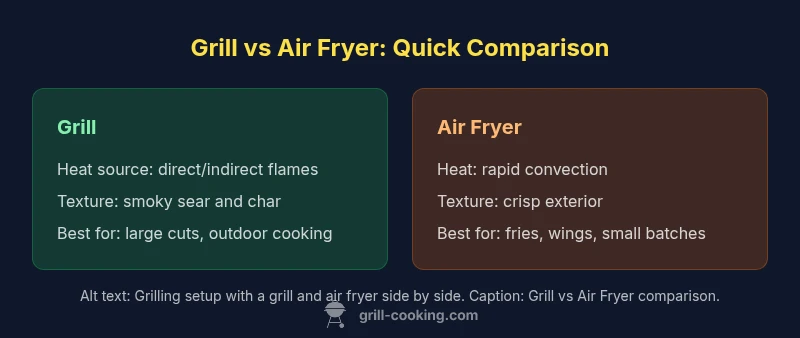
The difference between grill and air fryer comes down to heat source, cooking method, and texture. Grilling uses direct or indirect high heat to sear, char, and add smoky flavor, ideal for steaks, burgers, and vegetables. An air fryer relies on rapid convection to crisp foods with little oil, perfect for wings, fries, and bite-sized snacks. Your choice depends on texture goals, space, and cooking pace.
What the difference between grill and air fryer means for home cooks
For home cooks, understanding the difference between grill and air fryer starts with heat source, cooking approach, and the texture you want to achieve. According to Grill Cooking, these tools serve distinct culinary roles, shaping menu planning, timing, and cleanup. A grill relies on direct or indirect radiant heat from charcoal or gas, delivering sear marks, a deeper smoke note, and robust flavor that can stand up to bold sauces. An air fryer uses a controlled convection fan to move hot air around the food, producing a quick, even crisp with minimal oil. The difference between grill and air fryer is not just about speed; it’s about how heat interacts with fats, proteins, and moisture to create different textures. In this article we’ll map the key distinctions, illustrate practical examples, and provide a decision framework to help you pick the right tool for each dish you cook at home.
Heat delivery and browning: the core differences in the difference between grill and air fryer
Heat delivery sits at the core of the difference between grill and air fryer. On a grill, heat travels from flames or heated surfaces through direct contact or radiant heat, which creates rapid crust, caramelization, and a smoky aroma that characterizes grilled meals. Indirect heat keeps larger cuts from scorching while still adding flavor through slow, steady cooking. An air fryer, by contrast, relies on a high-velocity stream of hot air to surround each piece of food, resulting in even browning and crispness without the need for a heavy flame. The Grill Cooking team notes that this airflow-driven browning favors surface texture and dryness, while the inside remains moist when cooked properly. If your goal is a charred exterior with authentic barbecue notes, grilling is the preferred method. If you want a quick, evenly crisp finish with minimal oil, the air fryer delivers reliably. In practice, many cooks use a hybrid approach: sear on the grill for flavor, then finish in an air fryer for a crisp finish.
Comparison
| Feature | Grill | Air Fryer |
|---|---|---|
| Heat Source | Direct/indirect radiant heat (charcoal/gas) | Rapid convection of hot air |
| Texture / Flavor | Char, smoke, and sear marks | Crisp exterior with minimal oil |
| Best For | Large cuts, outdoor cooking, smoky flavor | Small batches, quick crisping, indoor use |
| Capacity / Batch Size | High capacity per session | Limited basket capacity |
| Cooking Time | Variable; often longer for large items | Usually faster for small portions |
| Maintenance | Grates; ash management or drip tray depending on fuel | Removable basket with easy cleaning |
| Energy / Fuel | Gas/charcoal; energy costs vary by fuel | Electricity; predictable consumption |
| Safety | Open flames; outdoor use; flare-ups | No open flames; hot surfaces; indoor safety |
Strengths
- Searing and smoky flavor on the grill adds character to main dishes
- Air fryer delivers fast, consistent crisp with minimal oil
- Both tools expand weeknight cooking options for different textures
- Grill capacity supports large batches and social cooking
Negatives
- Air fryer basket size can limit batch cooking
- Grill setup requires outdoor space and weather consideration
- Grill cleanup can be messier with fats and flames
- Air fryer may not replicate true smoky flavor
Grill and air fryer complement each other; use each tool for its strengths.
For flavor and crowd-pleasing mains, the grill wins; for quick, crispy sides and weeknight meals, the air fryer shines. Use both to expand texture options and cooking efficiency.
FAQ
What is the main difference between grill and air fryer?
The primary difference is the heat delivery and resulting texture. A grill uses direct or indirect flames to create smoke and sear, while an air fryer uses rapid air convection to produce a crisp finish with little oil. Both have distinct advantages depending on the dish and texture you want.
The grill gives you smoky flavor and char, while the air fryer gives you fast, crispy results with less oil.
Can I mimic grill flavor using an air fryer?
You can approach grill-like flavor by adding smoke-flavored chips in some models, using marinades that caramelize well, and finishing with a quick sear or broil to create surface browning. However, true smoky notes come primarily from direct heat and smoke exposure on a grill.
You can get closer with seasoning and finishing techniques, but you won’t fully replicate real grill smoke.
Are air fryers healthier than grills?
Air fryers often use less oil, which can lower fat in some dishes. Grills allow fat to drip away from the food, which can also influence health metrics. Health outcomes depend on the ingredients and cooking methods you choose; neither tool automatically ensures a healthy result.
Both can be healthy with smart choices; it’s about oil, portion size, and how you cook, not the appliance alone.
Which cooks faster for small portions?
Air fryers typically finish small portions faster due to rapid convection and compact air circulation. For very small items, the air fryer is often quicker than a grill that requires preheating and outdoor setup.
In most cases, the air fryer is the quicker option for small servings.
What foods are best suited to each appliance?
Grills excel with steaks, chops, burgers, and vegetables that benefit from smoky flavors and high-heat searing. Air fryers shine with fries, wings, and bite-sized items that benefit from a crispy exterior with minimal oil.
Grill for big, flavor-forward dishes; air fryer for quick, crispy sides and snacks.
What safety considerations should I know?
Grilling outdoors requires a stable setup, fire control, and proper distance from structures. Air fryers require ventilation and careful handling of hot baskets. Always follow manufacturer guidelines for both appliances and keep children away from hot surfaces.
Be mindful of hot surfaces and flare-ups on the grill, and of hot baskets on the air fryer.
Quick Summary
- Assess texture goals before choosing a method
- Grill for smoky flavor and large batches
- Air fryer for quick, crispy results with minimal oil
- Consider space, weather, and kitchen layout
- Experiment with hybrid approaches for best results
- Plan meals around each tool's strengths and weaknesses