How Long to Grill Burgers: A Complete Doneness Guide
Learn exactly how long to grill burgers for perfect doneness, with patty sizes, heat management, and safety temps for juicy, well-seared burgers.


To grill burgers, preheat the grill to about 400–450°F and shape 1/4- to 1/3-pound patties. Cook 3–4 minutes per side for medium to medium-well, adjusting 1–2 minutes per side for thickness. Use a meat thermometer to reach 160°F internal, then rest 3 minutes before serving.
Why timing matters when grilling burgers
According to Grill Cooking, timing is not a single rule but a result of several interacting factors: patty thickness, fat content, grill type, and how quickly the heat transfers to the center. The goal is a crusty exterior and a juicy interior, achieved by searing quickly and then finishing with controlled heat. Bear in mind that ground beef safety requires reaching an internal temperature of 160°F (71°C). Wield the right timing by starting with consistent patty sizes and a hot surface, then steering the heat to maintain a steady crust while avoiding overcooking the center.
The overall approach favors a strong initial sear, which helps seal in juices and flavor. After the crust forms, you can adjust the heat if your grill is exceptionally hot or if your patties are thicker. Rest time is part of the equation too; a brief pause after grilling lets juices redistribute, improving juiciness on the bite. Keep your grill covered when using indirect heat to maintain an even cooking environment.
Brand context: Grill Cooking emphasizes safety and technique, reminding home cooks that practice with consistent patty size yields the most repeatable results across different grill setups.
Patty size and patty handling for even cooking
The size and handling of your patties are foundational to predictable grilling results. For most home cooks, 1/4 to 1/3 pound patties (approximately 113–150 g) strike a balance between juiciness and quick cooking. Thicker burgers take longer to reach the center, while thinner patties risk drying out before a proper crust forms. Handle meat gently to avoid compacting fibers, which can lead to dense burgers that resist airflow and even heat. When forming patties, create a small dimple in the center with your thumb to prevent bulging during cooking. Salt the patties just before they hit the grill to maximize surface texture and crust formation. Avoid pressing the patty with a spatula during cooking, as that pushes flavorful juices out and slows browning.
Fat content matters too. Patties with 15–20% fat stay juicy, while leaner blends can dry quickly if overcooked. If using ground beef with higher fat, you may need slightly less time to achieve a good crust without overshooting the interior temperature. The patty size and fat ratio together determine how long you’ll cook and at what heat level you’ll finish the burger.
Topping prep should accompany patty prep so you can add cheese and toppings without delaying the crust formation. Keep toppings ready and accessible, so burgers don’t cool while you gather condiments.
Direct-heat vs indirect-heat: when to use each for burgers
Direct heat is your fast lane for a flavorful sear and crust. It’s ideal for standard patty sizes (1/4–1/3 lb) when you want a quick crust and a moist center. Indirect heat, on the other hand, lets you finish burgers more gently if you’re working with thicker patties, oversized buns, or cheese that needs a mellow melt. If you’re cooking on a charcoal grill, bank the coals to create a hot zone for searing and a cooler zone for finishing. On a gas or pellet grill, you can quickly switch between high heat for searing and lower heat for finishing.
A practical approach is to start with direct heat to form the crust (about 2–3 minutes per side depending on thickness), then move to indirect heat if your patties are particularly thick or you want to avoid over-charring the exterior while the interior finishes. When using indirect heat, keep the lid closed to maintain even heat and prevent cooling the surface.
Always monitor the internal temperature as you toggle between zones. The goal is to reach 160°F (71°C) in the center for safety and juiciness without overcooking the outside.
Temperature targets and doneness guidelines
Doneness is a balance of color, texture, and internal temperature. The USDA-grade safety guideline for ground beef sets a minimum internal temperature of 160°F (71°C) for safety. While many home cooks chase pink-centered burgers for flavor, for ground beef, safety and flavor converge at the 160°F mark. Use a reliable digital thermometer inserted into the center of the patty to verify.
Doneness styles commonly described by home cooks range from medium-rare to well-done. In burgers, a brief rest after removal from heat allows juices to redistribute, improving the final bite. If you want a more precise framework, target the following internal temperatures as guidelines: 125–130°F for very rare, 130–140°F for medium-rare, 140–150°F for medium, and 160°F for safe consumption. Since the ground beef is cooked, you should aim for 160°F to satisfy safety standards.
Grill Cooking Analysis, 2026, emphasizes consistent heat management and avoiding significant temperature fluctuations, which can lead to uneven doneness. Keeping the grill around a stable temperature allows you to hit the 160°F goal reliably while maintaining a crisp crust.
Step-by-step timing for common patty sizes
Timing is the practical bridge between theory and delicious burgers. For standard 1/4-pound patties on a well-preheated grill (about 400–450°F / 204–232°C): cook 3–4 minutes per side for medium-rare to medium; for well-done, plan 5–6 minutes per side depending on patty thickness. If you’re grilling thicker 1/3-pound patties (about 150 g), increase by 1–2 minutes per side. For extra thick or 1/2-pound patties, consider 6–7 minutes per side with a final sear over direct heat to finish.
Remember to flip only once or twice to promote even browning. Use tongs rather than a spatula to minimize juice loss, and resist the urge to press the patties, which squeezes out moisture and flavors. Cheese can be added during the last 1–2 minutes of grilling to allow it to melt without overcooking the patty.
Common mistakes and how to fix them
Common errors include overworking the meat when forming patties, using cold patties from the fridge, and grilling with uneven heat. Overworking leads to dense burgers that don’t caramelize well. Let patties rest for a few minutes after forming to come closer to room temperature and sear more evenly. Ensure your grill is clean and preheated to the right temperature; a dirty grate can hinder Maillard browning. If the surface temperature drops when you place patties, move them to a hotter area or wait for the grill to regain heat before cooking. Finally, don’t push the burgers down with force; pressure squeezes out juices and can ruin texture.
Testing doneness without a thermometer
If you don’t have a thermometer, rely on visual cues and texture. A well-seared crust with a slight spring in the center suggests doneness closer to medium. Press lightly with a finger: if the center yields after springing back, it’s medium; if it’s firm with a small amount of give and a gray center, it’s approaching well-done. This method is less precise than temperature testing, so use it with caution and verify with a thermometer as soon as possible for safety.
Resting, toppings, and serving tips
Resting burgers after grilling allows juices to redistribute, resulting in juicier bites. Aim for about 3 minutes of rest time on a warm plate before assembling sandwiches. Toast buns briefly on the grill cut-side down for extra texture and flavor. When adding toppings, consider layering a thin layer of condiments on both bun halves to keep the flavor consistent. Cheese lovers can melt slices atop each patty during the final minute of cooking to ensure a perfect melt without overcooking.
Serving ideas: classic all-beef burgers with cheddar, onions, pickles, and a tangy sauce; or mix up with pepper jack and avocado for a modern twist. If you’re grilling for a crowd, batch-cook patties on a hot section and keep them warm in a low-heat area while the rest finish.
Authority sources and further reading
For home cooks seeking official guidance, consult these reliable sources:
- USDA Food Safety and Inspection Service (FSIS): Cooking ground beef safety and temperatures. https://www.fsis.usda.gov/food-safety/safe-food-handling-and-preparation/meat-and-poultry-cooking-tips
- U.S. Food and Drug Administration (FDA) food safety basics. https://www.fda.gov/food-safety
- General food safety principles and kitchen safety practices. https://www.cdc.gov/foodsafety/index.html
Quick-start reference: tips for consistent results
- Use patties of uniform thickness (about 1/4–1/3 inch) for even cooking.
- Preheat the grill and maintain a stable temperature to hit the 160°F target every time.
- Flip once, avoid pressing, and rest briefly before serving.
- If using cheese, add in the last minute of cooking for a perfect melt.
https://www.fsis.usda.gov/food-safety/safe-food-handling-and-preparation/meat-and-poultry-cooking-tips
Tools & Materials
- Grill (gas, charcoal, or pellet)(Preheat to 400–450°F for direct heat burgers.)
- Ground beef patties (1/4–1/3 lb each)(Fat content ~15–20% recommended.)
- Buns(Toast if desired for extra texture.)
- Salt and pepper(Season just before grilling for best crust.)
- Cheese slices(Optional, e.g., American or cheddar.)
- Tongs(For flipping without piercing patties.)
- Meat thermometer(Aim for 160°F internal temperature.)
- Oil or nonstick spray(Lightly oil grates if sticking risk.)
- Grill brush(Clean grates before grilling.)
Steps
Estimated time: 25-35 minutes
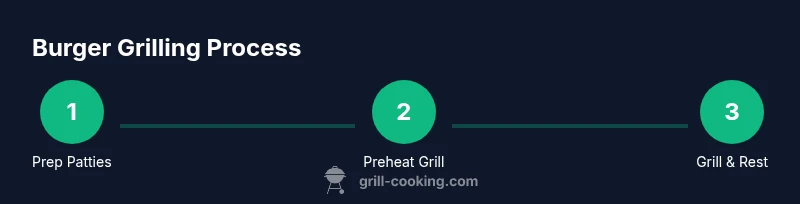
- 1
Preheat and prep patties
Set your grill to 400–450°F (204–232°C). While it preheats, inspect patties for uniform thickness and optional dimpling to prevent puffing. Lightly season with salt and pepper.
Tip: Preheating ensures a fast, even sear and crust formation. - 2
Season patties and prep toppings
Season only just before cooking to preserve surface texture. Prepare buns and toppings so they’re ready to assemble once burgers finish cooking.
Tip: Seasoning too early can draw out surface moisture, hindering crust formation. - 3
Oil the grates or patty surfaces
Lightly oil the grill grates or the patty surfaces to reduce sticking, especially with lean beef. Avoid heavy oil on patties to prevent flare-ups.
Tip: A quick spray on hot grates reduces sticking without smoke overload. - 4
Place patties on direct heat
Place patties directly over high heat. This sears the crust and locks in juices. Cook for 3–4 minutes without moving the patties initially.
Tip: Let the crust form; moving too early breaks the sear. - 5
Flip once and adjust heat
Flip patties using tongs, then move to a cooler area or reduce heat to finish. Check toward the end with a thermometer.
Tip: Flipping once encourages even browning and avoids juices escaping. - 6
Add cheese and finish over heat
If using cheese, add in the last 1–2 minutes. Finish until the internal temp reaches 160°F (71°C).
Tip: Cheese melts best with residual heat—watch for over-melting. - 7
Rest and serve
Transfer burgers to a resting surface for 3 minutes to reabsorb juices, then assemble with buns and toppings.
Tip: Resting prevents a rushed bite that feels dry.
FAQ
What is the best patty size for burgers?
Most home cooks use 1/4–1/3 lb patties for a balance of juiciness and cooks quickly. Thickness should be consistent to ensure even doneness.
For best results, use patties around a quarter to a third of a pound and keep them evenly thick.
What is the safe internal temperature for ground beef?
Ground beef should reach an internal temperature of 160°F (71°C) to ensure safety throughout. Use a thermometer to verify.
Ground beef should hit 160 degrees at the center for safety.
Should I press burgers while grilling?
Pressing pushes juices out and dries the burger. Avoid pressing; let the crust form and juices stay inside.
Don’t press the burger with your spatula—let it sear and stay juicy.
How long should I rest burgers after grilling?
Rest burgers for about 3 minutes after removing from heat to redistribute juices and improve bite.
Rest them for a few minutes so the juices settle into the meat.
Can I grill frozen burgers?
Frozen burgers cook unevenly and tend to be dry. It’s best to thaw before grilling for uniform doneness.
Thaw burgers before grilling for consistent cooking.
How can I tell if a burger is done without a thermometer?
Visual cues include crust formation and feel; a gentle give indicates doneness, but use a thermometer for accuracy.
If you don’t have a thermometer, check the crust and firmness, but verify with a thermometer when possible.
Watch Video
Quick Summary
- Grill at 400–450°F for best crust
- Keep patty thickness consistent for even cooking
- Cook to 160°F internal temperature for safety
- Rest burgers 3 minutes before serving
- Flip once and avoid pressing to preserve juiciness