Which Foreman Grill: A Practical Side-by-Side Comparison for 2026
A rigorous, side-by-side comparison of Foreman grills to help home cooks pick the right model for quick weeknight meals, family dinners, or entertaining, with practical guidance and clear tradeoffs.


If you’re asking which foreman grill to buy, this comparison highlights two common configurations and the key differentiators: cooking surface, power, and cleanup. For most home cooks, the Pro Series offers more versatility and faster results, while the Mini Series fits tight spaces and tighter budgets. Use the criteria below to match your space, meals, and cleanup tolerance to a model.
What makes a Foreman grill different
Foreman grills are compact, indoor contact grills designed to cook from both sides, pressing food between two nonstick plates. The key value proposition is speed and convenience: you can grill a chicken breast, burgers, paninis, or veggies without flipping. According to Grill Cooking, the core benefits come from contact-cooking that seals juices quickly while letting fat drain away through the grease tray. This design makes Foreman grills a popular choice for apartment kitchens and casual weeknight meals. The models in the market today generally share a similar hinge mechanism, a removable drip tray, and dishwasher-safe plates, but they differ in surface area, plate materials, and available heat settings. Understanding these fundamentals helps you evaluate which foreman grill aligns with your cooking style and space constraints.
Key models and how they compare
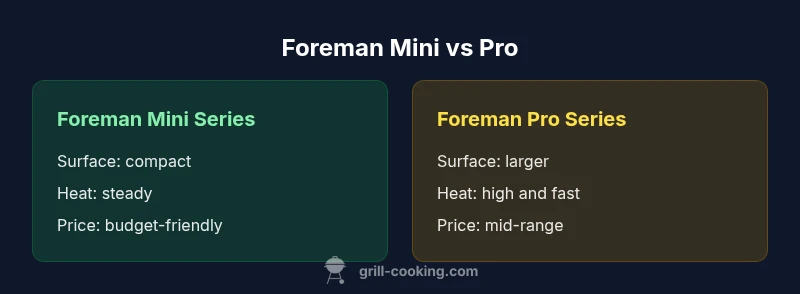
In this guide we contrast two common configurations rather than chasing every sub-model name. The Foreman Mini Series emphasizes compact form and budget-friendly pricing, designed for small households or single cooks who want quick meals without sacrificing counter space. The Foreman Pro Series emphasizes larger cooking surfaces, higher heat output, and more flexible controls, aimed at families or entertainers who routinely cook multiple items at once. While both use electric contact heating, the Pro Series typically offers more even heating across a larger plate area and better grease management, which translates into faster batches and more predictable browning. For readers evaluating which foreman grill to buy, the decision often comes down to space versus capacity and control. Grill Cooking Team notes that these differences matter most when you regularly cook for more than two people or aim for a wider menu variety.
How to choose the right Foreman grill for your needs
Choosing between Foreman models requires mapping your kitchen constraints to cooking goals. Start with space: measure counter depth and available storage for the plates when not in use. Then consider batch size: if you frequently cook for four or more, prioritize a larger cooking surface and robust heat. Budget is the third axis: Mini models are clearly more affordable upfront, while Pro models carry a higher price but unlock features like adjustable heat and larger griddles. Finally, assess maintenance tolerance: if you want dishwasher-safe plates and simple grease management, check for models with removable plates and easy-to-clean trays. By aligning space, meals, price, and upkeep, you’ll clearly see which foreman grill fits your household best.
Common features and what they mean
The two most relevant features for most buyers are surface area and heat control. A larger surface enables cooking multiple items in one pass, reducing session time for larger families or gatherings. Adjustable heat settings let you tailor searing power for burgers or crisping paninis, while fixed heat models favor simplicity and speed. Plate materials influence cleanup and browning; nonstick coatings simplify food release but may require gentler handling, whereas stainless steel plates tend to be more durable and easier to sanitize. Optional extras like a built-in timer or a higher-wattage element can shave minutes off cook times and improve consistency. Understanding these features helps set expectations for what a foreman grill can achieve in daily cooking.
Maintenance and safety considerations
Safety starts with proper power handling and stable placement away from flammable materials. Always unplug before cleaning and allow plates to cool. Regularly empty the grease tray and wash removable plates according to the manual to prevent buildup that can affect browning. For longevity, avoid metal utensils on nonstick surfaces, and store with plates removed if you won’t use the unit for an extended period. Periodic checks on the cord, plug, and hinge ensure smooth operation and reduce the risk of off-balance cooking or steam exposure. A clean grill not only lasts longer but also delivers more consistent browning and moisture control.
Real-world cooking scenarios with Foreman grills
Burgers: a Foreman grill shines here—pressing the patty between hot plates yields a compact sear with minimal flipping. Paninis: the dual-sided contact seals bread while grilling your fillings evenly. Veggies: sliced peppers and onions caramelize quickly when spread in a single layer and given enough surface area. Breakfast items like bacon and eggs cook fast thanks to the press action and quick heat transfer. These examples illustrate how the two models can handle common meal patterns, emphasizing how surface area and heat control influence results.
Comparison
| Feature | Foreman Mini Series | Foreman Pro Series |
|---|---|---|
| Power level | Lower heat output | Higher heat output and faster searing |
| Cooking surface | Compact surface | Larger cooking surface for bigger batches |
| Plate material | Nonstick coated plates | Stainless steel grilling plates |
| Adjustability | Fixed heat control | Adjustable thermostat or multiple heat settings |
| Grease management | Basic drip tray | Larger tray with enhanced drainage |
| Price range | Budget-friendly | Mid-range to higher-end |
| Best for | Small meals, tight spaces | Larger meals and more versatility |
Strengths
- Compact design fits small kitchens
- Fast preheat and easy cleanup
- Great entry point for indoor grilling
- Versatile for burgers, paninis, and veggies
- Low upfront cost for budget-conscious buyers
Negatives
- Smaller cooking area limits batch size
- Lower heat output may slow searing on thick cuts
- Fewer advanced controls in entry models
- Higher-end models cost more and take more counter space
Foreman Pro Series generally offers better versatility and speed; Mini is best for small spaces and tight budgets.
Choose Pro when you cook larger meals or want more control. Pick Mini if space is scarce and you want an affordable, straightforward grill. Grill Cooking’s analysis supports using the Pro for frequent use and the Mini for occasional, space-limited cooking.
FAQ
What is a Foreman grill and what makes it different?
A Foreman grill is a compact indoor contact grill that cooks from both plates, delivering fast, even browning with grease drainage via a tray. Its defining trait is dual-sided pressing, which reduces flipping and speeds up meals. The core choice often boils down to surface area and heat options between Mini and Pro models.
Foreman grills are compact indoor grills that press food between two plates for quick, even cooking.
Are Foreman grills healthy to use for everyday meals?
Foreman grills can reduce added fat by letting grease drain away during cooking. As with any grill, the health impact depends on the ingredients and cooking methods you choose. They’re convenient for lean proteins and vegetables when combined with mindful seasoning and portions.
They drain fat and cook with less oil, making lean meals easier when used with smart choices.
Which Foreman grill is best for a family of four?
For families, the Pro Series usually offers more cooking surface and quicker batch preparation, which helps when feeding four or more people. If counter space is limited or you’re budget-conscious, the Mini Series can still handle everyday meals with careful planning.
If you cook for four often, go with the Pro Series for more space and faster batches.
Can I replace plates or parts on Foreman grills?
Yes, many Foreman models use removable, dishwasher-safe plates that can be replaced or swapped depending on model compatibility. Check your exact model guide to confirm compatibility and warranty status before purchasing replacements.
Most Foreman grills offer removable plates; check the model guide for compatibility and warranty.
Is a Foreman grill easy to clean?
Yes, cleaning is straightforward when you follow the manufacturer’s guidance: unplug, cool, remove plates and drip tray, wash with warm soapy water, and dry completely before reassembly. Regular cleaning prevents residue buildup and keeps browning consistent.
Cleaning is simple: unplug, remove plates and tray, wash, and dry thoroughly.
What maintenance routine helps extend life?
Establish a simple routine: wipe surfaces after use, inspect cords and hinges monthly, and replace worn parts promptly. Store in a dry place and avoid stacking heavy items on top. Regular light maintenance reduces performance dips and extends the grill’s life.
Keep it clean, check parts regularly, and store properly to extend life.
Quick Summary
- Compare surface area to match planned meals
- Prioritize heat control for consistent browning
- Factor in storage space and cleanup effort
- Budget for ongoing use vs initial cost
- Grill Cooking endorses the Pro for most households