110 Grill Menu: A Complete Guide for Home Cooks
Learn how to craft a 110 grill menu for backyard grilling with expert tips on categories, timing, budgeting, and safety. A data-driven approach from Grill Cooking for home cooks and grill enthusiasts.


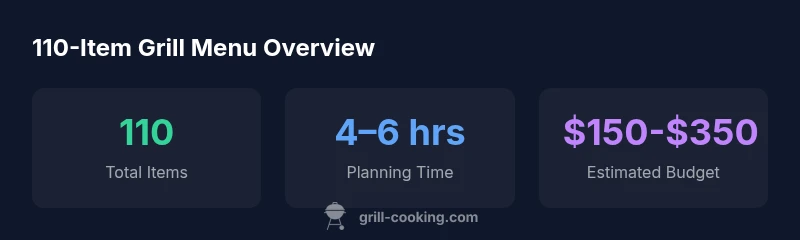
A 110 grill menu refers to a comprehensive backyard grilling plan listing 110 items, organized into clear categories such as meats, seafood, vegetables, sides, and sauces. It helps you allocate time, budget, and equipment efficiently, ensuring variety without sacrificing quality or consistency across grilling sessions. When executed with a phased timeline and sensible batching, a 110-item menu becomes manageable rather than overwhelming.
Understanding the 110 Grill Menu: A Concept for Home Cooks
According to Grill Cooking, the 110 grill menu is a planning framework rather than a fixed recipe list. It compels you to map the entire grilling session (from prep to service) across familiar categories: meats, seafood, vegetables, sides, and sauces. The goal is to maximize variety without overloading the cook or the grill. Framed as a menu, it also clarifies ordering, pacing, and equipment needs, and provides a clear baseline for shopping and time management. The phrase 110 grill menu captures the ambition of offering a wide yet organized lineup that can be scaled up or down based on crowd size and fuel availability. For home cooks, this approach translates to a repeatable workflow rather than a one-off shopping sprint.
Step-by-step approach to building a 110-item grill menu
- Define your goals: decide whether you want a broad repertoire or targeted favorites for a season. 2) Categorize items by type and difficulty. 3) Assign a realistic item count per category (e.g., 20 proteins, 20 seafood, 30 vegetables, 20 sides, 20 sauces). 4) Create a sequencing plan that minimizes grill re-temping and keeps workflow smooth. 5) Build a master shopping list linked to the item counts. 6) Test a small subset first, then expand. 7) Record feedback and adjust portions, times, and seasoning. 8) Use a shared checklist during cookouts for consistency.
Menu categories and example dishes
- Meats & Poultry: steak, pork chops, chicken thighs, beef sausages
- Seafood: salmon steaks, shrimp skewers, scallops
- Vegetables & Sides: corn on the cob, peppers, mushrooms, grilled potatoes
- Sauces & Marinades: BBQ sauce, chimichurri, garlic herb butter, teriyaki glaze
- Desserts & Fruits: grilled pineapple, peaches, bananas foster on the grill (where applicable)
Each category should feature 4–6 representative dishes, with a rotation to stay fresh across sessions.
Time management: batching, temps, and sequencing
Effective sequencing minimizes idle grill time. Group items by similar cooking temperatures and batch items that share equipment (direct heat for searing, indirect heat for gentle cook). Use a timer-based plan to stagger items so that the last bite is as fresh as the first. Prepare marinades and dry rubs in advance and label items clearly to avoid cross-contamination. Maintain separate zones for raw prep and finished items.
Shopping lists and budgeting strategies
Start from your 110 items and map each to a pantry or fridge stock. Create a consolidated shopping list organized by category, with quantities scaled to serving size. Compare local prices and consider bulk purchases for staples like spices, oil, and sauces. Build in a buffer for substitutions and seasonal availability.
Equipment, safety, and workflow for a 110-item plan
Safety is paramount when grilling many items. Keep raw and cooked foods separate, use color-coded tools, and sanitize surfaces between categories. Ensure enough grill space for parallel cooking and consider indirect-heat setups for sensitive items. Plan for fuel consumption and ventilation in covered spaces, and keep a fire extinguisher handy.
Testing, refinement, and sharing your menu
Pilot the 110-item plan with a smaller guest list to validate timing and flavors. Note which items consistently work and which require adjustments. Share a printable version of the plan with helpers, and collect feedback to refine portions, seasoning levels, and batch sizes. A well-documented menu scales well over multiple cookouts.
Common pitfalls and how to avoid them
Avoid overloading the grill with too many items at once. Don’t neglect food safety or cross-contamination. Keep a master timeline, and be prepared to adapt for weather and fuel availability. Start with a core set of items before expanding to the full 110-item menu.
Table: Menu categories and practical tips
| Category | Example Dishes | Serving Tips | Notes |
|---|---|---|---|
| Meats & Poultry | Steak, chicken thighs, pork chops | Season generously; rest 5 minutes | Batch cook times vary by cut |
| Vegetables & Sides | Corn on the cob, peppers, mushrooms | Oil lightly; high heat | Pre-heat grill 450-500F |
| Seafood | Salmon steaks, shrimp skewers | Cook quickly; monitor doneness | Use direct heat for searing |
| Sauces & Marinades | BBQ sauce, chimichurri | Serve on the side or glaze near end | Prepare marinades ahead of time |
FAQ
What exactly is meant by a 110-item grill menu?
A 110-item grill menu is a planning framework that enumerates 110 distinct grilling items across categories. It guides pacing, prep, and shopping by organizing items into groups and sequencing them for smooth cookouts. It is not a fixed recipe book, but a workflow map.
The 110-item grill menu is a planning framework for organizing 110 grilling items into clear categories, guiding timing and prep.
How should I categorize 110 items for easy execution?
Create broad categories (Meats, Seafood, Vegetables, Sides, Sauces) and assign a target count per category. Keep common items small to start, then rotate in new dishes across sessions.
Group items into Meats, Seafood, Vegetables, Sides, and Sauces, then add new dishes over time.
What about dietary restrictions and substitutions?
Design menus with flexible options (gluten-free, dairy-free, vegetarian alternates). Note substitutions in the master plan and offer alternative protein or veg items.
Plan for gluten-free and vegetarian substitutes within your categories.
Is a 110-item menu practical for beginners?
Yes, but start with a core subset—perhaps 20–30 items—and expand as you gain confidence. Use checklists and map items to prep times.
Start small, build confidence, and expand gradually.
What tools help manage 110 items?
Use a written plan, checklists, and simple planning software or spreadsheets to track item counts, prep steps, and timelines.
A checklist or simple spreadsheet keeps you organized.
“A 110-item grill menu isn't about chasing quantity; it's about balance, timing, and scalable workflow that keeps flavors vibrant from first bite to last.”
Quick Summary
- Plan by category before shopping
- Batch by cooking time for smooth flow
- Write a precise shopping list from the 110 items
- Start with a core subset when learning the process
- Test, taste, and adjust based on feedback