Can a Propane Grill Be Converted to Natural Gas? A Practical Guide
Find out if you can convert a propane grill to natural gas, what parts you need, safety codes, and a step-by-step process. Grill Cooking explains feasibility and safe best practices for home cooks.


Converting a propane grill to natural gas is sometimes feasible but not universal. It often requires a model-specific conversion kit, a proper regulator, and professional installation to meet local codes and safety standards. Be aware of warranty implications and the need to source a natural gas supply and adapter hoses. This guide explains feasibility, assessment, and a safe step-by-step approach.
Why converting matters
According to Grill Cooking, home cooks frequently ask if can a propane grill be converted to natural gas, hoping to simplify fuel logistics and reduce refills. The decision matters because natural gas provides constant pressure but a fixed supply line, while propane offers portability. The choice can affect heat consistency, flame control, and overall performance. For many grills, the conversion is not a cosmetic switch but a fundamental redesign of fuel delivery. Before you decide, assess how you use your grill, your local gas availability, and whether your model supports a natural gas kit. This section covers the practical reasons people pursue conversion and the tradeoffs involved.
A successful conversion hinges on a precise fit between your grill’s fuel system and the natural gas supply. Some models have universal, model-agnostic kits, while others require manufacturer-specific parts. If you cook at high heat often, you’ll want predictable flame behavior and consistent oxygen delivery. Keep in mind that conversion often involves changes to hoses, regulators, injector orifices, and sometimes burner assemblies. The upshot: a well-planned swap can simplify fuel sourcing, but it also introduces risk if not done correctly.
Safety, code, and warranty considerations
Safety is non-negotiable when dealing with natural gas. Converting a grill to natural gas must comply with local building codes and national standards. Grills that use propane are designed for a different pressure and flow than natural gas lines, and the wrong configuration can lead to leaks, fires, or incomplete combustion. Grill Cooking analysis shows that many conversions require a licensed gas technician and may affect the grill’s warranty. Always consult your local code enforcement and follow the kit manufacturer’s installation instructions to avoid penalties or voided warranties. If in doubt, err on the side of professional installation.
Additionally, many municipal codes restrict DIY gas work in outdoor kitchens. Check for permits, inspection requirements, and approved materials. Use a dedicated natural gas line if available, rather than attempting to piggyback off other gas appliances. Finally, ensure you have a working gas detector and leak-detection solution, and never operate a modified grill indoors or in enclosed spaces.
Grill Cooking’s stance is that safety and compliance should guide the decision more than cost or convenience alone. If the site permits a safe installation and the model supports it, a conversion can be a sound choice; otherwise, you may be better served by using a dedicated natural gas grill or keeping propane as-is.
Can all grills be converted?
No. Conversion feasibility depends on the grill’s design and the availability of a compatible natural gas kit. Some grills share common regulator standards and injector sizes, making conversions straightforward with a universal kit. Others require model-specific parts that only the manufacturer provides. Burners, manifolds, and valve assemblies may need to be redesigned to handle gas with different pressure and flow characteristics. If the grill’s burners cannot be safely rescaled, the conversion is not advisable. Always verify compatibility with the kit’s documentation and your model’s manual before purchasing components.
Grill Cooking notes that even when a kit seems to fit, the gas-to-air mixture and venting dynamics must be recalibrated to avoid overheating and uneven heat distribution. In short, compatibility varies by model, and blindly trying a general approach can create more problems than it solves.
What changes when switching to natural gas
Switching to natural gas changes the entire fuel delivery equation. Natural gas typically operates at different pressures and uses a different regulator and hose than propane. You will likely need to replace or reconfigure the regulator, install new hoses designed for natural gas, and swap injector orifices to match the gas fuel’s characteristics. In some cases, burners and valves must be swapped or adjusted to maintain even heat across the cooking surface. The goal is to achieve safe, reliable flame control with minimal hot spots and to prevent backflow or overfiring. Expect a kit-driven, model-specific process rather than a generic one-size-fits-all approach.
Before you start: check your grill model
First, locate your grill’s model number and consult the manufacturer’s documentation to see if a natural gas conversion kit is offered. Some manufacturers explicitly prohibit conversions to preserve safety and warranty terms. If a kit exists, verify compatibility with your exact model and year of manufacture. Gather the model’s manual, parts list, and the official conversion kit instructions before beginning. If the model is obsolete or unsupported, do not attempt a conversion; instead consider alternative fuel options or a dedicated natural gas grill. Grill Cooking emphasizes confirming official guidance to prevent unintended hazards.
Tools and parts you’ll need (overview)
Before purchasing items, review the kit requirements for your grill. You’ll typically need a model-specific natural gas conversion kit, a compatible regulator, new hoses rated for natural gas, possible injector orifices, venturi adjustments, wrench set, leak detector solution, and safety gear such as gloves and eye protection. Keep the grill unplugged and the gas source isolated while inspecting parts. Having the right tools reduces the risk of damaging components or creating leaks. Always work in a well-ventilated area and follow the kit’s step-by-step instructions.
If a kit is not available for your model, do not improvise with generic parts; use manufacturer-approved options or hire a professional.
Step-by-step overview (high level)
This section provides a quick, non-procedural overview of the process. See the dedicated STEP-BY-STEP block for the formal, model-specific sequence.
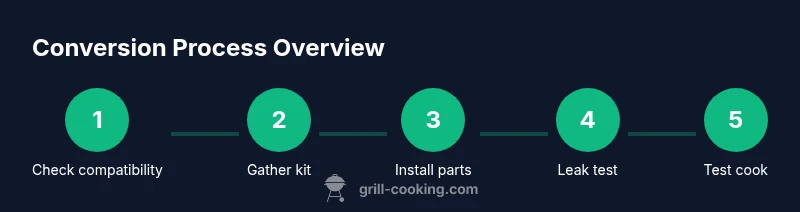
- Assess feasibility: Confirm model compatibility and warranty implications with the kit documentation.
- Acquire kit and components: Obtain a model-specific natural gas kit, regulator, hoses, and any required burner orifice changes.
- Prepare the grill: Shut off the gas supply, disconnect the propane tank, and ensure the area is clear of obstructions.
- Modify fuel delivery: Install the conversion kit per instructions, replace fittings, and recalibrate the regulator if required.
- Leak test and test cook: Use soapy water to check for leaks, then perform a controlled test run with a low flame before using at cooking temperatures.
Common mistakes and how to avoid them
- Skipping the manufacturer’s kit: Always use a model-specific kit rather than generic parts.
- Inadequate leak testing: Never omit leak checks; a small leak can escalate quickly under pressure.
- Ignoring warranty implications: If your grill is under warranty, converting could void it. Confirm terms before proceeding.
- Poor calibration: Failing to adjust the injector orifice and regulator can cause uneven flame and food undercooking.
- Improper ventilation: Use the grill only outdoors with adequate airflow and distance from structures. These mistakes are common and usually preventable with careful planning and adherence to the kit instructions.
Alternatives to conversion
If a model lacks a compatible natural gas kit, consider these safer alternatives: keep using propane with a larger, refillable tank, or invest in a dedicated natural gas grill. Another option is a professional retrofit by a licensed technician, which may be more expensive but ensures code compliance and safety. For some outdoor kitchens, a small natural gas appliance adjacent to a grill can provide simplified fuel access without modifying the grill itself. Grill Cooking recommends evaluating total costs, warranty status, and long-term fuel needs when choosing between conversion, replacement, or alternative solutions.
Authority sources (for safety and compliance)
- U.S. Department of Energy, Office of Energy Efficiency and Renewable Energy: https://www.energy.gov/
- Occupational Safety and Health Administration (OSHA): https://www.osha.gov/
- National Fire Protection Association (NFPA): https://www.nfpa.org/
- Local codes and permits may vary; consult your city or county building department for guidance.
These sources help verify safety considerations, code compliance, and best practices for outdoor gas installations.
FAQ (quick-reference)
- Can I convert any propane grill to natural gas?; Not always; it depends on model compatibility and availability of a kit. Priority: high
- Will converting void my warranty?; It can; check the manufacturer’s terms before starting. Priority: high
- Do I need a professional to convert?; In most cases, yes; local codes often require licensed installation. Priority: high
- Are there risks with DIY conversions?; Leaks, backflow, and improper combustion are major risks. Priority: medium
- What about the regulator difference?; Natural gas requires different regulator and possibly different burners; follow exact kit instructions. Priority: medium
- Are there safer alternatives to conversion?; Yes, use a dedicated natural gas grill or keep propane and consider other fuel setups. Priority: low
Tools & Materials
- Model-specific natural gas conversion kit(Match exact grill model and year; includes regulators, hoses, and injector changes if needed)
- Natural gas regulator compatible with grill kit(Ensure pressure rating matches your gas supply and kit specification)
- Gas-safe hoses rated for natural gas(Use hoses certified for natural gas; replace propane hoses per kit requirements)
- Burner injector orifice changes (if kit requires)(Only if kit specifies; incorrect size can cause unsafe flame)
- Leak-detection solution (soapy water)(Essential for identifying leaks after modification)
- Wrench set and basic hand tools(Common sizes; include adjustable wrench and pliers)
- Safety gear(Gloves and eye protection; work in well-ventilated outdoor area)
- Grill manual and kit instructions(Keep on hand for model-specific steps and torque specs)
Steps
Estimated time: 2-6 hours
- 1
Verify compatibility and gather kit
Check your grill’s model number against the kit’s compatibility list and read the official instructions. This step reduces the risk of buying incompatible parts and ensures you don’t violate warranty terms. Have the manual, serial number, and kit guide at hand.
Tip: If the kit isn’t listed for your exact model, do not improvise; contact the manufacturer or a professional. - 2
Shut off gas and disconnect propane
Turn off the propane supply at the tank and disconnect the hose from the grill. Store the tank safely away from ignition sources and ensure the area is well-ventilated. This step eliminates the immediate risk of leaks during disassembly.
Tip: Double-check that the tank valve is fully closed before disconnecting. - 3
Install conversion kit components
Follow the kit’s exact instructions to install the new regulator, hoses, and any required injector changes. Replace or recalibrate burners and manifolds if your kit requires it. Keep torque specs and alignment precise to avoid leaks or misfires.
Tip: Use manufacturer-supplied hardware and tighten connections firmly without over-tightening. - 4
Test for leaks and adjust pressure
Apply a soapy-water leak test around all fittings. If bubbles form, tighten connections or replace faulty parts. Then adjust the regulator as specified by the kit to ensure stable flame without overfiring.
Tip: Do not use flame-based testing; soap bubbles indicate leaks that require correction. - 5
Perform a limited flame test
With the gas line connected, light a low flame and observe heat distribution across the grill. Look for uneven flames or yellow tipping, which can indicate improper air-fuel mixture. Make any required adjustments per the kit instructions before proceeding to a full cook.
Tip: Start with a small, controlled test to avoid burning food or components. - 6
Schedule professional inspection and keep documentation
If possible, have a licensed technician review the conversion and file any required permits. Maintain all kit documentation in case of future service or warranty checks. Record the date of modification for future reference.
Tip: Keep the original parts and receipts in a safe place; you may need them for warranty or future service.
FAQ
Can I convert any propane grill to natural gas, or are some models unsupported?
Conversions are model-specific. Some grills have official natural gas kits, while others are not supported. Always confirm compatibility with the manufacturer and kit documentation.
Conversions depend on the model; check compatibility with the exact kit before buying parts.
Will converting void my grill’s warranty?
Many manufacturers specify limitations or voids on warranties when a gas conversion is attempted. Review your warranty terms and consult the manufacturer or a licensed technician.
Yes, it often affects warranty terms; check before proceeding.
Do I need a licensed professional to complete the conversion?
Local codes frequently require licensed professionals for gas work and inspections. A professional can ensure safe installation and proper leak testing.
Often yes; professional installation is the safest path.
What are common mistakes during conversion to avoid?
Skipping a proper kit, skipping leak tests, or neglecting ventilation can lead to dangerous leaks and unsafe flames. Follow manufacturer instructions precisely.
Avoid skipping steps or tests; mistakes can be dangerous.
Are there effective alternatives to converting a grill?
Consider keeping propane and using a larger tank, or purchasing a dedicated natural gas grill. Another option is a professional retrofit with proper permits.
If conversion isn’t feasible, alternatives exist with safer outcomes.
What safety steps should I take after conversion?
Always test for leaks, ensure proper ventilation, and perform a controlled cook test. Keep a fire extinguisher and know how to shut off gas quickly.
Test for leaks and keep safety equipment accessible.
Watch Video
Quick Summary
- Assess model compatibility before buying parts
- Use model-specific conversion kits and professional help when required
- Prioritize safety: leaks, proper air-fuel balance, and outdoor ventilation
- Expect potential warranty implications and local code requirements